Sign in. It’s quick, free and it’s up to you.
An account is an optional way to support the work we do. Find out more.
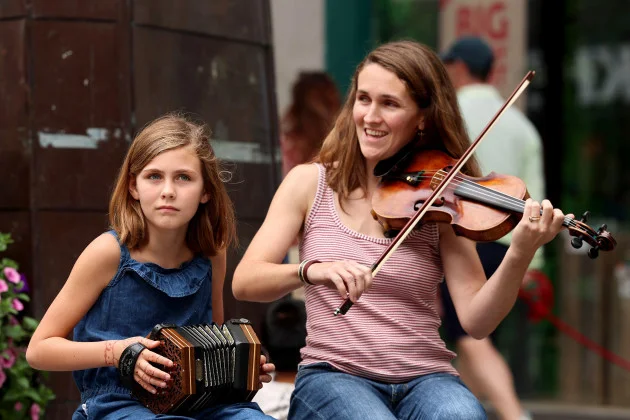
BELFAST HOSTING THE Fleadh Ceoil na hÉireann this month feels not only fitting but a powerful, progressive moment. Only the second time the world’s biggest annual celebration of Irish music and culture has crossed the border since its inception in the 1950s, the city has embraced the opportunity with gusto, exactly as I knew it would, to celebrate what unites us rather than what divides us.
I grew up in a border county in the 90s, halfway between Dublin and Belfast. Through the years, I’ve never understood the number of people I’ve met in the Republic who have never stepped foot into Northern Ireland.
They’ll happily travel to the Ring of Kerry or Sliabh Liag but remain noticeably hesitant about crossing the border. For me, Northern Ireland was ‘up the road’, easier and quicker to get to Derry or Ballycastle than Connemara or West Cork.
Though I was yet to hit double digits when the Good Friday Agreement was signed, Millennials of my age still remember checkpoints, bomb scares and the hesitation our parents and grandparents held about travelling north. However, in coming of age in the 2000s, a different future was not only possible but already taking shape. The island of Ireland was entering a more mature and inclusive era and, for southerners, Northern Ireland became somewhere to explore rather than somewhere to avoid.
Though it has its issues, like any capital city, Belfast is incredibly cosmopolitan and has an energy unlike any other city on this island, which makes its two-year tenure as Fleadh host all the more exciting. New figures from the Northern Ireland Statistics & Research Agency show overnight trips from the Republic rose by 15% between 2024 and 2025.
A decade ago the figure was 320,000, barely a quarter of what it now stands at. Tourism NI now describes the Republic as one of its most important growth markets. Will the exposure of the Fleadh be the ultimate gateway, encouraging those from the Republic to explore and embrace the north long after the fiddles, bodhrans and uilleann pipes depart?
Belfast is a city we should all be proud of and share equally in its success, if for nothing else but how incredibly delicious it is. I feel sad for anyone who has yet to sink their teeth into a floury soda farl, warm from the oven and split through the middle, lavished in real butter. Likewise, the pure majesty of a fudgy, bouncy Fifteen, scented by coconut, sweetened by condensed milk and punctuated by fat little glacé cherries like rubies.
Northern Ireland produces some of this island’s best food. Young Buck blue cheese from Ards, Broighter Gold oil from Limavady, Peter Hannan’s beef from his Himalayan salt chambers in Moira. Comber potatoes, Lough Neagh eel, Armagh cider, the list goes on. You need not take my word for it; the annual Blas na hÉireann and Great Taste Awards tell the story of what a food producer powerhouse this region is.
Dublin might have visionary cocktail bars like Bar 1661, but Belfast boasts multi-award-winning mixology at Rattlebag, a tiny, sexy little cocktail den in the unlikeliest little corner of the Bullitt Hotel. Dublin has Bambino, but Belfast has the far superior slice shop in Peter Thompson’s Flout.
While Dublin’s dining prestige is rooted in classical rooms like Chapter One and Restaurant Patrick Guilbaud, Belfast’s Michelin stars occupy contemporary, cool perches, like OX overlooking the Lagan on Oxford Street and The Muddler’s Club, hiding unsuspectingly down Warehouse Lane.
I could literally guide you through Belfast in five distinct sips: drip filter or a flat white at Established, the vanguard third wave coffee shop in the Cathedral Quarter; a cocktail or mocktail at the Observatory bar, perched on the 23rd floor of Grand Central Hotel with the most breathtaking vista of the city; a Belfast coffee, an almost espresso martini elevation of the Irish standard, at The Garrick; a Jawbox gin and ginger, the traditional serve with ginger ale which was invented in the city, at the John Hewitt; and a pint of the black stuff at The Sunflower, where Guinness is not served but Beamish is.
Many a delicate head after the night before has been soothed by an Ulster fry at Bright’s, and there’s nothing like the hum and heft of the handsome Victorian market, St. George’s, on a weekend. Its stalls sell everything from jewellery, vinyl and baby clothes to Mangalitza coppa, olive-studded focaccia and freshly-shucked oysters.
Even service feels different up north. Having spent a significant amount of my adult life returning to Northern Ireland, and covering it now as a restaurant critic on an all-island beat, I have come to believe that Northern Irish service is the best on this island. Warm, witty, engaging and effortless, for the most part.
Your taste buds can’t differentiate between green and orange. Our food culture, like our Fleadh, transcends borders and community lines; food doesn’t ask first where you come from. Fadge and boxty, tripe and drisheen, coddle and colcannon all go down the same way, regardless of the community you were born into. As John Hume famously said, “you can’t eat a flag.” Social and economic prosperity should always outweigh tribalism.
From the opening remarks of the Fleadh, it wasn’t the words of President Connolly or First Minister Michelle O’Neill which lingered but those of Deputy First Minister, Emma Little-Pengelly of the DUP. “Culture need not divide us; at its best, it invites us to listen, to learn and to discover… may we always have the confidence to celebrate every tradition that enriches our shared home, knowing that respecting another’s culture never diminishes our own but it strengthens the place we all call home.”
It’s amazing what becomes possible once we stop asking who something belongs to and simply choose to enjoy it together. That’s what progress tastes like.
Patrick Hanlon is a writer, food critic and columnist with TheJournal.ie.
To embed this post, copy the code below on your site