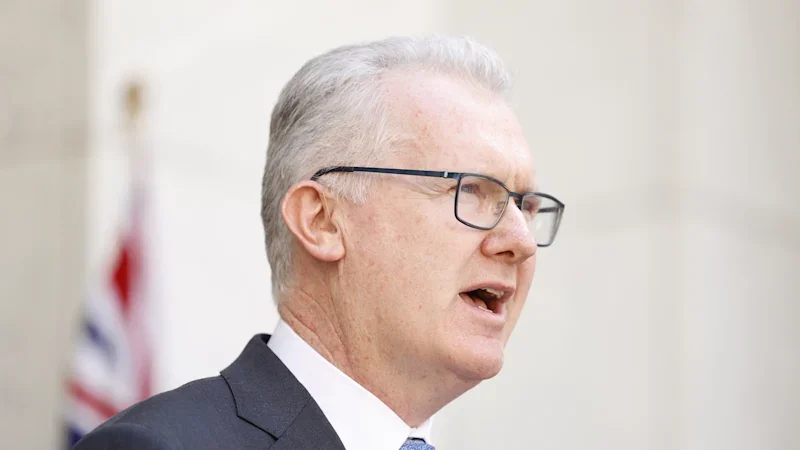
Labor’s last-minute delay on plans to unveil a significant immigration crackdown has been seized upon by the Coalition and One Nation as proof of government confusion about the controversial issue, following the cancellation of Home Affairs Minister Tony Burke’s keynote speech this Thursday after cabinet ministers raised questions about the political backlash and unresolved financial costs.
One Nation’s leader Pauline Hanson seized on the delay, saying Burke was only pretending to reduce migration.
Hanson, who advocates for a drastic cut to only 130,000 visas per year, posted on Facebook that “he wants to look like he’s cutting migration, but he’s not – he’s lying. All he’s doing is moving things around to make the number seem smaller.”
Acting opposition leader Jane Hume said if Burke “had the guts to turn up to the National Press Club ... we would have a better idea of what it is that he wants to see.”
The Coalition has also been campaigning on tying permanent and temporary intake caps directly to national home-building completions and restricting welfare access for non-citizens.
Government sources including cabinet ministers said the last-minute postponement of Home Affairs Minister Tony Burke’s keynote speech at the National Press Club, which had been scheduled for Thursday, would allow Prime Minister Anthony Albanese to oversee the sensitive announcement when he returns from leave at week’s end.
Burke was preparing to unveil his plans for bringing net migration down by as many as 75,000 people in the next two years. While that target is already baked into the federal budget, Labor has consistently blown its migration targets, and further policies were needed to meet the lower figure.
But ministers at a cabinet meeting on Monday, which was held without the prime minister, asked questions about how Labor would justify tighter measures and respond to criticism from the Greens and others on the left who may claim Labor was demonising migrants at a time when Pauline Hanson was stoking tension on race relations.
Burke decided to pull the speech because some of the policies needed more work given their flow-on effects. These considerations include, but were not limited to, how migration changes would affect labour supply in key industries and how the tweaks could affect the budget and the economy, which has been underpinned by high migration for years.
It was Albanese’s preference to be back at work for the announcement, they said, though this was not a critical consideration.
Ministers said Burke was prepared for the political fight to come, and would be likely to focus on firmer controls of the migration system by stopping people taking advantage of it through manoeuvres such as overstaying or using the family system.
Sources said Burke would tell the public that the tightening was justified because existing integrity measures, which Labor adopted well before One Nation’s rise, had not done enough to bring down net overseas migration. The government would argue that it was required to take more action to gain control of migration numbers.
All the sources who spoke to this masthead denied any cabinet bust-up. Several said ministers were highly engaged on the issue and wanted to get the policy right to avoid repeating the challenges of the federal budget, whereby Labor was required to clean up its tax changes with amendments.
Albanese and his ministers support the changes, but Burke will take more time to finalise the policies. A speech is likely to be rescheduled in the next few weeks.
“We’ll be acknowledging the genuine concerns people have about the migration system without dividing or demonising,” one senior Labor figure said. “We’ve been working on these issues for about a year so it isn’t a direct response to Hanson, but the language will obviously respond to One Nation and the current political climate.”
Climate Change and Energy Minister Chris Bowen said on Wednesday that Labor needed a balanced approach.
“A lot of businesses rely on a very well calibrated immigration system to provide the workers that, frankly, it’s difficult for the domestic market to supply,” he said.
The ABC, which revealed Burke’s delay on Tuesday, said the government was considering tougher family visa rules, capping the number of backpackers, and curbing the appeal rights of asylum seekers.
Ministers said Burke’s speech would focus on people taking advantage of the migration system. Burke is not expected to announce a further cut to Labor’s forecast net overseas migration figure. Rather, he is likely to announce new methods to achieve its lower targets.
In October 2022, it forecast there would be 235,000 net overseas migrants that financial year – instead there were 538,000. Latest figures suggest the intake has bottomed out around 300,000, which is higher than the pre-pandemic average.
In the May budget, government estimates for this financial year rose to 295,000 from the previous expectation of 260,000. The budget predicts the figure will drop to 225,000 by 2027-28.
A spokesman for Burke said it became clear on Tuesday that some elements of the speech would not be finished by Thursday.
“The speech will deal with the migration system as a whole. Yesterday it became clear that some elements of the speech would not be finalised by Thursday,” he said.
International students, temporary graduates, working holidaymakers and high arrival numbers of New Zealanders, who can migrate freely, have contributed to the post-pandemic surge in migration levels – as have relatively low departure rates.
While the government has made several policy changes to temper international student demand, a record number of working holidaymakers have arrived in Australia: 321,000 working holiday visas were issued in 2024-2025, up more than a third on the previous year.
This has been led by British backpackers, whose numbers have surged under the Scott Morrison-era deal with the UK that expanded the eligible age range and scrapped requirements for regional work stints.
While the UK numbers are uncapped under the free trade agreement, the government revealed in the May budget that it would expand a lottery system for other countries to effectively set a limit on backpacker numbers.
In another budget decision, Labor also reworked the permanent visa allocation, so that a higher proportion of the 185,000 permanent visas issued each year would come from onshore, rather than offshore, applicants.
Within the permanent visa stream, there is already a backlog of demand for family visas, with more than 100,000 people facing a 17-month wait for partner visas.