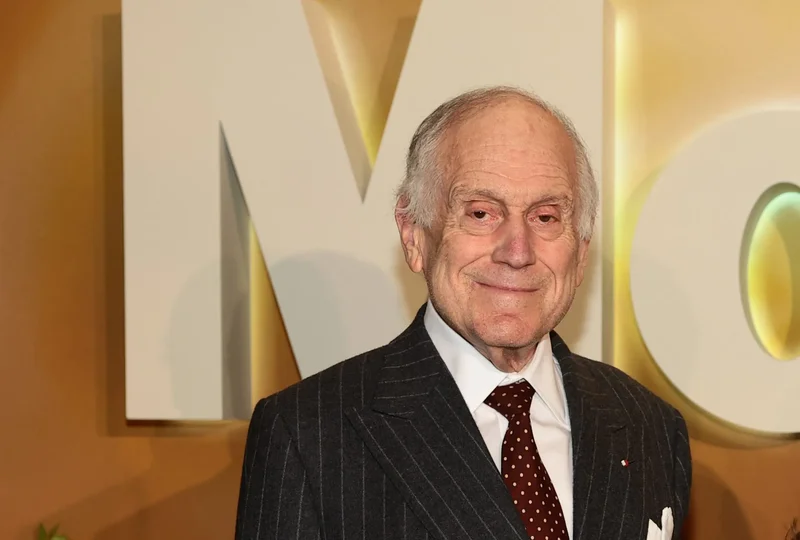
For months, billionaires have been funneling swaths of money into Republican midterm campaigns. But a New York Times report published Tuesday shows one of the most prominent GOP donors has quietly backed off.
Ronald Lauder, the billionaire heir to cosmetics conglomerate Estée Lauder and longtime supporter of President Donald Trump, has pumped tens of millions of dollars into Republican campaigns over the past couple of decades, campaign donation records show. So much so that the NYT even referred to him as a “one-man bank for Republicans in New York.”
But their report shows Lauder, 82, appears to have stopped his political donations, which goes against the grain of billionaires flooding the GOP zone ahead of midterms. According to Federal Election Commission records, the last political donation he made was in January for just $5,000 to Security is Strength PAC, a conservative super PAC.
Compare that to just two years earlier, when he made a $250,000 donation to the Truth & Courage PAC to help secure Sen. Ted Cruz’s reelection campaign in Texas; or his more than $13 million in donations between 2020 and 2022 to Safe Together New York Inc., a Super PAC to support Lee Zeldin’s 2022 gubernatorial campaign in New York.
The January 2026 donation of $5,000 also pales in comparison both to megadonations he’s made to the party in the past and how much other donors are throwing at Republicans this election season. Take, for example, his $5 million donation to MAGA Inc. in 2025. Elon Musk also donated $5 million to MAGA Inc. around the same time, according to the Brennan Center for Justice.
Billionaires donating to Republican campaigns
Billionaires have poured hundreds of millions into the 2026 midterms, and most of it is backing Republicans. American billionaires have already poured more than $433 million into the 2026 midterms, and nearly 80 cents of every donated dollar is backing Republicans, according to a report by the Americans for Tax Fairness (ATF), a progressive advocacy group. And in race after race, the bigger checkbook wins: The higher-spending House candidate prevails more than 90% of the time, according to research from OpenSecrets.
While one donor going quiet doesn’t drastically move those numbers, it matters more that New York is losing a major political donor. In New York, Lauder has been one of the Republican Party’s most reliable donors for decades. He bankrolled a 1990s term-limits campaign in New York City and helped fund a lawsuit challenging the state’s congressional map.
Now that he’s pulled back from political donations, Republicans could feel that pain more as Gov. Kathy Hochul will defend her seat in the November election. Gerard Kassar, who chairs the state Conservative Party, told the NYT no one can replace Lauder as a funder.
To be sure, money isn’t everything in politics. While the higher-spending candidate usually wins, strategists who raise and spend that money are the first to say it has limits.
Christopher Lee, a former DCCC regional political director, previously told Fortune donor money “puts you in the room”—it buys the ads, the data, and the field operations that let a campaign compete at all. But money can’t manufacture a reason for voters to say yes. Maggie Paulin, a vice president at the Republican firm Campaign Solutions, also told The Hill that “money matters immensely in campaign politics, but donor dollars are not destiny.”
It’s not entirely clear why Lauder stopped giving to political campaigns, but sources told NYT one potential reason could be his adult children are slowing his spending as their family fortune shrinks. (The man is still worth nearly $5 billion as of Tuesday). Another potential reason could be he’s simplifying his life to focus instead on his legacy.
Meanwhile, Estée Lauder’s stock has dropped nearly 75% during the past five years, and nearly all of Lauder’s stake is tied up. As of July 31, 2025, he had pledged about 99% of his Class B shares to a bank as collateral for a loan, according to the company’s most recent proxy statement. The filing doesn’t name the bank or spell out the loan’s terms. Lauder has also been selling real estate and a collection of World War II fighter planes among the assets, according to the NYT report. Lauder also reportedly dismissed the longtime advisors and ad makers who ran his political operation, the NYT report shows.
Representatives for Lauder didn’t immediately respond to Fortune‘s request for comment.
Lauder also appears to be trading influence for legacy. In May, he announced his Neue Galerie, the Upper East Side museum he founded, would merge with the Metropolitan Museum of Art. He has also said he won’t seek reelection as president of the World Jewish Congress, ending a run of nearly 20 years.
“Look, when I first started, no one had money, so I paid the money,” he told eJewishPhilanthropy in a July interview. “But your schools now have parents who are wealthy … I want you to get used to having parents give you money because I don’t want you to get so caught up that someday, when I’m not here, you’re gonna be in trouble.”
breaks the traditional barrier between audience and newsroom. The show transforms
Fortune DailyFortune’s trusted reporting into actionable, conversational, and entertaining insights for an emerging class of business leaders.
Watch here.