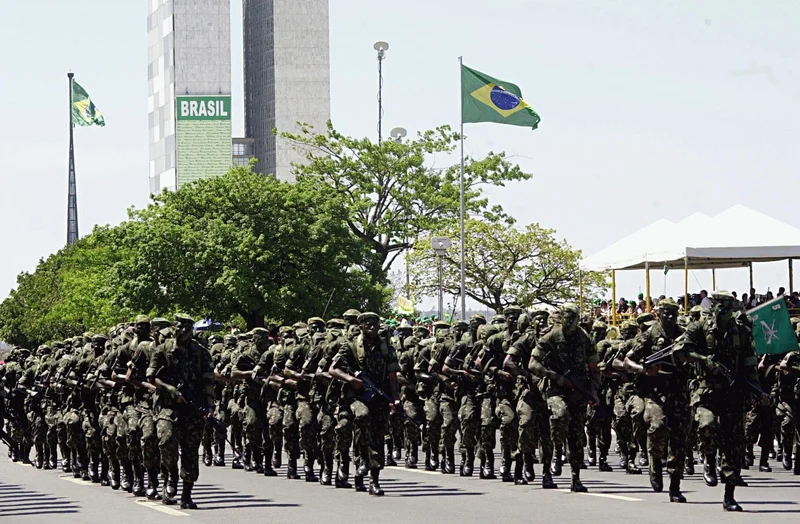
US Announces Hemisphere Military Drills Involving Brazil
Defense: Brasília
US military exercises spanning the Western Hemisphere have drawn in Brazil just as its defence minister publicly acknowledged the gulf between Brazilian and American armed forces.
What the United States Announced
On 3 August 2026, US Southern Command (SOUTHCOM) launched Panamax 2026, an annual exercise held in and around the Panama Canal, this year expanded to include the armies of 18 other countries, among them Brazil. The manoeuvres run through 13 August.
SOUTHCOM said the drills aim to “guarantee the stability of the Western Hemisphere and combat the threat of narcoterrorism.” The command also announced a new “Joint Task Force Western Hemisphere,” a rebranding of an operation launched in 2025 to counter drug trafficking in the region.
In its statement, the United States said it would “apply total systemic pressure” on drug cartels and “eliminate all threats,” without specifying which. Participating nations, it said, “share a common determination to detect, disrupt and defeat existing and emerging threats” in the hemisphere.
Where Brazil Fits In
Brazil is taking part in the Panamax exercise but is not a member of the US-led Americas Coalition Against Cartels, the group coordinating the broader campaign. Mexico, the Netherlands and the United Kingdom also join the drills without belonging to the coalition.
That distinction matters. The Brazilian and Mexican governments, in particular, do not share the Trump administration’s ideological framing of the effort, and Brasília has kept its distance from the coalition even as its forces train alongside US units.
Joint US-Brazil military exercises are not new: the two armies have run regular drills such as Southern Vanguard in recent years, part of a long-standing defence relationship that has continued despite political friction.
Múcio’s ‘Open the Gate’ Comment
Against that backdrop, Brazil’s Defense Minister José Múcio drew attention with remarks at an event hosted by the National Confederation of Industry (CNI) on 4 August. He said Brazil would not be able to confront the United States militarily in a hypothetical invasion.
“A journalist asked me: ‘If the United States wants to invade Brazil, what do you do as Defence Minister?’” Múcio recounted. “Open the gate, because we don’t have the equipment to face them, nor the money to fix the gate. I’d rather open the gate.”
Poder360, citing O Globo, reported that Múcio spoke in a joking tone while arguing for higher defence spending. He said Brazil invests less in defence than many peers and faces budget constraints, as health, education and social programmes compete for the same resources.
Reading the Remarks in Context
Múcio’s comment was a rhetorical device to press for investment, not a description of any imminent conflict. He cited the high cost of submarines and combat aircraft and called for budget predictability for long-term projects, comparing defence spending to a health plan one hopes never to use.
Reporting on the remarks noted they did not indicate any concrete threat of war between Brazil and the United States. The minister also said Brazil aims to strengthen deterrence and expand its defence industry, adding that the country is preparing to export submarines, aircraft and armoured vehicles.
The Diplomatic Backdrop
The military news landed the same day the US State Department revoked the visa of Brazil’s ambassador in Washington, Maria Luiza Ribeiro Viotti, deepening a diplomatic rift that also features 25 percent US tariffs imposed in July and a dispute over ambassadorial appointments.
The Trump administration has adopted an assertive posture toward the region in its second term, tying counter-narcotics goals to pressure on governments it views as insufficiently aligned. Brazil, governed by the left under Lula, has been among the most vocal critics of that approach.
What to Watch
The Panamax exercise ends on 13 August, and the new task force’s operational focus—officially counter-narcotics—will be watched closely in Brasília, which is not part of the coalition steering it.
For now, Brazilian officials have paired public calm with calls for stronger defences. Whether the diplomatic chill with Washington eases or hardens is likely to shape how Brazil positions itself in future regional exercises.
Frequently Asked Questions
What military exercises did the United States announce?
SOUTHCOM launched Panamax 2026 in and around the Panama Canal, expanded this year to 18-plus partner armies including Brazil and running through 13 August, and stood up a new Joint Task Force Western Hemisphere focused on narcoterrorism.
What did Brazil’s defence minister say?
José Múcio said Brazil could not militarily match the United States and joked he would “open the gate” in a hypothetical invasion, using the remark to argue for higher defence spending.
Is Brazil part of the US-led anti-cartel coalition?
No. Brazil takes part in the Panamax drills but has not joined the Americas Coalition Against Cartels; Mexico, the Netherlands and the UK also participate without being coalition members.
Sources: Poder360, Rondônia Dinâmica / G1, Zona Militar.
This article was produced by The Rio Times’ automated newsroom system. How we use AI · Report an error