In the kitchen of their double-storey country hotel in Lamotte-Beuvron in the Centre-Val de Loire region of France, the Tatin sisters, Caroline and Stéphanie, would bustle among the burbling pots and pans, cooking and dishing up their country food to travellers strolling in and needing food and refreshment for the next stage of their journey.
As in all the old French kitchens of the time, copper pots hung on hooks on the walls, with gaps between them where a pot was being used to make a sauce or bake a tart in.
One day in the late 1880s, Stéphanie â who was the cook while Caroline played hostess â took a tart pan down and placed it on the flame. She added some butter and sugar, then carried on with her other tasks.
After a while, there was a strangely honeyed aroma in the air that seemed to mingle with the smoke from the wood-burning oven. Something prickled Stéphanieâs nostrils. Turning back to the stove, Fanny (as Caroline called her) sighed when she saw that the apples and the sugar and butter they had been simmering in had burnt.
She had made some pastry, so she quickly cut out a round to fit the top of the copper pan, put it on, placed a lid on the pot, and added some embers to encourage the pastry to cook quickly. If nothing else, it might stem the burning. She popped it in the old oven.
Soon, wafts of molten caramel had drifted out of the kitchen and into the dining room, where we can imagine the diners nearest to the door licking their lips and asking what fine repast it could be.
Caroline may have said, âUne moment, je vais me renseigner,â and hurried into the kitchen to ask Fanny what it was.
Stéphanieâs nose discerned perplexing flavours coming from the oven, so she whisked the copper pan out, lifted the lid and upturned what she presumed to be the burnt apple tart onto a platter. What she saw had her and her sister gasping and cooing with delight, so Fanny served it up while Caroline returned to the dining room to take orders for their apple tart.
The fine details have been embellished by me, using common sense, my understanding of drama and dialogue, and my comprehension of human behaviour. But I donât think itâs far from the truth of what must have happened in the kitchen on that happy day in 1888 at the Hôtel Tatin.
The hotel today is called Maison Tatin and their famous accidental tart remains as a global reminder of how greatness can be borne of a supposed mistake, and come to represent the best of what a humble cuisine can be.
It was seeing my old copper pots hanging on their hooks in our kitchen that got me thinking I should use one of them to make a tarte Tatin. One had a long, pointed handle, the other two chubby little round handles. This is the one that would fit the larger of my air fryer ovens, for, yes, I cooked this tarte Tatin in one of those. But this recipe is better suited to your big old oven.
In this recipe, just as it was for the sisters Tatin, I have not measured anything. I just added to the copper pan an amount of butter that seemed generous and sufficient, a quantity of sugar that seemed sensible, and then set about peeling some pears and slicing them in half.
Iâd read about the sisters and their tart and had also written about the soeurs Tatin before. As youâll read in that story I wrote in 2021, there are parts of the story that are contested, but I like the idea of the famous assumption, which is in fact a perfect illustration of what âassumptionâ means â the acceptance of something as fact without feeling the need to assess the evidence for or against it.
Or, to put it another way, never spoil a good story with boring facts.
I thought about quantities before starting this recipe. Should I measure everything the way the likes of me (and you I suspect) usually do, or should I cook the way I really like to cook, which is just to grab this and that and add something to the pan, only moving to the next step once the previous one has produced the happy result Iâm always looking for? Like that perfect caramelisation that could be mistaken for âburntâ.
And that, good people, is called the art of cooking.
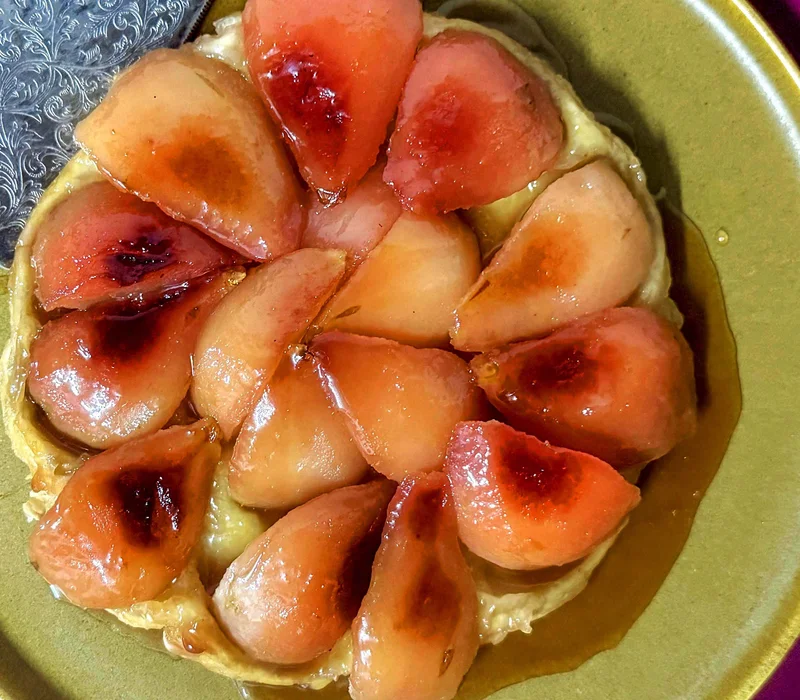
Here is my latest tarte Tatin, and itâs a pear one, not apples, and look, ma â no measurementsâ¦
Now, be strong, people, because youâre winging this. Just use your instincts and really cook. Let me know how it went.
Tonyâs pear tarte Tatin, cooked in an old copper pot
(Serves, um, four? Okay, six, if you must.)
Ingredients
Some butter
Some sugar
Some pears (or apples), peeled and sliced in half
More sugar
No more butter
(Okay, close your eyes and just go with the next ingredientâ¦)
1 packet of frozen shop-bought puff pastry
(At which, the Tatin sisters shifted uncomfortably in their graves)
Method
Take that copper pan off the wall on its hook and give it a wash in lightly soapy warm water. Rinse under cold running water and dry thoroughly.
Put it on the hob with some butter in it. Quite a lot, but not too much.
Sprinkle sugar over and stop when your instincts tell you itâs enough. Then add just a touch more.
Put a very low heat under it and do not move away from the stove. Once the hot butter has started to meld with the melting sugar, tilt the pan a little this way and that, for even caramelisation.
When it starts to take on a bit of a golden hue, add the peeled and sliced pears (or apples if youâd rather) in a way that you think will look pretty when you upturn the pan later.
Cut a round of pastry to fit the top of the pears or apples â just enough to be tucked in randomly around the edges. Donât overthink it, just sommer do it.
Prick the pastry in four or five places.
Now shove it in the oven you preheated earlier to â I dunno, 200°C maybe, what do you think? â and bake it until the pastry is golden and lovely.
Turn off the oven and let it cool with the door ajar. Imagine youâre in the moody old kitchen of a country hotel in France.
When the copper pan has cooled, place a plate over the top, flip it over, and lift the pan to reveal the beauty beneath. Yum. DM
To buy a copy of Tony Jackmanâs Retro Karoo Food (Penguin Random House) signed by the author in gold, send an email to him at tony@dailymaverick.co.zaOr buy it through the Daily Maverick shop.
Tony Jackman is twice winner of the Galliova Food Writer of the Year award.