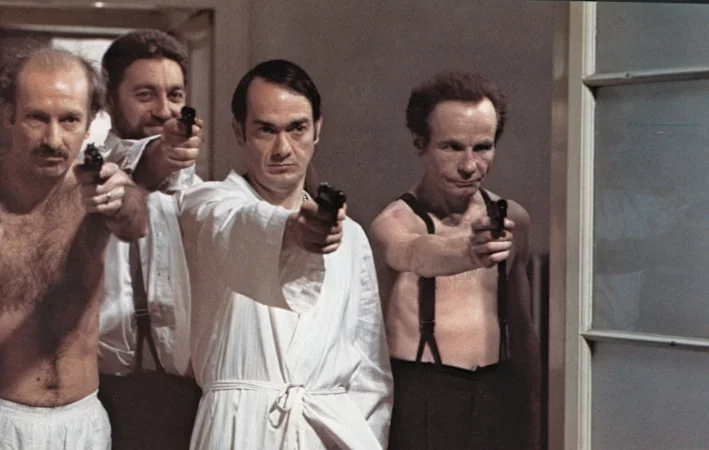
It is said that no one forgets the first time they saw Salo, or the 120 Days of Sodom, the notorious film by the late Italian filmmaker Pier Paolo Pasolini. Renowned for its relentless depravity, the film – often labelled the “world’s most reviled film” – has come to be a sort of rite of passage for generations of cineastes.
For Jane Mills, associate professor in film studies at the University of NSW, it happened in her 30s in a sleazy backstreet cinema in London’s Soho, at a time when the film was still banned in England. “I was the only woman there. There were about 10 to 15 men, and they weren’t actually wearing dirty raincoats but they might as well have been,” she says. “It was a pretty interesting introduction to this film. It is incredibly confronting, but it gets easier when you see it subsequently.”
Originally released in November 1975, just three weeks after Pasolini was murdered at the age of 53, Salo was routinely banned across much of the globe. This month it will have a rare public screening as part of the Festival of Dangerous Ideas’ new Dangerous Films program, alongside other controversial films including Kathryn Bigelow’s Zero Dark Thirty and John Cameron Mitchell’s Shortbus.
But in the world of dangerous films, Salo is on another level. Writing about the film, filmmaker Catherine Breillat – whose film Romance (1999) was itself briefly banned in Australia – noted: “You must know whether to risk seeing Salo through to the end the first time; you must know the exact measure of your strength.”
“You’re in for a treat – well, I don’t know if I’d call it a treat, but you’re in for an interesting experience,” says Bruce Isaacs, associate professor in film studies at the University of Sydney, when I tell him I’ve booked my ticket for a film I’ve read about for almost 30 years but not yet seen.
“Part of what Pasolini is doing with Salo is enacting a kind of suffering on you. That is very much part of the experience of watching this film,” he says. “It’s an allegory of Italian fascism, but that’s not really the core of the film. The core of the film is the experience the spectator is compelled to have simply by being there watching the film.
“Pasolini made many films, and he’s one of the most respected Italian filmmakers in history, but nothing he ever did is quite like Salo. Salo is nearer to the experimental surrealist cinema of the 1920s and 1930s that was designed literally to shock you. Part of the purpose of Salo is to shock you into a kind of political reckoning. That’s what makes it so fascinating.”
Isaacs similarly recalls his first experience with the film, when a European distributor screened the film at the Chauvel in the mid-’90s when it was still banned in Australia. “I was probably 18, and me and a buddy caught a train from Mount Druitt to the city. It was the kind of film where if you were into movies, everybody knew about it, but it was impossible to see. I think a lot of people didn’t know what to expect. There was a kind of commitment to just getting through it.”
Salo’s history in Australia is a circuitous journey of censorship. “I think ping-pong is the best way to describe what happened between the film and the Classification Board,” says UNSW’s Mills.
It was originally banned in 1976 for its “extreme depictions of sadism, sexual violence and psychological torture”. In 1992, it was unbanned and granted an uncut cinema release with an R18+ rating, and it had brief theatrical runs between 1993 and 1996. In 1997, Queensland’s attorney-general Denver Beanland applied for a complete review of the film, and in 1998 it was banned again. It wasn’t until 2010 that it was unbanned again and released on DVD, pending the inclusion of 176 minutes of additional material that provided a context to the film.
“I mean, how dare they be so patronising?” Mills says. “Education is not compulsory for adults, OK? It also suggests that you will not find this film anything other than educational. This notion that we have to be protected from being offended; what’s so wrong with being offended?”
Mills notes there were extensive appeals against the film’s ban throughout the period, including one by a surprising source: the Catholic priest Father Peter Malone, MSC, who as the director of the Australian Catholic Film Office was a vocal critic of the film’s 1998 re-banning. He argued that Salo was “a searing political allegory about fascism, totalitarianism, and the corruption of human dignity”.
In the intervening years, Salo has remained a film that, if seen at all, has largely been watched in private: a Criterion DVD, a shaky Reddit link. Mills says it’s worth watching on the big screen as intended.
“The way in which Pasolini shoots it, his framing does something that he very deliberately wanted to achieve, which was a distance between the viewer and what was happening on the screen. In pornography, you go up close. You don’t want anything to get in the way of that money shot. But what Pasolini does is he pulls back. There’s distance between you and what’s happening on the screen, and it means you can’t empathise with the victims. And when you don’t empathise, it means you take the position of the perpetrators, the torturers … The narrative and the framing are very closely linked together. It’s a very smart film.”
Pasolini’s film was inspired by the writings of the Marquis de Sade but translated to Salo (the Nazi-controlled Italian Social Republic of 1943 to 1945) and the events during the Ardeatine Caves massacre in Rome in March 1944, when Hitler – in retaliation for an attack by Italian resistance fighters that killed 33 German soldiers – demanded 10 Italians be executed for every one German soldier killed. Within 24 hours, the Nazi forces had killed 335 Italians at random.
“The thing that Pasolini was really intent on showing was the arbitrary nature of power and how that leads to abuse,” says Mills. She suspects the film has a renewed relevancy today. “There is a rise of fascism and this film is about the dangers of uncontrolled power, the abuse of power, and fascism.”
Isaacs says the notoriety around Salo has created a distorted view around one of cinema’s great filmmakers. He recalls a retrospective on Pasolini that screened at The Ritz in Randwick three years ago, where he had the task of introducing the Italian filmmaker’s 1964 film, The Gospel According to St. Matthew – in his opinion, the greatest film ever made about the life of Christ.
“Everyone thinks Pasolini is just that weirdo who did Salo, or he’s the openly gay filmmaker who got assassinated on the steps,” Isaacs says. “In some ways, Salo is an outlier in his body of work, but in other ways it perfectly fits with the fact that Pasolini was a political filmmaker. There’s nothing he ever did that wasn’t aggressively political.
“The fact that Salo has this weird underground reputation, it’s titillating. You do it as a rite of passage. But that’s not really what the film is at all. I think it’s an important record in the 20th century history of cinema and art, and I think it is important to see.”
Salo, or 120 Days of Sodom screens as part of the Festival of Dangerous Ideas on August 29. The festival’s Dangerous Films program runs August 20-30.