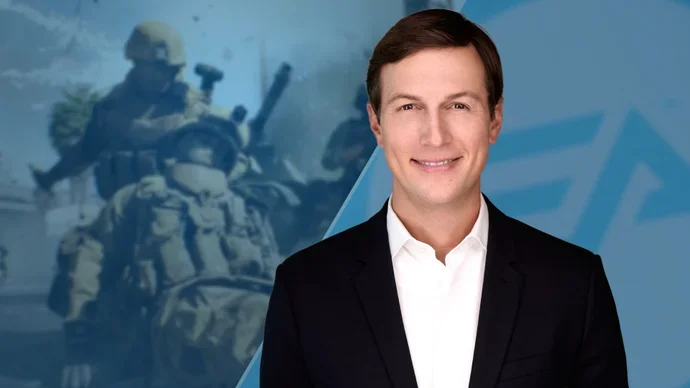
The months-long process of Electronic Art's acquisition finally came to a close late last night.
The company is now privately owned by investment firm Silver Lake, private equity group Affinity Partners (led by US president's son-in-law Jared Kushner), and the Kingdom of Saudi Arabia's Public Investment Fund (PIF).
In a press release penned by the companies involved, the completion of the deal was announced to the public. EA will be delisted from the NASDAQ, and EA stockholders - employees included - will receive $210 for each share of EA common stock they own.
"This moment recognizes the extraordinary people whose creativity, ambition and passion have made EA one of the world's leading interactive entertainment companies," said EA CEO Andrew Wilson. "We're entering this next chapter from a position of strength with partners who share our vision and ambition. Together, we'll invest boldly, accelerate innovation, and build the next generation of games and experiences for the hundreds of millions of players and fans who inspire us every day."
"Having been a minority investor in the company for more than five years, we have a deep understanding of EA's unique platform, massive global sports and gaming franchises, and iconic IP," said PIF Deputy Governor and Head of International Investments Turqi Alnowaiser. "Entertainment and sports are key areas of strategic focus for PIF, and are among the fastest growing and evolving sectors around the world. Together, the Consortium is uniquely positioned to be a long-term partner to EA's management team in driving sustained growth and innovation for EA and the industry."
"EA's franchises are some of the most beloved in entertainment, combining exceptional creative talent with a relentless focus on players," said Silver Lake CEO Egon Durban. "As long-term investors in technology, we admire how EA's innovation fuels imagination and human connection. We're proud to join with PIF and Affinity Partners to invest heavily in EA's growth, including what AI can do to enhance game development and player experience, and excited to partner with Andrew and the EA team as they raise the bar for fans everywhere."
"EA has created stories, characters, and communities that have become part of everyday life for hundreds of millions of people," said Affinity Partners CEO Jared Kushner. "We're excited to support the company as it continues to reach new audiences, inspire the next generation of creators, and expand the ways people around the world connect through play."
First announced in September of last year, the deal gradually won over various regulatory hurdles, including the European Commission and the United States' Federal Trade Commission. Parties involved in the acquisition have faced criticism during the process, including Jared Kushner's connection to political power and Saudi Arabia's poor human rights record.
It is also worth noting that this acquisition is a leveraged buyout - and a record-breaking one, too. The purchase of EA has been partially made with debt, which means interest payments every year must be made by the company's new owners. $18bn of debt has been taken on by EA, with annual interest payments of $1.8bn now an added cost it must contend with.
EA is already a very profitable company, but even so big changes will be needed if the company ever wants to clear this debt. Executives have already implemented generative AI tools into the company, though the rate-on-investment and actual usefulness of these tools remains unclear. Some have speculated that layoffs, aggressive cost-cutting, and further monetisation could be the answer.
According to Jason Schrier at Bloomberg, EA has told debt investors it will cut $700m in annual costs, including $170m in "organizational efficiencies", which Schreier interprets as "mass layoffs".
What EA's future looks like under new management is a real mystery, especially since it doesn't have to publicly release nearly as much documentation now it's a private company. One thing is clear: it's a milestone moment for one of gaming's oldest and largest entities, and Western game development in general.