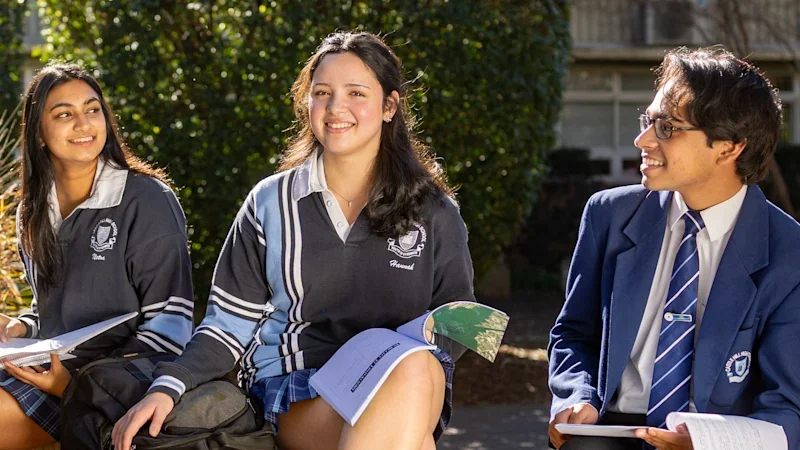
Inside her office in the 1960s Castle Hill High School building in Sydney’s north-west, principal Georgina Cuthbertson can hear the school landlines ringing in the front office.
And who might be calling? Parents, she says, all trying to apply to enrol their children at the school.
“I’d probably knock back 15 a week,” she says.
The school can’t take any more students beyond its catchment – it has 1845 pupils and 51 demountables scattered over its campus.
Cuthbertson attributes the unrelenting enrolment demand to the school’s strong HSC results.
Castle Hill High School was among the top dozen academically performing comprehensive schools in the state, according to a Herald analysis of HSC average scores, which provides the most granular data on HSC performance among public schools.
A particularly strong subject at Castle Hill is English advanced, in which students recorded an average mark of 85, outperforming several fully selective schools.
Unlike some public schools where only a small cohort of the students take the subject, 128 enrolled in the course at Castle Hill last year.
Head of English Lindy Jones says low staff turnover, having teachers who did HSC marking, and studying the same texts each year provided consistency, while a common set of resources developed over years helped staff work as a team to drive results.
“They’re not going to have to scrounge around to find material that’s already there; it’s written up for them,” she said.
On HSC results day she leaves home at 5am to get to school by 6am so she can pore over the released marks the minute they are released. She spends part of the Christmas break looking at precise topics where students performed the best last year.
“I saw the delight from my younger teachers last year when the HSC results came out, and they were just so happy,” she said.
Jones has been at the school since 1984, when it was surrounded by paddocks and when the local Country Women’s Association was involved in running debutante balls.
But academic results have not always been guaranteed at the school. More than a decade ago the school noticed it was slipping behind other neighbouring schools.
It adopted what is known as the ALARM (A Learning and Responding Matrix), which helped students deconstruct exam questions and write structured responses.
“It actually taught staff how to look at responses and how to encourage students to write more conceptually complex responses,” she said.
“I am a competitive person … There’s a personal pride that comes from seeing the success and seeing the joy that students get when they put in the effort or the hard work.”
Year 12 student Netra Sangameswar said she was intimidated by English advanced before she enrolled in it.
“When you’re in year 10, it’s like, ‘oh my god, English advanced … Am I ready for it?’”
Her teachers helped her improve noticeably.
“I think the teachers at Castle Hill High School have helped me take a more structured approach to my essay writing and make sure that I tick those boxes in terms of the analysis and help me argue my perspective on the text more clearly,” she said.
Killarney Heights High, Ashfield Boys High and Willoughby Girls High were other high-performing comprehensive schools in HSC English advanced last year. The state average mark was 81.8 for advanced and 71.6 for standard.
Willoughby Girls principal Adrienne Scalese said the school’s strong results across all subjects was driven by its focus on literacy and mapping what skills they focused on from year 7 to ensure year 12 success.
“To get that success in stage 6 we’ve spent a lot of time backward mapping to look at how we can embed those practices from year 7,” she said.
At the school, teachers work in different teams to develop ways for the school to achieve its goals identified in the school’s strategic improvement plan every four years – including in literacy.
“So all of those teams worked on an action research project, and what they’ve been doing in those teams. Those individual staff have really mastered that. And then, from that team, we’ve taken that across the whole school.
“So we’ll look at explicit literacy strategies related to writing, and so how we can get the best out of our students when they’re responding to extended responses.”
Fully selective schools North Sydney Boys and North Sydney Girls were the top-performing schools for English advanced, while Killarney Heights High was the top-scoring school for English standard.
Most independent and Catholic schools do not report subject averages. The English advanced average at selective Sydney Grammar School was 88.