- See more This is Money on Google - save us as a Preferred Source
Audi is bringing its A2 back after more than 20 years on ice, and it will be resurrected as the German marque's most efficient car yet.
The original was a short-lived but much-loved early noughties model.
It debuted in 2000 as a premium compact family car boasting premium quality and fuel-efficient engines. However, extremely high production costs, due to its lightweight all-aluminium space frame, saw the German brand put it out to pasture in 2005.
Sales were reasonably strong and it was quickly missed when it was axed, largely because it was spacious, supremely lightweight and efficient, with some variants returning up to 75mpg.
After a two-decade hiatus, the A2 nameplate is officially making a comeback as an even greener electric car and will once again serve as an entry point to the German brand with four rings.
The new A2 e-tron will be the cheapest Audi EV you can buy, with prices expected to start at less than £35,000.
It will primarily be an urban electric runaround, sharing the same MEB+ architecture as the new VW ID.3 Neo.
Audi will be hoping its reinvention captures customers seeking a small luxury EV, while also tapping into the cult following the A2 cultivated when it first burst onto the scene.
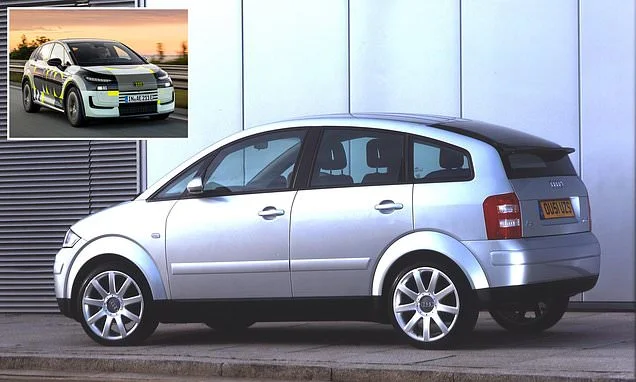
The A2's long-awaiting comeback: One of the biggest modern era cult classics from Audi is making a return to the market as an electric car
The original A2 (left) went on sale in 2000 but was discontinued by 2005 - and for one very good reason. Audi will be hoping the new A2 e-tron (right) will last longer in showrooms
In the five years it spent in showrooms, Audi delivered around 176,000 A2s globally.
But the German marque reportedly took a substantial hit on each one.
Because manufacturing its frame was far more costly than that of a conventional steel-bodied small car, losses were estimated at between £4,000 and £6,000 per unit, totalling up to £1.1billion.
It's no surprise, then, that it had one of the shortest showroom runs of the modern era in the UK.
Since then, enthusiasts and collectors have been trying to snap up the best surviving examples of this quirky premium small car. Back in 2019, the Daily Mail and This is Money even listed it among our top ten picks for modern-era vehicles destined to become classics in the future.
And Audi has been teasing a return for the A2 for years.
In 2011, it revealed an A2 Concept at the Frankfurt Motor Show, showcasing a car very much in the mould of the original that, sadly, never came to fruition.
Extremely high production costs in the early 2000s, due to the A2s lightweight all-aluminium space frame, saw Audi lose around £6k on each car. Unsurprisingly, it was axed after 5 years
In the five years it spent in showrooms, Audi delivered around 176,000 A2s globally
The sloping roofline and short, rounded nose are the most obvious similarities, along with the bubbly, slightly toy-like shape. That said, the new EV is a lot more svelte, with a far lower roof than the boxier A2 original.
Audi A2 e-tron looks
The final design of the 2026 Audi A2 has yet to be revealed, as prototypes remain hidden beneath modern art-style camouflage. However, you can already see the influence of the original 2000s A2 in the new e-tron version.
The sloping roofline and short, rounded nose are the most obvious similarities, along with the bubbly, slightly toy-like shape.
That said, the new EV is a lot more svelte, with a far lower roof than the boxier A2 original.
Modern touches include new tail-lights inspired by Audi's Nuvolari concept, aerodynamically optimised wheels, sleek light bars and an overall smoother shape, all of which keep it in line with other e-tron models while reducing drag.
We can't yet talk about the interior because Audi is keeping that under wraps, though we're expecting to learn more soon.
The original Audi A2 (left) is now considered a modern classic. And the German marque has tried to emulate much of its looks with the A2 e-tron (right), though with new LED tail-lights and aerodynamically optimised wheels
The A2 e-tron will share batteries with the VW Neo. The Neo's range stretches from 258 miles to 390 miles, so the even more efficient A2 could break the 400-mile barrier
A2 e-tron range
The Volkswagen Neo, with which the A2 shares its architecture, comes with battery packs ranging from 50kWh to 79kWh.
Powered by a rear-mounted electric motor, the VW produces between 168bhp and 228bhp.
The Neo's range stretches from 258 miles to 390 miles when equipped with the 79kWh battery.
With the A2 expected to be even more aerodynamically efficient, it could break through the 400-mile barrier.
This would give the Audi a distinct advantage over the best-selling Renault 5 electric supermini, which can travel up to 252 miles on a single charge.
With the 187bhp motor and Efficiency Pack fitted, the A2 e-tron's official WLTP efficiency figure stands at 4.85 miles per kWh.
That would make it one of the most efficient EVs on sale today, although the Mercedes CLA EV currently holds the crown with 5.1mi/kWh, while the Tesla Model 3 achieves 5.0mi/kWh.
When the Audi A2 arrived in the UK in August 2000, it was the brand's cheapest car. The new A2 e-tron will be its least expensive EV, though still cost in the region of £35,000
The A2 e-tron should cost around the same as the VW ID.3 Neo on which it is based, albeit with the modest premium typically associated with a more upmarket Audi model
A2 e-tron: How much is it and when can I order one?
It's expected that the A2 e-tron will cost around the same as the Volkswagen ID.3 Neo on which it is based, albeit with the modest premium typically associated with a more upmarket Audi model.
The Neo starts from £31,850 with the Government's £1,500 Band 2 Electric Car Grant automatically applied. The A2 e-tron is also likely to qualify for the same incentive.
If it comes in at less than £35,000, it will carry a premium of under £6,000 over the entry-level petrol A3, which starts from just under £29,000.
You should also expect it to go on sale following its full reveal this autumn, with UK deliveries beginning in early 2027.