Sun news August 5: Solar cycle 25 update
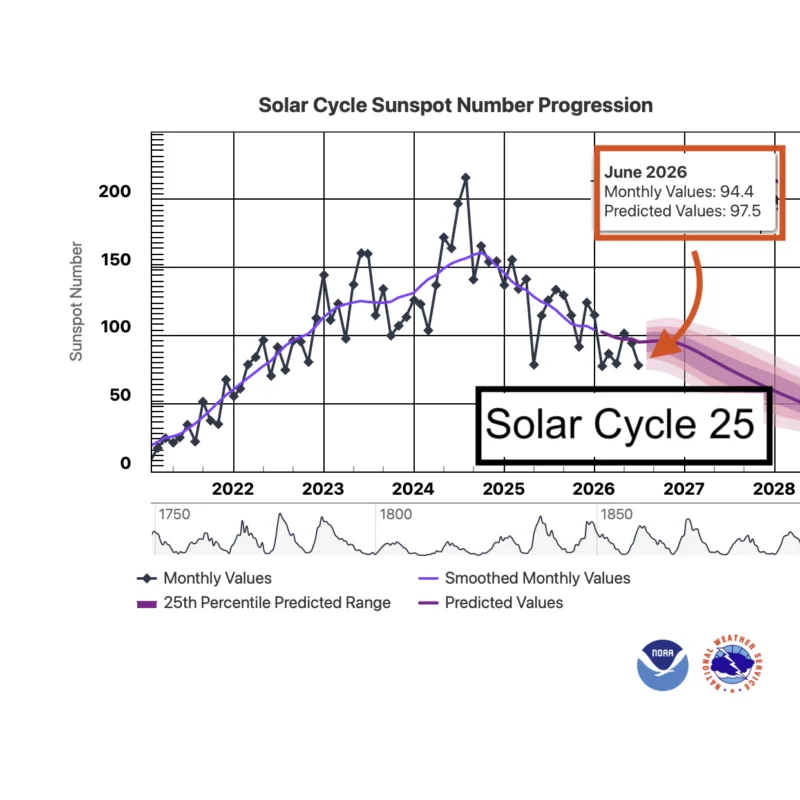
Today’s top story: Sun activity going thru very low levels in terms of flare production, with just C (common) and B (weak) flares gives a good opportunity to review a Solar Cycle 25 update. NOOA release the result for July 2026. The sunspot number was 78.1. It showed a decrease compared to June 2026 results which indicated a sunspot number of 94.4. Despite we saw a monster sunspot region like AR4493, the production of an X flare plus a number of M flares, the solar disk showed only one day with up to 10 numbered sunspot regions on its side we see from Earth. The majority of the days through July we saw two or three sunspots. All this contribute in the drop of the final number. The max peak of Solar Cycle 25 remains August 2024 with a sunspot value of 216.
Turning our eyes to the solar disk, it continued showing intense action from fiery filaments – long ropes of solar material – which caused several eruptions. Observers spotted several chunks of solar stuff, or coronal mass ejections (CMEs), soaring into space during these events. As a result, specialists anticipate weak glancing blows on August 7 thru 9.
Past 24 hours on the sun
(11 UTC August 4 – 11 UTC August 5)
Flare activity: Flare activity registered a notable increase in flare production. Still only C-class (common) and B-class (weak) flares makes it very low levels. Our star produced a total of 11 flares. Compared to only three minor flares yesterday, makes it a noticeable increase in flare production: five C-class (common) and six B-class (weak) flares during the period.
- Strongest flare:A C1.7 from active region AR4502 at 6:22 UTC on August 5.
- Lead flare producer:A newcomer sunspot region on the southeast shoulder of the horizon, as-yet-unnumbered, topped the list, firing four flares during this period: two C and two B flares.
Sunspot regions: The side of the solar disk we see from Earth shows today five numbered active regions.
- AR4498 (beta-delta): Lost its delta magnetic complexity and today it shows a simper beta configuration. It keeps the largest in extent but suffered some fragmentations in its leader spot.
- AR4496 (alpha): Fully rotated to the far side.
- AR4499 (beta): This region showed signs of decay in this period.
- AR4500 (beta): This region exhibited some signs of penumbral decay in its leading spot.
- AR4501 (beta): The region loss in its trailing spots.
- AR4502 (beta): This region continued showing significant growth over the past 24 hours.
Blasts from the sun? Observers continued spotting several coronal mass ejections (CMEs) during the past 24 hours. All this CMEs are associated with lifting filament eruptions. Nevertheless, modeling and analysis continue but as a result of these plasma ejecta, a minor glancing blow may occur on August 9.
Past 24 hours in space weather
Solar wind: Solar wind speeds averaged moderate-low levels during the whole period. No significant space weather to report.
Bt, Bz and magnetic coupling: The total interplanetary magnetic field showed weak strength during the period. Meanwhile, the Bz component pointed mostly northward during the whole period with a few peaks south oriented. All in all, both orientations showed weak peaks.
Earth’s magnetic field: The geomagnetic field at very-low levels (Kp 0–1) during the period. At the time of this writing, the Kp index sits slightly above level 0.
What’s ahead? Sun–Earth forecast
Flare activity forecast: Forecasters expect low levels of solar activity to continue through August 6. Chances for M flares continue at (20%) with low expectation of M-class (moderate) flares. AR4498 and AR4499 are main players, with contribution of AR4502. Meanwhile, the chance for X-class (strong) flares remains very low, at 1%.
Geomagnetic activity forecast:
- August 5:Mostly quiet conditions anticipated (Kp 0–2). No passing CMEs or fast solar wind from a coronal hole to provoke any enhancements. A return to near-background solar wind levels is likely.
- August 6:Quiet conditions (Kp 0–2) should prevail, with no significant solar wind drivers forecast. Any residual effects from the July 31 CME arrivals should have fully subsided by then. Solar wind parameters should sit at background levels.
- August 7:An increase to unsettled-to-active conditions may occur with isolated chances for a G1 (minor) geomagnetic storm as filament activity hurled ejecta into space and may provide weak glancing blow.
Sun news August 4: Several bursts of sun-stuff fired from our star
Today’s top story: Sun activity returned to very low levels in terms of flare production, with just one C (common) flare and two B (weak) flares fired over the past day. However, the solar disk still put on a show. Intense action from fiery filaments – long ropes of solar material – caused several eruptions.
Observers spotted several chunks of solar stuff, or coronal mass ejections (CMEs), soaring into space during these events. So far, specialists don’t foresee any major impacts to Earth, but modeling and analysis is ongoing. Stay with us and we will keep you updated.
Past 24 hours on the sun
(11 UTC August 3 – 11 UTC August 4)
Flare activity: Flare activity dropped to very low levels and production decreased overall. Our star produced only three minor flares: one C-class (common) and two B-class (weak) flares during the period.
- Strongest flare:A C1.4 from active region AR4498 at 11:33 UTC on August 3.
- Lead flare producer:AR4498 topped the list, firing two flares during this period: the C1.4 mentioned above, plus a B flare. Meanwhile, an incoming, as-yet-unnumbered region sparked the second B flare of the period.
Sunspot regions: Currently, the solar disk displays 6 numbered active regions on the side we see from Earth.
- AR4498 (beta-delta): This region kept its delta configuration. It also remained the largest and most magnetically complex on the visible disk. For now, it’s attracting all the attention.
- AR4496 (alpha): This sunspot region now sits over the west horizon, poised to depart to the far side. It showed stability with a simpler alpha configuration.
- AR4499 (beta): This region showed growth in its trailing spots.
- AR4500 (beta): This region produced no flare activity and shows some signs of decay.
- AR4501 (beta): This region showed the most growth during the period. Therefore, it warrants monitoring in the coming days.
- AR4502 (beta): This region showed significant growth over the past 24 hours.
- AR4492: All gone. It has fully rotated out of view.
Blasts from the sun? Observers spotted several coronal mass ejections (CMEs) during the past 24 hours, associated with lifting filament eruptions. So far, they have detected no clearly Earth-directed CMEs. Nevertheless, modeling and analysis continue.
Past 24 hours in space weather
Solar wind: Solar wind speeds averaged moderate-low levels during the whole period, as effects from the CME began to wane.
Bt, Bz and magnetic coupling: The total interplanetary magnetic field was moderate for most of the period. Meanwhile, the Bz component pointed mostly southward during the whole period. That orientation opened the door for significant energy transfer into Earth’s magnetosphere.
Earth’s magnetic field: The geomagnetic field ranged from quiet to active levels (Kp 2–4) during the period. Effects of the passing CME showed up as a Kp 4 level. Conditions first reached that threshold at 21 UTC on August 3. At the time of this writing, the Kp index sits at level 3, as CME enhancements continue to wane.
What’s ahead? Sun–Earth forecast
Flare activity forecast: Forecasters expect low levels of solar activity to continue through August 5, with C-class flares likely. A slight chance (20%) exists for M-class (moderate) flares. AR4498 and AR4499 are the primary candidates. AR4501, which showed the most growth this period, also bears watching. Meanwhile, the chance for X-class (strong) flares remains very low, at 1%.
Geomagnetic activity forecast:
- August 4:Expect mostly quiet to unsettled conditions (Kp 1–3) as CME influences fully diminish. Two weak CMEs from July 31 have model runs suggesting arrival around 8–14 UTC. However, Kp estimates of only 2–3 indicate these would produce at most unsettled conditions. A return to near-background solar wind levels is likely.
- August 5:Quiet conditions (Kp 0–2) should prevail, with no significant solar wind drivers forecast. Any residual effects from the July 31 CME arrivals should have fully subsided by then. Solar wind parameters should sit at background levels.
Sun news August 3: Big sun blast sparks geomagnetic storm and auroras
Earth’s magnetic field lit up yesterday from a huge blast of solar material and magnetic fields from the sun. A coronal mass ejection (CME) slammed into our planet’s magnetosphere around midday on August 2. Forecasters believe the impact was either a slow-moving CME launched on July 27, or a glancing blow from a July 30 eruption. Either way, it drove geomagnetic storm conditions to G2 (moderate) levels. As a result, auroral displays became possible across northern Scotland, Scandinavia, and similar high-latitude locations. Did you see them? Post your photo to our community page!
Past 24 hours on the sun
(11 UTC August 2 – 11 UTC August 3)
Flare activity: The sun itself took a breather over the past day. Flare production remained at low levels, with only minor C-class (common) or weaker flares recorded. Observers logged 2 C-class and 2 B-class (weak) flares during the period.
- Strongest flare:NOAA noted a C6.3 flare from an area around the northwest limb at 05:35 UTC on August 2 as the largest event of the broader 24-hour summary. But it fell just before our reporting window. Within the 11 UTC to 11 UTC window, the strongest flare was a C1.3 from sunspot region AR4492 at 14:41 UTC on August 2.
- In addition, sunspot region AR4498 fired a C1.0 flare at 00:39 UTC on August 3.
Sunspot regions: The Earth-facing solar disk displayed approximately seven to 10 numbered active regions during the period. The SIDC identified ten groups, while NOAA focused on the most significant ones.
- AR4498 (beta-delta): This region continued as the largest and most magnetically complex on the visible disk. It features a moderately large lead spot, plus a cluster of peripheral minor spots to the south that includes a weak delta configuration. As it approaches center disk, it remains the primary source for elevated flare potential.
- AR4499: Located just northeast of AR4498, this region drew the SIDC’s attention as the most magnetically complex (beta-delta). It also produced most of the minor flaring activity. But it showed overall weakening in recent imagery.
- AR4501 (beta): This region showed the most growth during the period. So it warrants monitoring in the coming days.
- AR4492: This region produced the C6.3 and C1.3 flares. But it now sits at the extreme northwest limb and is rotating out of view.
- Finally, a moderate-size bipolar region in the southwest quadrant, likely AR4496, provided some additional flare potential. Even so, it showed recent decay in its trailing portion. The remaining regions stayed relatively simpler, smaller and largely stable, with only minor changes.
Blasts from the sun? Observers spotted no Earth-directed coronal mass ejections (CMEs) in available coronagraph imagery during the period. They did catalog one non-Earth-directed CME.
Past 24 hours in space weather
Solar wind: A CME-driven interplanetary shock dramatically reshaped solar wind conditions when it arrived at 11:29 UTC on August 2. Before the shock, solar wind speeds sat at a sluggish 290 km/s. The shock then drove speeds sharply to about 350 km/s. From there, they climbed unsteadily to a peak of 440 km/s by 17:17 UTC. Afterward, speeds eased below 400 km/s following 22:00 UTC. Solar wind density also jumped from 4 to 33 particles per cubic centimeter during the shock arrival.
Bt, Bz and magnetic coupling: The total interplanetary magnetic field jumped from 4 nT to about 14 nT at shock onset. It eventually peaked at a strong 22 nT around 15:00 UTC. Meanwhile, the Bz component initially dropped to –8 nT. Then it plunged to –17 nT at 15:02 UTC. That deeply southward orientation opened the door for significant energy transfer into Earth’s magnetosphere. By around 19 UTC, the Bz rotated northward and stayed mostly moderate in strength.
Earth’s magnetic field: The geomagnetic field stayed quiet (Kp 0–2) during the first half of the past day. Then it responded vigorously to the CME arrival. Conditions escalated rapidly, reaching G2 (moderate) geomagnetic storm levels (Kp 6) between approximately 12:00–21:00 UTC on August 2. Across multiple three-hour synoptic periods, Kp ranged from 3–5, meaning active to G1 (minor) storm conditions. Notably, the peak storm interval coincided with the deeply southward Bz near 15:00 UTC. After the Bz rotated northward around 19:00 UTC, activity gradually subsided. Aurora may have appeared over locations such as Edinburgh, northern England and similar latitudes. However, short summer nights limited viewing opportunities.
The sun in recent days
Sun images from our community
We sometimes feature sun images obtained using hydrogen-alpha filters. Read why.
Bottom line: Sun news August 4, 2026: Flares dropped to very low levels, but filaments put on a show with several eruptions and coronal mass ejections.