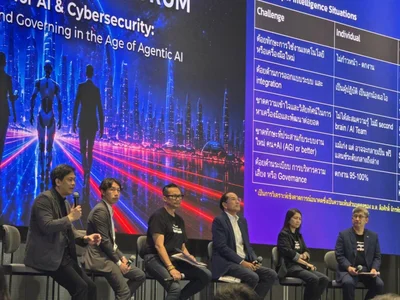
From left: M.L. Luesak, Mr Santi, AVM Amorn, Mr Tatchapol and Ms Panita share their views at the forum.
The rapid rise of artificial intelligence (AI) is forcing organisations to rethink workforce skills, accountability and cybersecurity to prevent job displacement and operational risk, say tech pundits.
M.L. Luesak Chakrabandhu, president of the Association of Thailand Open Source Federation and director of the Digital Council of Thailand, warned of massive job displacement for those who fail to adapt to survive the severe societal and workforce impacts of advancing AI technologies.
Cybersecurity success requires a dedicated, accountable person in charge rather than just a focus on making profits, he said, speaking at a digital workforce forum held yesterday by the National Electronics and Computer Technology Center (Nectec).
He sees challenges in a post-artificial general intelligence (AGI) era, predicting that individuals who lack technology and integration skills face a 95-100% chance of job loss.
"Organisations failing to design secure systems and integrate AI will face operational conflicts and jobless productivity, while nations could suffer from stagnant GDPs and inefficient supply chains."
M.L. Luesak said AI can never replace human accountability because it cannot bear legal responsibility or be held liable. "Humans will always remain the accountable decision-makers, as well as the creators and consumers who define AI's purpose."
He outlined a three-tier upskilling strategy: executives and boards should become "Humans Beyond the Loop" -- intent architects responsible for strategy, governance and guardrails; middle managers should serve as "Humans Over the Loop" -- orchestrating workflows and validating AI outputs; while all employees should operate as "Humans In and On the Loop" -- filtering AI-generated information and ensuring tasks align with organisational goals and safety.
Future skills
Tatchapol Poshyyanonda, country director of Palo Alto Networks for Thailand and Vietnam, said security should be viewed as an enabler of potential rather than merely a business expense.
"Because hackers are using AI, defenders must use AI to fight back and reduce incident response times from hours down to mere minutes."
Top executives must take the lead by defining clear business priorities for AI and establishing "Trust AI" -- ensuring data accuracy, appropriate models and verifiable results -- rather than just blindly following tech trends.
Organisations are encouraged to adopt a five-stage AI governance framework covering assessment and inventory, governance and design, protection and operations, monitoring and assurance, and continuous reporting and improvement.
Future cybersecurity professionals will need to have AI and data literacy, AI security knowledge, AI agent management, threat analysis, critical thinking, ethics and governance, alongside communication and collaboration skills.
Data classification
Panita Pongpaibool, deputy executive director of Nectec, said humans are the most critical vulnerability in any cybersecurity system.
Organisations should implement mandatory security awareness training, such as phishing email simulations, for all employees.
Top executives -- not just IT departments -- must take responsibility for classifying corporate data because IT does not know the business value of the data.
Nectec also provided an open-source cybersecurity monitoring system developed for SMEs to help them achieve high-quality security affordably.
Natural Intelligence
AVM Amorn Chomchoey, secretary general of the National Cyber Security Agency, said AI users must develop their "natural intelligence", specifically critical thinking and cognitive skills, to avoid being manipulated or becoming willing victims of AI.
Scammers are using advanced AI to conduct highly realistic fraud. In Thailand, while scams remain a severe issue, daily financial losses from these scams have recently decreased to around 15-35 million baht.
Cybersecurity is the fundamental framework of any digital system. Organisations must integrate security into AI systems from the very beginning of their development.
Users should not blindly trust digital interactions; "digital trust" must be granted only after careful verification.
Furthermore, every organisation must urgently establish clear guidelines and acceptable use policies for AI to ensure that employees use the technology safely, responsibly and without exposing sensitive data.
"A lack of budget is not a valid excuse, as free open-source tools and learning resources are widely available, though they require more hands-on effort from the team."
Santi Siritheerajesd, child protection specialist of Unicef Thailand, said the core risks of the internet include inappropriate content (violence/18+), dangerous contact (grooming), poor conduct by youths themselves, and contact/data privacy issues.
He warned that malicious actors are weaponising AI, such as using deepfakes for extortion or manipulating AI prompts to bypass safety guardrails and generate abusive images.