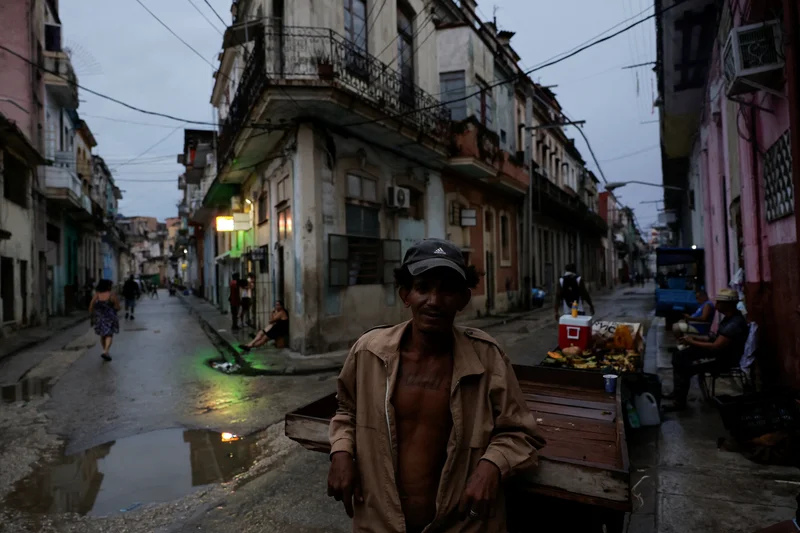
In everyday Cubans’ lives there are two unwritten rules. The first is resolver — finding ways to get by. The second is no coger lucha. In other words: keep your composure even when everything is going wrong. But recently both precepts have been pushed to the limit. Squeezed by U.S. sanctions and cornered by decades of mismanagement, islanders have seen that even after hitting rock bottom a new sinkhole always opens. Within hours the country suffered yet another total collapse of the National Electric System (SEN). The second in less than a day, the seventh in 2026, and the eleventh in the past two years.
In Cuba, a country that has learned to live with anomalies better than most, turning on a light bulb has become an act of fiction. The most recent example occurred on Monday. The latest nationwide blackout, which left the island’s nine million residents without power, occurred while operators at the state electric utility were working to restore service after the SEN failure recorded Sunday night. The state company Unión Eléctrica (UNE) confirmed the worst fears when only 14% of Havana — about two million residents — had recovered power. That same weekend the energy system had suffered a partial disconnection that left half the island in the dark.
It’s a story that never ends. Cubans, with their characteristic irony, had long joked that it’s impossible to tell a normal day from one when the SEN collapses. Milagros, 38, a mother of two and a resident of Matanzas in western Cuba, only learned much later that the grid had failed. “The system went out three days ago. That’s what I heard. At the time it went down, we had no power. And without power, we didn’t know if it was real. Cell phones lose service, either coverage or data connection. God forbid an emergency happens and you’re cut off,” she tells EL PAÍS by phone.
SEN collapses
Network collapses should not be confused with power outages. In the first case, the system collapses, so not a single megawatt (MW) is generated across the territory. Outages, on the other hand, occur routinely. They are caused when the country is unable to generate enough electricity to meet demand, or by a localized failure. In recent weeks routine interruptions have exceeded 20 hours in Havana and reached up to 72 consecutive hours in other provinces.
According to the government, the most recent grid collapse was caused by “weather events” that affected the system and “directly impacted the generating units that were online.” For Cuban expert and researcher at the University of Texas’ Institute of the Americas, Jorge Piñón, the latest grid problems “are not only technical failures,” but something more worrying. “[The complications have been in] the transmission lines, which in Cuba are connected to one another like dominoes. If you knock down the first one, they all fall. You can have generation, but if you don’t have the cables to carry that electricity to consumers, it’s useless,” he explains.
Washington’s maximum-pressure campaign, with Cuban-American Senator Marco Rubio as its spearhead, has shaken a system already suffering chronic underfunding. The U.S. squeeze has been delivered in two acts: the capture of Nicolás Maduro in Venezuela — Cuba’s main fuel supplier — and the blockage of any tanker attempting to supply Havana under the tariff threat from Donald Trump. Both moves took place earlier this year and have worsened the precarious energy situation even further, not to mention the Republican’s bellicose rhetoric toward the island.
An analysis by this newspaper at the end of May, based on official data, documented the immediate effect of the sanctions. Generation fell by 20% between January and February. Blackouts in Havana rose from an average of four hours to 18 hours a day. On the other hand, the arrival in March of the Russian tanker Anatoly Kolodkin —the last to berth on the island, delivering more than 700,000 barrels (Cuba needs 110,000 barrels a day to operate normally) — caused outages to drop sharply in April. The shortfall fell by 50%, but the supply was exhausted to the last drop.
Economic reforms
As a panic move the government ignored six decades of anti–private sector rhetoric and allowed small entrepreneurs to import limited amounts of fuel. It also recently approved private operation of gas stations. These contradictions stand out in a year when the revolution marks the centenary of the late leader Fidel Castro’s birth and approaches the 10th anniversary of his death.
The current crisis has also revealed deep economic inequalities. The country is divided between those with access to foreign currency — either through relatives abroad or by owning private businesses — and those left in the dark and sweltering in the heat of the Cuban summer. For Maribel Villalonga, 65 and a resident of Matanzas, the greatest consolation is that the food in her refrigerator doesn’t spoil because she has a generator sent from the United States. “Imagine: yesterday the system went down and in the circuit where I live there is still no power. There are days that go by, the full 24 hours, without electricity. Sometimes longer,” she complains.
The timid economic opening, forced by circumstances, has not changed the underlying problem. Generating electricity has always been a headache, even before the White House’s barrage of sanctions. The SEN’s backbone rests on 16 units at Soviet-era thermal plants that have long passed their useful life, estimated by experts at 35 years, and the diesel and fuel-oil engines scattered across the country. Together they account for 80% of the generation mix.
In short, the oil blockade has backed the system into a corner. In fact, all diesel and fuel-oil generators are completely idle. Piñón insists, however, that it is a self-inflicted problem. The expert cites historically low investment in the industry, lack of maintenance, and the wear caused by using Cuban crude — with a very high sulfur content — in generating plants. “What is very clear is that the thermal plants are not directly impacted by the lack of fuel as a result of the United States’ blockade,” he says.
Several independent analysts outside the island, like Piñón, warn that the situation is so severe that even if Washington decided to lift the energy embargo today, long blackouts would continue. Reviving the industry would require about $10 billion, an amount Cuba does not have. The severe situation, which the regime likens to a wartime economy, has completely paralyzed the little economic activity remaining. The Economic Commission for Latin America and the Caribbean (ECLAC) estimates GDP will contract by at least 6.5% this year. Over the past five fiscal years there has been a cumulative decline of 15%.
Amid it all, Cubans continue to get by while trying to retain their composure. Milagros’s youngest daughter, who is eight years old, “has spent the last three full nights doing nothing but screaming, sweating [from the extreme summer heat], and not sleeping.” “And on top of that, there’s no water — because they don’t even provide water under normal conditions, let alone when there’s no power,” she concludes.