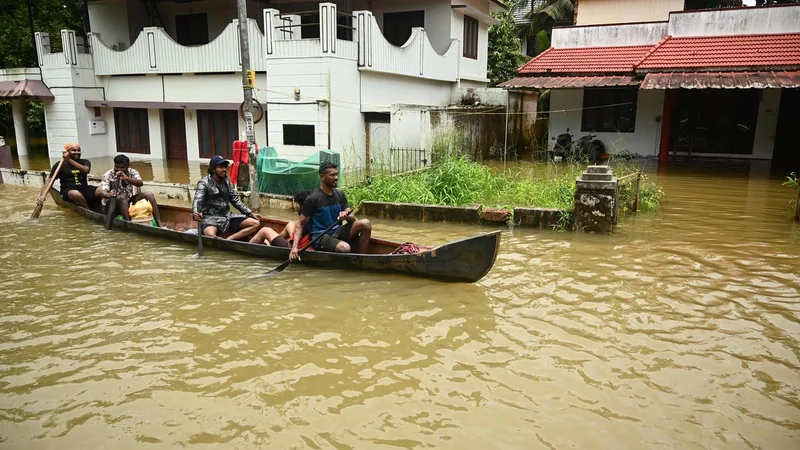
Researchers at the Advanced Centre for Atmospheric Radar Research (ACARR) in the Cochin University of Science and Technology have recommended a fundamental shift in Kerala’s disaster management strategy with extreme rainfall events becoming a more frequent feature of the State’s climate scenario.
They point out that Kerala is emerging as a hotspot for mesoscale mini cloudbursts due to changing rainfall patterns and cloud structures. Mesoscale cloudbursts are extreme, highly localised downpour, mostly exceeding 100 mm in an hour, falling over a scale spanning tens to hundreds of square kilometers.
“Driven by strong convection and orographic lifting, these short-duration extreme events generate rapid runoff and flash floods. Land degradation and deforestation further aggravate impacts, making the State a hotspot for mesoscale mini cloudburst-induced disasters,” said S. Abhilash, Director of ACARR.
“Given the growing unpredictability of cyclone behaviour, improved impact-based forecasting, real-time prediction systems, and climate-informed policy planning are essential to safeguard coastal populations and marine-dependent livelihoods. Studies have shown that mesoscale cloudbursts occurring under favourable ocean-atmospheric conditions may leave a vast area of the State vulnerable to flash floods and landslides, anytime during the monsoon season,” he said.
Suggesting an urgent need for participatory, localised disaster management frameworks, Mr. Abhilash said that centralised approaches alone are insufficient in view of the State’s rapidly changing climate and terrain fragility.
Region-specific interventions
“A bottom-up, people-centred, multi-hazard early warning system, integrating local knowledge, scientific monitoring, ecosystem-based adaptation, and decentralised governance, is essential. Continuous, multi-scale atmospheric monitoring and region-specific policy interventions are critical to reduce fatalities, protect livelihoods, and enhance resilience in the face of increasingly localised and extreme weather events,” he said.
Researchers indicated that a warming Arabian Sea and a warmer atmosphere are increasing the moisture available to the monsoon system, creating favourable conditions for more intense rainfall events. “With deep mesoscale convective systems and towering convective clouds developing rapidly and producing exceptionally heavy rainfall over small areas within a few hours, neighbouring districts or even nearby river basins can experience very different rainfall amounts. This increasing spatial variability makes it challenging to accurately predict the exact location, timing, and intensity of extreme rainfall, even with improvements in weather models and observation systems,” said Ajil Kottayil, scientist at the ACARR.
A mesocale convective system is a complex of thunderstorms that becomes organised on a scale larger than the individual thunderstorms but smaller than continental cyclones that normally persists for several hours or more. Towering convective clouds are massive vertical clouds that often bring heavy rain showers or grow into thunderstorms.
Minimising consequences
Mr. Kottayil said that the challenge before Kerala is not to stop extreme rainfall, but to build the capacity to anticipate it, prepare for it and minimise its consequences. “The State’s greatest advantage lies in the strong institutional framework it has developed for disaster management and climate research. The challenge is therefore not the lack of expertise or institutions, but the need for stronger integration of these capabilities,” he said.
He recommended setting up a permanent multidisciplinary expert panel involving climate scientists, meteorologists, hydrologists, geologists, engineers, disaster managers, and policymakers to provide coordinated scientific guidance before, during, and after extreme weather events. “Such a platform would help bridge the gap between scientific knowledge and operational decision-making, ensuring that Kerala’s considerable expertise is translated into timely action on the ground,” he said.
Stating that the focus has to shift from controlling the hazard to reducing its impact, he said that it required denser rainfall and weather observation networks, hyper-local and impact-based forecasting, improved river basin and reservoir management, better landslide monitoring systems, climate-resilient infrastructure and stronger coordination between scientific institutions, government agencies, and local communities.
Published - August 05, 2026 04:25 pm IST