Uber issued a forecast for bookings and earnings that trailed analysts' estimates, while second-quarter profit was in line with expectations.
Here's how the company did versus analysts' estimates compiled by LSEG:
- Earnings per share:81 cents vs. 81 cents expected
- Revenue:$14.19 billion vs. $14.24 billion expected
Revenue increased 12% from $12.65 billion a year earlier. Net income climbed to $2.39 billion, or $1.17 a share, from $1.35 billion, or 63 cents a share, a year ago.
Uber's core mobility service accounted for $7.36 billion of second-quarter sales, while delivery revenue reached $5.25 billion. Mobility gross bookings climbed 22% from a year to $28.99 billion, and delivery bookings increased 26% $27.46 billion. Total bookings of $58 billion topped the $57.23 billion average analyst estimate, according to StreetAccount.
For the third quarter, Uber sees bookings of $59.25 billion at the middle of its range. That trails the average StreetAccount estimate of $59.33 billion. And the company's EPS forecast of 84 cents to 88 cents fell below the 89-cent average analyst estimate, according to LSEG.
Uber shares are down 12% this year as of Tuesday's close, while the Nasdaq is up 14% over that stretch.
Uber is pushing further into deliveries, and last month announced a $14.8 billion agreement to acquire Germany's Delivery Hero. That deal will increase the number of markets where Uber can deliver food and groceries.
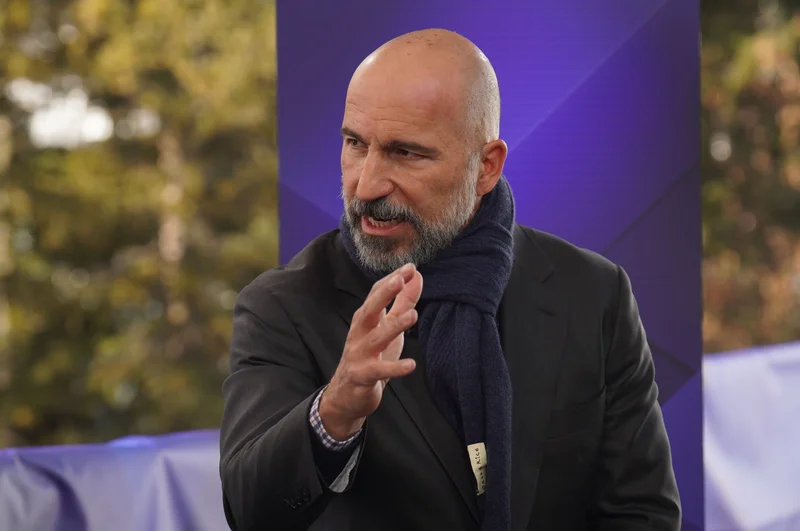
CEO Dara Khosrowshahi said in prepared remarks ahead of the earnings call that the World Cup was a boon for the ride-hail business in the quarter. More than 8 million tourists took rides across host cities in the U.S., Canada and Mexico
Uber is also continuing to make big bets on autonomous vehicles.
The company said it expects to commit over $10 billion in coming years to "bring AVs to market at scale." Uber, which has been inking partnerships with robotaxi providers, doesn't break out the share of rides or deliveries that have drivers and those that don't.
"As the industry shifts from proving the technology to commercializing it at scale," Uber is building "one of the most valuable positions in the AV ecosystem," Khosrowshahi said.
However, early robotaxi partner Waymo appears to be pulling away. The companies recently said they would be ending an exclusive agreement in Atlanta and Austin, Texas, by early 2028.
Uber will host a conference call with analysts at 8 a.m. ET.