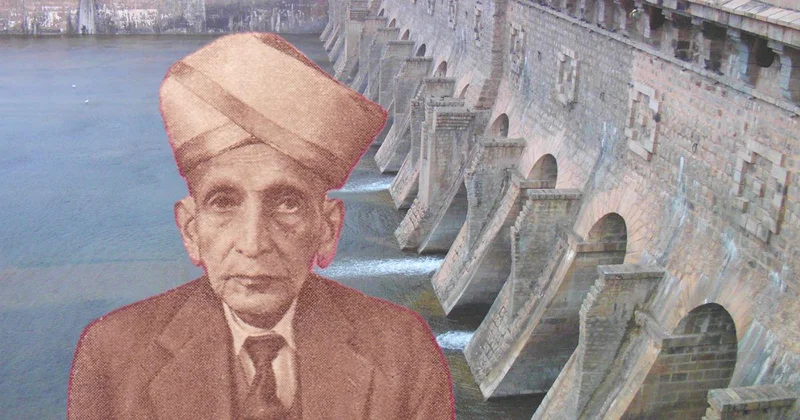
Engineers rarely become celebrities. Yet M Visvesvaraya (1861-1962) is a notable exception, a man whose career and achievements continue to be widely celebrated in India. He presided over the construction of some of colonial India’s most audacious development projects, such as the Krishnarajasagara dam and reservoir near Mysuru. He became an evangelist for industrialisation and set out a technocratic vision for an independent India.
That vision remains powerful today. Aparajith Ramnath, the author of Engineering a Nation and winner of the 2025 Kamaladevi Chattopadhyay NIF Book Prize, has provided Visvesvaraya with the comprehensive biography he has long deserved. In this episode of Past Imperfect, Ramnath details Visvesvaraya’s achievements but also offers some cautionary words about technocratic thinking.
Born in a small town in the erstwhile princely state of Mysore, Visvesvaraya went on to have multiple careers. In 1884, he joined the Bombay Public Works Department as a civil engineer, entering a profession where a solid glass ceiling remained intact for Indians. He nevertheless rose through the ranks with stunning speed. Leaving Bombay, he accepted the position of chief engineer of Mysore state and, in 1912, became the state’s diwan or prime minister. A consummate workaholic, Visvesvaraya pushed through projects like the KRS, started an ironworks, expanded infrastructure, initiated compulsory education, and transformed Mysore’s higher educational landscape.
Some of these projects were, according to Ramnath, unprecedented by global standards. The KRS dam and reservoir preceded the multipurpose dams of the Tennessee Valley Authority by two decades and set the template for the large dam projects of the Nehruvian era. Visvesvaraya deftly navigated engineering, bureaucratic, and political challenges. And he constructed these monuments to technological progress despite India’s very real technological limits: the KRS was largely constructed with manual and animal labour.
Visvesvaraya was a demanding boss, practicing a distinctly top-down form of administration and constantly coaxing Mysore bureaucrats to show more drive and initiative. Not everyone was happy with his leadership style. HV Cobb, the British resident of Mysore state, complained that Visvesvaraya “resents opposition as though he were a Napoleon”.
The most important contribution of Ramnath’s book is how it rounds out Visvesvaraya’s life story: telling us what he did after he resigned as diwan in 1918. He became a liberal statesman, taking a significant role in Indian politics in the 1920s and 1930s. In Ramnath’s opinion, Visvesvaraya the politician “deserves to be studied as seriously as Nehru, Gandhi, Ambedkar, Tilak or Bose”.
It was here that Visvesvaraya balanced his technocratic instincts, honed during his time in Bombay and Mysore, with democratic ones. In collaboration with liberal Congress members like Madan Mohan Malaviya and M. R. Jayakar, he attempted brokering a compromise between Mahatma Gandhi and the British government and, later, sketched out plans for achieving dominion status.
Most surprisingly, this former diwan became a spokesman for the state people’s movement, an alliance of reformers in Indian princely states which clamored for increased democratisation. Despite his continuing ties with Mysore and numerous other maharajas and diwans across the subcontinent, Visvesvaraya could be blisteringly critical of princely India. “There is no instance of any State in any part of the world which is ruled on the medieval principles that the Indian States at present are,” he told one gathering.
Yet Visvesvaraya the technocrat could regularly trump Visvesvaraya the democrat. He became an early advocate of economic planning, laying out in the 1930s ambitions to double national income in 10 years and shunt 20% of the agricultural workforce into factories.
His prescriptions for industrial development, as Ramnath tells us, “often appeared to flirt with militarism and authoritarianism,” providing precious little room for democratic inputs. “He was surprisingly unmindful of the evils bound up with the kinds of industrialism that prevailed in the countries he cited as role models,” Ramnath notes. At the same time, Visvesvaraya advocated some form of top-down cultural homogenisation in India and had little sympathy with campaigns for reservations launched by the non-Brahmin movement in south India.
These insights matter: Ramnath credits Visvesvaraya for helping popularise technocratic thinking in modern India. While his plans and prescriptions were made with eminently good faith and a fervid desire to release India from the grips of chronic poverty, the “lack of engagement with humanistic schools led to blind spots”. Such blind spots continue to bedevil many technocratically-oriented development projects today.
Visvesvaraya ultimately helps us tell a bigger global story: how engineers have shaped politics since the early twentieth century. While engineers like Herbert Hoover rose to leadership positions in places like the United States, an engineering mindset shaped development agendas in other countries such as the Soviet Union, Atatürk’s Turkey, and Nehru’s India. In China, meanwhile – as the technology writer Dan Wang argues in a new book, *Breakneck * – an engineer-dominated leadership cadre has even created an “engineering state.”
Ramnath’s earlier scholarship has demonstrated how India’s own tryst with global engineering has had deep roots. As the country continues to churn out over a million engineering graduates every year, his book on M Visvesvaraya allows us see India’s future as well as an important chapter in its recent past.
Dinyar Patel is an associate professor of history at the SP Jain Institute of Management and Research in Mumbai. His award-winning biography of Dadabhai Naoroji, Naoroji: Pioneer of Indian Nationalism, was published by Harvard University Press in May 2020.
Past Imperfect is sponsored and produced by the Centre for Wisdom and Leadership at the SP Jain Institute of Management and Research.
We welcome your comments at letters@scroll.in.