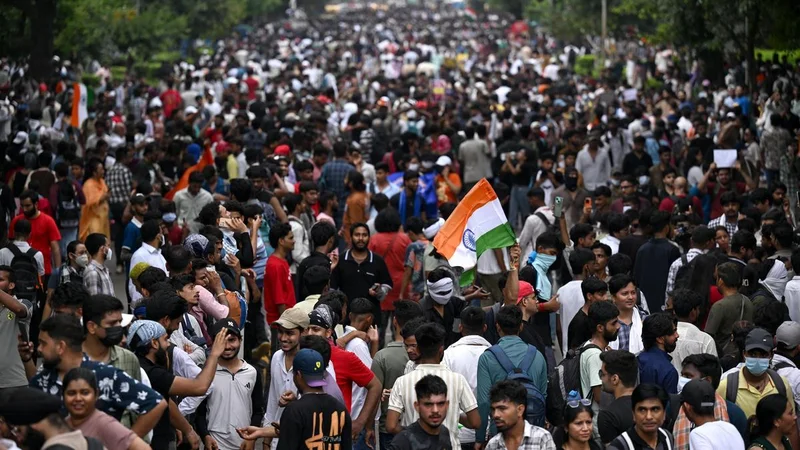
The story so far: Following protests by the Cockroach Janta Party at Jantar Mantar, multiple FIRs were registered against demonstrators over the use of allegedly “abusive and objectionable language”.
Among them was a Zero FIR, which allows a complaint to be registered at any police station regardless of where the alleged offence occurred. It was lodged at the Expressway Police Station in Uttar Pradesh on the complaint of a Ghaziabad resident. The FIR invokes Sections 352 (intentional insult to provoke breach of peace), 353(1) (statements conducive to public mischief), and 356(1) (defamation) of the Bharatiya Nyaya Sanhita (BNS), alleging that the remarks were intended to “spread hatred and disrupt public peace”.
The case once again raises a recurring legal question: Is using abusive language, by itself, a criminal offence in India?
What provisions of the BNS deal with abusive speech?
The BNS does not criminalise abusive language as a standalone offence. Whether abusive speech amounts to a crime depends on its nature, context and consequences.
Section 352 of the BNS, which corresponds to Section 504 of the erstwhile Indian Penal Code (IPC), deals with intentional insult with intent to provoke a breach of peace. It penalises intentional insults only when they are made with the intention, or knowledge, that they are likely to provoke the person insulted into breaking the public peace or committing another offence. Mere abusive language, without these ingredients, does not automatically attract the provision. The offence is punishable with imprisonment of up to two years, or with fine, or both.
Where abusive language is accompanied by threats to a person’s life, reputation or property, Section 351, dealing with criminal intimidation, may apply.
Section 353, corresponding to Section 505 of the IPC, criminalises statements, rumours or false information made with the intent, or likelihood, of causing public mischief. This includes statements intended to incite offences against the State, disturb public tranquillity, or provoke one community against another.
Section 356(1), corresponding to Section 499 of the IPC, deals with criminal defamation. It applies where a person makes or publishes an imputation concerning another with the intention, knowledge or reason to believe that it will harm that person’s reputation.
The BNS also recognises several exceptions to criminal defamation. These include imputations that are true and made for the public good; fair criticism of the public conduct of public servants or any person involved in a public question; publication of substantially true reports of court proceedings; fair criticism of public performances; censure passed by a person having lawful authority; accusations made in good faith before a competent authority; imputations made in good faith to protect one’s own or another’s interests; and cautions issued in good faith for the benefit of the recipient or the public.
Additionally, where abusive words, gestures, sounds or acts are directed at a woman with the intention of insulting her modesty, Section 79 of the BNS, corresponding to the erstwhile Section 509 of the IPC, may be attracted.
What have the courts said?
In State of Telangana v. Nalla Balu @ Durgam Shashidhar Goud (2026), the Supreme Court upheld operational guidelines framed by the Telangana High Court for police authorities and Judicial Magistrates dealing with criminal proceedings arising from social media posts and public speeches.
The Court held that the police cannot mechanically register FIRs merely because someone finds a social media post or public speech offensive or insulting. This applies even where allegations relate to promotion of enmity, intentional insult, public mischief or threats to public order. An FIR should be registered only where there is prima facie material indicating that the speech amounts to incitement to violence, hatred or public disorder.
The Court further observed that police should not routinely invoke criminal law against harsh, offensive or critical political speech. Only where the speech amounts to incitement to violence or poses an imminent threat to public order can criminal prosecution be justified. Constitutional protection of political speech under Article 19(1)(a) must be scrupulously enforced.
The Supreme Court had earlier, in Shreya Singhal v. Union of India (2015), held that mere annoyance or offence caused to others is not a constitutionally permissible ground to restrict free speech. Only speech amounting to incitement to imminent violence or public disorder may attract criminal sanction. Read in this constitutional framework, Section 352 must be interpreted narrowly and applied with restraint.
Courts have also drawn a distinction between obscenity and language that is merely abusive or vulgar.
In Mani @ Subramaniyam v. State, represented by the Deputy Superintendent of Police (2026), the Supreme Court held that obscenity is not synonymous with vulgarity, abuse or profanity.
“Legally, obscenity is not synonymous with vulgarity, abuse or profanity. Mere swear words, profanities and vulgar expletives, however distasteful or uncivil, cannot be equated with obscenity,” the Court observed.
The Court held that the test of obscenity is whether the words are lascivious, appeal to prurient interests, or tend to deprave and corrupt impressionable minds. It must also be shown that their use caused annoyance to others. Unless these essential ingredients are established, the offence of obscenity under Section 296 of the BNS, dealing with obscene acts and songs in public places, is not made out.
The Bench further observed that words may be insulting, offensive or unpleasant without necessarily being obscene in law. While vulgar or abusive language may evoke disgust, shock or revulsion, that alone does not make it criminally obscene.
The distinction was also emphasised by the Supreme Court in Mohammad Wajid & Anr. v. State of Uttar Pradesh & Ors. (2023). The Court said that mere abuse, discourtesy, rudeness or insolence may not amount to an intentional insult within the meaning of the law.
Interpreting Section 504 of the IPC, now Section 352 of the BNS, the Court held that the offence would not be attracted if the speech lacked the necessary element of being likely to incite the person insulted to commit a breach of the peace or another offence, and if there was no intention or knowledge on the part of the accused that such a breach of the peace was likely. Each case involving abusive language, the Court said, must be decided on its own facts and circumstances, and there can be no general proposition that merely using abusive language against a complainant would never amount to an offence under Section 504 of the IPC.
Abusive language, by itself, is not a standalone criminal offence under the BNS. Depending on the context, however, it may attract provisions relating to intentional insult, criminal intimidation, public mischief, defamation or offences against women. Courts have consistently held that criminal liability depends not on the mere use of offensive or vulgar language, but on whether the statutory ingredients of the offence are satisfied in the facts of each case.
Reportedly, the Delhi Police have decided not to pursue a case against the 15-year-old girl seen abusing Prime Minister Narendra Modi in a viral protest video. The decision follows Prime Minister Modi’s public statement that he had forgiven the “misguided children.”
Published - August 05, 2026 04:42 pm IST