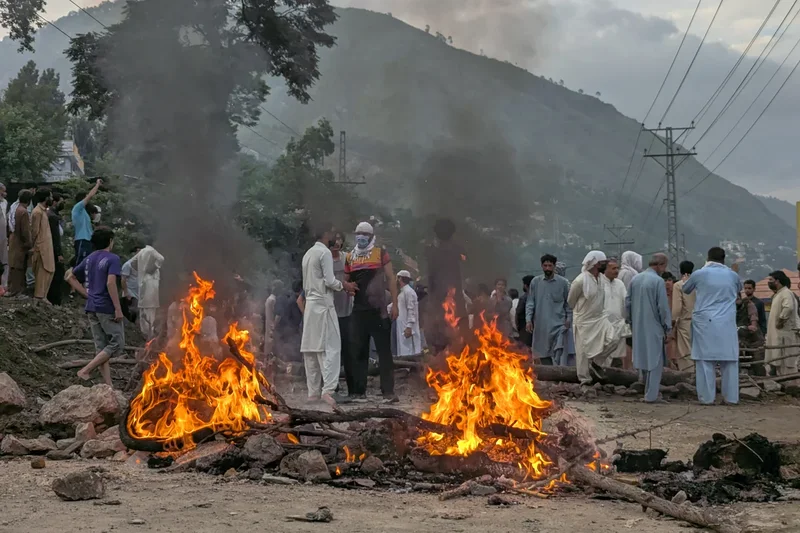
An election in Pakistan-administered Kashmir has resulted in deadly violence, an internet blackout, and allegations of a heavy-handed state crackdown, leaving the disputed Himalayan territory facing its most serious internal political crisis in years.
Voting in the semi-autonomous region has been split into three phases after weeks of unrest that claimed dozens of lives, with competing estimates of the death toll and sharply conflicting accounts from protesters and the authorities.
While officials insist security forces have acted only in response to attacks, rights groups and protesters accuse the state of using excessive force to suppress a growing movement demanding political reform.
The unrest centres around the Jammu Kashmir Joint Awami Action Committee (JAAC), a coalition that began as a grassroots campaign against rising electricity prices and the cost of living before expanding into a broader challenge to the region's constitutional and political structure.
The movement is boycotting the elections, arguing that the current system does not fairly represent residents of Pakistan-administered Kashmir.
Its supporters want the abolition of 12 seats in the regional Legislative Assembly that are reserved for refugees from Indian-administered Kashmir living elsewhere in Pakistan.
They argue that the arrangement enables Pakistan's mainstream political parties to influence governments in Muzaffarabad through legislators elected by people who do not reside in the territory. Muzaffarabad is the capital and largest city of the Pakistani-administered territory.
The Pakistani government rejects those demands, saying the reserved seats are constitutionally protected and essential to maintaining Pakistan's longstanding position that the whole of the former princely state of Jammu and Kashmir remains disputed.
The dispute has steadily escalated since early June leading to the change in voting dates.
The polls in the 45-seat Legislative Assembly, originally scheduled on one day, have been split across three dates - 27 July, 2 August, and 10 August.
Authorities banned the JAAC under anti-terrorism laws, arrested several of its leaders, and launched a security operation after the group announced a march towards Muzaffarabad. Protesters insist the movement is peaceful and deny allegations that it receives backing from India or has engaged in organised violence.
The latest round of clashes erupted as polling began in late June, prompting security to be strengthened across the territory and leading election officials to stagger voting across three phases because of concerns over maintaining order.
Official casualty figures remain unclear due to internet blackout and security restrictions.
According to Amnesty International, at least 40 people have been killed, including 34 civilians and six security personnel.
Government officials have confirmed multiple deaths among protesters and members of the security forces during recent confrontations.
According to protesters, many of those who were wounded avoided government hospitals because they feared arrest or further violence.
The Pakistan-administered Kashmir government disputes those allegations, saying security forces did not fire indiscriminately on peaceful demonstrators and acted only against individuals who attacked law enforcement officers, endangered public safety or obstructed lawful authority.
The authorities have repeatedly accused the JAAC of using violence to disrupt the elections. Police have also displayed firearms allegedly seized from JAAC supporters and say several security personnel have been killed during the unrest.
The JAAC has strongly denied the accusations that it is an armed organisation or that it is attempting to derail the electoral process.
Umar Nazir, a member of the group's core committee, acknowledged that security personnel had died during the unrest but questioned the official account of how the violence unfolded.
"Look, perhaps such deaths did occur – I will not comment on that," he said.
"However, I believe that certain elements, who are under their control, were infiltrated into our ranks. Such people were certainly present among us,” he told the BBC.
"I believe they may have carried out such actions themselves in order to justify their own narrative. I am not making a definitive claim, but there is no evidence whatsoever that any such violence came from our side." Mr Nazir did not provide evidence to support those allegations.
The authorities, meanwhile, have accused the JAAC of spreading disinformation, particularly through social media, and insist that officers have come under armed attack during the demonstrations.
The conflicting narratives have proved difficult to verify independently.
Extended internet shutdowns across much of the territory have hampered reporting, while roadblocks, checkpoints and restrictions on movement have limited access to several protest hotspots.
Rights groups criticised the communications blackout, arguing that it has made independent verification of events increasingly difficult and restricted public access to information.
Amnesty International has urged Pakistan to restore internet and mobile services and called for an independent investigation into allegations that security forces used unlawful force against protesters.
It also demanded independent investigation into the violence by the security personnel.
The communications restrictions have also disrupted daily life.
Residents and businesses have struggled to operate without internet access, while election candidates complained they were unable to communicate with voters during campaigning.
Independent candidate Malik Alauddin told AFP said the blackout forced him to abandon online outreach and instead rely on traditional campaigning across remote mountain villages.
"The internet shutdown has created serious difficulties … for political candidates and the electoral process itself. Reaching voters has become much harder," he said.
"This is a vast mountainous constituency. If the internet were available, a single social media post could reach thousands of voters, but now we have to travel to every small village."
“Local businesses are suffering due to the unrest,” said Muhammad Akbar, who manages a riverside waterfall attraction, told the *New York Times. *