In a bunch of ways, there is no real percentage in remembering what things were actually like during the worst years of the COVID-19 pandemic. Beyond all the uncertainty and suffering and death, there is just not a lot to hang your hat on. It was, in the manner of every single thing befouled by Donald Trump's sticky palm prints, very manifestly going to be made worse and more damaging for all that nasty attention, and was in fact made much worse and more damaging for it. From one moment to the next, it was brutally or just banally bad, the latest and worst in a long line of collective national traumas that was fractured, in classic American fashion, into a wilderness of atomized and alienated and terribly isolated instances of individuated suffering.
It was also, in every moment, just so obviously and crushingly a colossal and humiliating waste. There is, for those who have made it to the other side of it, the blank satisfaction of having done so, and memories of some hopeful and uncertain eruptions of solidarity during it and the tentative return to everyday life in the long and unfinished after. But for those who remember what it was actually like and how it actually went, about all you've got is that alongside a great deal of sadness over the lives lost and the brighter possibilities that have gone so determinedly unrealized in their wake. You don't need me to tell you that it sucked, and that the damage it has done to our culture and politics is grievous and ongoing. It is in every way the sort of experience you would be anxious to see shrinking away in the rearview mirror, and then ideally not see at all.
There is a less mournful and more active way to think and feel and be about all this, as it happens. It is demeaning, stupid, and wrong, but also impressively modular. Where actually remembering what this particular bit of extremely recent history is an endlessly revolving locked groove of recrimination and grief, the Choose Your Own Adventure approach favored by a large and growing segment of the American populace—and the current leadership of the federal government's public health agencies, and virtually all national Republican elected officials, and an exhaustingly heterodox tranche of media types—is positively sprawling. What this approach lacks in coherence it more than makes up for in options. In place of what actually happened can be more or less whatever you want, or just want to be upset about. The familiar and dispiriting and already plenty infuriating herky-jerk realities of public health policy conceived and executed under pressure is replaced not with one singular sprawling conspiracy but an endless algorithmic scroll of Intriguing Questions.
There are no satisfying answers in this, of course, but also answers are not the idea, here. This strange and vibrant misinformation economy exists not counter to some establishment narrative but parallel to it, and its relationship to the reality of the pandemic as it actually happened is similarly abstracted. That story is knowable and known, but it is finally and fundamentally the story of a terrible loss, and of a thing that happened to all of us more or less together; the people held up as its heroes when it was happening were heroic precisely because of how vulnerable they made themselves, and because of the sacrifices inherent in that choice.
The social movement that arose from this moment reflected that, too, in its insistence that, contra all the institutional brutality and neglect and incapacity, the most vulnerable and least valued lives mattered as much as every other. That, it seems to me, was the hardest lesson to learn, and ultimately the one that the culture resisted most strongly and ultimately rejected most vigorously—that how you looked or what you believed or how much stuff you had really didn't have much bearing on whether you got sick or not, and that medicines worked the same on every human body.
It is probably a little reductive but also not substantively wrong to say that the long and ongoing counter-story of the COVID pandemic is grounded in the refusal to acknowledge that fact. More than a million Americans died during the pandemic, a number so staggering that it is difficult and maybe impossible to fully comprehend, but also large enough that someone in your life was very likely among that number. The counterstory does not necessarily deny this, but it can't really acknowledge it, either; the fractal millions of incoherent and inconclusive personal counter-narratives are all the same in their shared inability to acknowledge that any disease that didn't kill the person with those beliefs, each one the heroic protagonist of reality, couldn't really have been as bad as They said it was.
How could it be, if the main character was left alive at the end? That unsatisfying answer is replaced not with any more satisfying one but with a metastasis of questions; scientific inquiry yields to the giddy circularity of Doing Your Own Research. The story reorients itself, moving its protagonist out from under the annihilating bootheel of history alongside everyone else and lifting them back up where they belong—at the center of a thrilling investigation into how all this could have happened to them, and leading the search for who did it.
In the lowest moments of COVID as I experienced it, with the sirens beating up the streets of my city all day long and the people I love most sick and scared and exposed to something that no one understood or could control, I harbored some hope that it might ultimately add up to something. Maybe not a realization that we are all the same or whatever, or even that there was a shared responsibility incumbent in our shared vulnerability. Trump's presidency wouldn't and Biden's presidency couldn't argue for a response grounded in simple neighborliness, let alone one that spoke to any broader purpose.
The movement that sprang up in that empty space was much smaller in the moment—I could describe many of the dozen or so activists in my (very big) city who protested first the public health measures designed to mitigate the spread of the disease and then against the vaccines that would ultimately neutralize it—but clearly built to last. If their actions were in some sense pro-COVID, they were more precisely opposed to acknowledging its dominion, or its reality; the questions were asked, and asked, and asked as a way of refusing an unsatisfying answer. Their argument would outlast the disease because it was so much more about continuing to have that argument than it was about anything else. And as the urgency of the moment passed into a dull ache, all those signifying refusals continued. In the damp and fervid spaces where men debate What's Now based mostly on motion, heat, and noise, this has had about the effect you'd expect.
This was always going to become more and more abstract over time, as the ostensible subject receded into the past and the endless argument grew to supplant it in the present. All those Intriguing Questions would, first in lieu of satisfactory answers and ultimately in defiance of the very idea of such a thing, be asked over and over again. When Anthony Fauci, the head of the National Institute of Allergy and Infectious Diseases during the Trump and Biden administrations' response to COVID, testified in front of Congress last week, the unworkability of it all was manifest. Senators blustered and chastised and talked about imprisoning Fauci for the high crimes he committed in office; he refused to answer any of their not-quite-questions, invoking his rights under the Fifth Amendment. They couldn't quite say what those crimes might have been, both because there is now and never has been any convincing evidence that COVID originated in a Chinese laboratory, or represented some sort of sinister social engineering gambit, or that the vaccines that ultimately brought it to heel were unsafe; Fauci sat there and took it. Senators read his diary into the record, but nothing of any real substance was exposed, let alone learned; the meeting very much could have been an email.
The story of the pandemic, in most every meaningful sense, is over. But its queasy afterlife, which has always been much more about questions than answers, is undeniably robust. Even the more high-minded after-action questions that high-minded commentators subbed in for the ones that Fauci was asked—"why, for example, wasn’t there an all-government effort to get schools reopened sooner and more consistently?" Amy Sorkin Davidson wondered in The New Yorker, which if nothing else sounds better than Sen. Ron Johnson asking "dd you literally lie to your own diary?"—have more or less been answered as well, albeit in dispiriting and familiar ways.
The less high-minded questions, such as the ones that Kansas Sen. Roger Marshall asked on Fox News—"Who didn't have a friend who took this vaccine and had some time of complication?" Marshall said, "A stroke, a blood clot, a young man getting some type of heart inflammation"—are effectively rhetorical, because they are grounded less in observable reality than years of half-noticed posts and half-remembered headlines, and built on the wobbly and fragrant fill of all those years of Questions. It is not that even these extremely powerful people don't or can't know what happened. It's that they have chosen this instead.
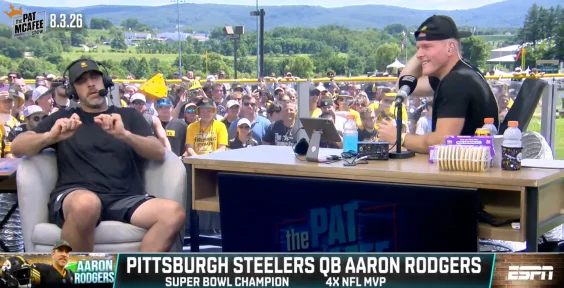
It is maybe unfair to judge a movement by its single most unappealing proponent, but if Aaron Rodgers's ultra-nasty appearance on Pat McAfee's ESPN show earlier this week demonstrated anything beyond what an apocalyptically miserable hang Rodgers himself is, it is that this sour and catechistic Asking Of Questions has become a sort of answer in itself. It's an answer that has, according to various members of the radio host community, earned him the same apology Stephen A. Smith now believes he owes to Kyrie Irving.
In the interview, Rodgers slouches and grouses and hisses a bunch of questions at McAfee about all the things that ESPN should have been talking about, but was too cowardly to do. As has long been the case with Rodgers, there is a sort of elemental bad breath to it all, and the sense of walking into a room that has been locked for many years. What is ultimately most striking about it, as Rodgers toggles back and forth through his various gripes, is how imprecise it all is. He won't or maybe can't say what he's mad about, and doesn't bother asking for answers. He just asks and asks, in escalating tones of impatience, why no one is asking the questions.