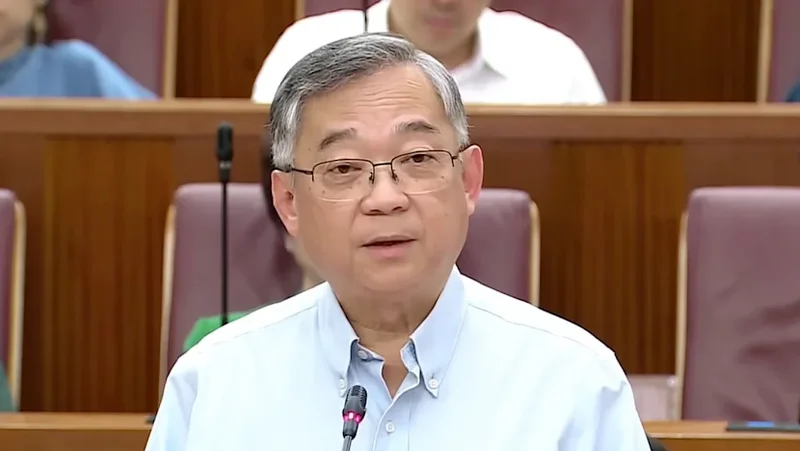
Singapore to weigh wider trade-offs before seeking lower US tariffs: Gan Kim Yong
Around one-third of Singapore's domestic exports to the United States, valued at S$9.5 billion annually, are affected under the new 12.5 per cent tariff imposed by Washington.
SINGAPORE: Singapore is taking a cautious approach to any concessions that could secure lower tariffs from the United States, with Deputy Prime Minister Gan Kim Yong saying that the government must first assess the significant costs and wider trade implications of measures sought by Washington.
In a written reply to questions from members of parliament on whether Singapore could negotiate a lower tariff, Mr Gan, who is also the Minister for Trade and Industry (Trade), said that Singapore would continue engaging the US Trade Representative (USTR), but he stressed that any response must be "considered carefully".
The US imposed tariffs of between 10 per cent and 12.5 per cent on 60 economies covered by its forced labour investigation.
Singapore was hit with the highest rate because it does not have a law prohibiting imports produced with forced labour or have an Agreement of Reciprocal Trade with the US committing it to introduce one.
MP Yip Hong Weng (PAP-Yio Chu Kang) had asked Mr Gan about the impact of the tariff, and whether the government would introduce more measures to help affected exporters.
Mr Gan said that about one-third of Singapore's domestic exports to the US, worth around S$9.5 billion (US$7.4 billion) yearly, are affected by the new tariff. These include optical instruments and chemical products.
However, the tariff does not apply to energy and energy products, certain electronics and aerospace products.
Products already subject to separate US tariffs or investigations, such as pharmaceuticals and semiconductors, are also excluded.
Compared to an earlier US 10 per cent tariff, which expired last month, the new measure raises Singapore's overall effective tariff rate by an estimated 0.7 percentage point, he added.
"Throughout the investigation, Singapore engaged the USTR actively at both the political and official levels, including during my visit to Washington DC in April this year," Mr Gan said.
"We made clear that there is no evidence that Singapore is involved in the trade of goods associated with forced labour," he added, citing data from the US Department of Labour and Customs and Border Protection.
"We emphasised that our policies do not burden US commerce, as reflected in the longstanding and substantial trade surplus the US continues to enjoy with Singapore."
The USTR website stated that the US goods trade surplus with Singapore was US$3.6 billion in 2025. It did not state the country's services trade balance with Singapore for that year, but said it amounted to a US$25.1 billion surplus in 2024.
Mr Gan said that the government will continue to engage the USTR constructively, but it also has to consider carefully what steps, if any, Singapore should take in response.
As a major trading hub, with goods and services trade amounting to around S$2.5 trillion yearly – including S$1.4 trillion in goods – any import prohibition Singapore imposes would have significant implications, Mr Gan cautioned.
"Businesses could face substantial compliance costs arising from supply-chain due diligence, documentation and investigations, particularly where production takes place outside Singapore and beyond our jurisdiction," he said.
"Such measures could also affect our broader trade relationship with other partners."
Mr Gan also said that Singapore would need to assess carefully what an Agreement of Reciprocal Trade with the US might entail.
Based on the agreements that the US has concluded with other economies, such arrangements may involve commitments beyond an import prohibition, including export controls or restrictions relating to other countries, he added.
"These wider implications have to be assessed carefully before Singapore decides on any course of action.
"Our immediate priority is to help businesses and workers adjust."
EFFORTS TO HELP BUSINESSES AND WORKERS
Mr Gan said that the government has been engaging the business community to understand their concerns better and help employers and workers adjust to the new tariff.
It will continue discussions through the Singapore Economic Resilience Taskforce (SERT).
"As the Singapore Business Federation noted in its recent statement, any new regulatory requirements should be carefully studied in consultation with industry," he said.
The task force is also working with tripartite and industry partners to support businesses and workers affected by the new tariff.
He highlighted several measures already in place to help companies adapt. These include the Business Adaptation Grant, launched in October 2025, to help eligible enterprises strengthen their operations and supply chain resilience.
At this year's Budget, the government announced several enhancements to existing initiatives, including raising the maximum grant support levels from 50 per cent to 70 per cent for internationalisation-related schemes such as the Market Readiness Assistance grant.
To help businesses cope with higher costs and uncertainty, it recently introduced a one-off cash grant of S$500 for every Singapore employee in small- and medium-sized enterprises, capped at S$2,500 for each company.
For workers, the government and the Employment and Employability Institute (e2i) have expanded career services.
"The Ministry of Manpower has also launched the Graduate Industry Traineeship programme to help fresh graduates gain industry-relevant experience and transition into full-time employment," Mr Gan added.
"We will continue working closely with businesses and workers, and provide targeted support where necessary.
"Above all, we will continue to strengthen Singapore's competitiveness and keep our economy resilient in an increasingly uncertain global trading environment."