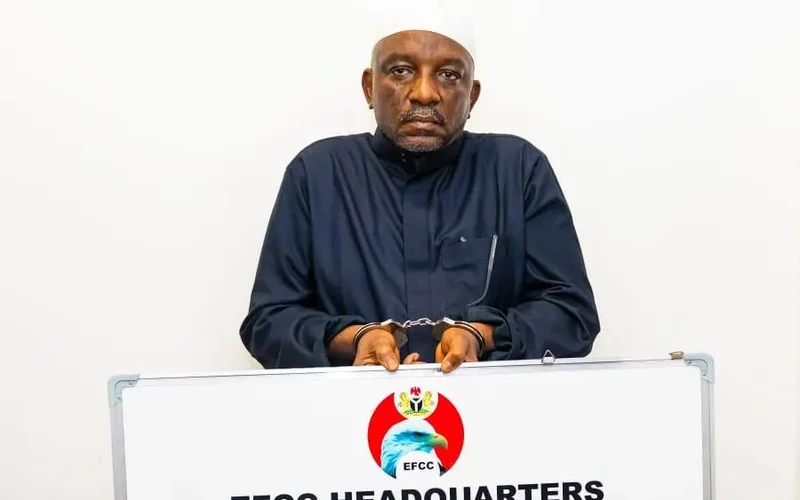
When the Economic and Financial Crimes Commission (EFCC) announced the re-arrest of the fleeing former Minister of Power Saleh Mamman in May, the news of capturing him after days of searching became less interesting than his picture accompanying the update.
Looking sad, the former minister was pictured in handcuffs while his withered hands clamped a booking board. It was a rare sight that sketched his journey to jail.
On 7 May, the Federal High Court in Abuja convicted former Minister of Power, Saleh Mamman, of money laundering involving a whopping N33.8 billion meant for Nigeria’s electricity projects.
LETwelve days later, on 19 May, the court sentenced him to prison on each of the 12 charges brought against him by the EFCC.
| | |
|---|
He received seven years’ imprisonment for each of 10 counts, two years for one count and three years for another count. The sentences for all 12 counts, which the court ordered to run consecutively, summed up to 75 years in jail for the 68-year-old man.
His case has brought renewed attention to how corruption has derailed electricity reform promises under successive administrations, deepening Nigeria’s long-running power crisis. Nigerians continue to suffer acute power shortages despite huge public spending on the power sector over the years.
At the heart of Mr Mamman’s trial was the theft of funds meant for Mambilla and Zungeru hydropower schemes, conceived to contribute altogether nearly 4,000 megawatts to Nigeria’s electricity grid.
The construction of the Zungeru Hydroelectric Power Station, a 700 megawatt plant in Niger State, began in 2013 and is near completion. The $5.8 billion, 3,050 MW Mambilla Hydropower Project in Taraba State has remained stalled since it was conceived in the 1970s.
The EFCC preferred 12 money laundering charges against Mr Mamman under the Money Laundering (Prohibition) Act, 2011, accusing him of diverting billions of naira released for the Mambilla and Zungeru Hydroelectric Power Plant projects.
It charged him with diverting the funds in breach of public trust and splurging them on personal luxurious expenses, property acquisition in choice areas of Abuja.
The first count alleged that Mr Mamman conspired with some officials of the ministry of power and private companies to convert over N33.8 billion from the funds released for the power projects in 2019.
Counts 2 to 8 revolve around the trail of the stolen money and how Mr Mamman lavished part of the stolen wealth on luxury and property acquisition in choice areas of Abuja.
In the third category of offences spread across Counts 9 to 12, the prosecution accused him of diverting millions of naira from the power project funds in criminal breach of trust at various times between January 2020 and December 2022.
The EFCC arraigned him in July 2024 on the 12 counts of money laundering. He denied the allegations.
On 12 July 2024, the court granted him N10 billion bail with two sureties.
During the trial, the EFCC called 17 witnesses and tendered about 43 exhibits through the lead prosecution lawyer, Rotimi Oyedepo, a Senior Advocate of Nigeria (SAN) who is the Director of Public Prosecutions for the Federation (DPPF). But Mr Mamman presented no defence witness to rebut the prosecution’s case.
PREMIUM TIMES has reviewed newly obtained filings, which the court examined to come to its judgement.
Together with previous reporting, the filings offer clearer understanding of the scope of Mr Mamman’s lavish spending on luxury and real estate at the expense of Nigeria’s critical power projects. This review highlights EFCC’s key revelations about the corrupt use of public funds and how Mr Mamman’s conviction struck a historic note.
N200 million Abuja property purchased with dollar cash
The prosecution presented in several charges a trail of money stolen from the power projects funds and how it ended up as payment for a N200 million property for Mr Mamman.
The prosecution accused Mr Mamman of conspiring with one Samson Bitrus, procuring him, and aiding him to make the payment in cash without passing through a financial institution.
Then, another count alleged that Mr Bitrus paid for the property with $655,700 in cash to Mohiba Investment Limited to acquire the N200 million worth of property of Mr Mamman.
As of when the parties closed the real estate deal in 2019, the prosecution said, the $655,700 paid was equivalent to N200 million, the agreed price of the property at No. 12 A & B, Lungi Street, Off Cairo Street, Wuse II, Abuja.
Mohammed Asheik Jidda, who represented the seller, Mohiba Investment Limited, in the transactions, appeared during Mr Mamman’s trial as the 14th prosecution witness.
Mr Jidda confirmed the cash transaction, which the EFCC alleged violated the provisions of the Money Laundering (Prohibition) Act, 2011, and the Foreign Exchange (Monitoring and Miscellaneous Provisions) Act prohibiting individuals from making cash payments above N5 million outside a financial institution.
The testimony of the 12th prosecution witness, Samson Bitrus, who is a real estate agent, shed light on the transactions.
Narrating his role in the deal, Mr Bitrus told the court that Mr Mamman, whom he said he knew through a business associate, Mustapha Dandaura, instructed him to search for a property. He said he found the property on Lungi Street and linked the former minister to the owner.
According to his account, after negotiations were concluded, he accompanied Mr Mamman to the office of the seller, where the dollar equivalent of the N200 million was physically counted. Mr Mamman and others involved witnessed the counting and that the title documents were subsequently handed to “Saleh Mamman and his friend Mohammed Hussein.”.
Mr Bitrus also said he later managed the property and that rent was paid into an account provided by the ex-minister belonging to Nasiru Mamman,.Prosecutors presented the receipt as evidence of continued financial benefit after the transaction.
The 13th prosecution witness, a Zenith Bank compliance officer, tendered account records of accounts that received rent proceeds from the property. According to the prosecution, the records showed inflows connected to the Lungi Street property and subsequent transfers to accounts associated with Mr Mamman and his relatives.
The property owner, Mohammed Asheik Jidda, also testified as the 14th prosecution witness, confirming that Mr Mammant visited his office and negotiated price. He said the then-minister paid for the property in dollar cash without routing the funds through a financial institution despite having bank accounts.
“I sold my property to the minister,” Mr Jidda told the court. The EFCC described his testimony as “independent corroboration” that strengthened the property transaction narrative.
How Mamman laundered power sector’s funds
Counts 6 to 12 accused Mr Mamman of criminal breach of trust by allegedly diverting billions of naira in Mambilla and Zungeru hydropower projects funds through a money laundering scheme.
The prosecution said Mr Mamman converted the diverted funds into personal use.
The counts were brought under Section 15(2)(d) of the Money Laundering (Prohibition) Act, 2011, which criminalises the indirect use or possession of proceeds reasonably suspected to be derived from unlawful activity.
Prosecutors proved that Mr Mamman diverted the funds to identifiable financial endpoints, including real estate, accommodation and proxy-driven transactions between 2019 and 2022.
This means that while Mr Buhari removed Mr Mamman from office on 1 September 2021, the former minister continued using stolen funds.
The first prosecution witness, Abubakar Kweido, an EFCC investigator, told the court that funds released for the Mambilla and Zungeru projects were diverted from Federal Ministry of Power accounts at the Central Bank of Nigeria (CBN) into bank accounts of several Bureau de Change (BDC) operators who had no known contracts with the ministry.
He listed the entities allegedly used as conduits to include Prymint Investment, Strongfield International Project Limited, Mintedge Nigeria Limited, First Class Construction and Project, Silverline Ocean Ventures, and Golden Bond Nigeria Limited.
Others are Sipikin Global Enterprise, Spinhills Business International Limited, Fullest Utility Concept Limited, Breathable Investment Limited and Gurupche Business Enterprise.
Prosecutors said all the entities were owned and maintained by Suleiman Abdullahi, who appeared in court as the ninth prosecution witness.
In his testimony, Mr Abdullahi confirmed he had business dealings with Mr Mamman through one Mr Mustapha, who worked at the Ministry of Power at the time.
Connecting the dots, Mr Kweido said his team’s investigations showed that the funds stolen from the ministry were converted into cash through the companies.
He said some of the funds were used for paying for Mr Mamman’s accommodation at Sammy Court Resort.
He also tendered a letter from the Accountant General’s Office showing that BDC companies received funds from the ministry even though they “were neither contractors nor rendered any services” on the Mambilla and Zungeru projects.
Throwing more light on the content of the letter, the second prosecution witness, Abdulkarim Ozi Ibrahim, who is an official of the Office of the Accountant-General of the Federation under the Federal Project Financial Management Department (FPFMD), confirmed that the funds passed through official government financial systems and that many of the beneficiary companies were not legitimate contractors.
Mr Ibrahim told the court that the EFCC requested account statements covering “all transactions that are taking place in Mambila, Zungeru, from inception to date,” which investigators later used to trace the alleged diversion.
EFCC said the records showed that the “defendant, along with an official of the Accountant General’s Office posted to the Ministry of Power, surreptitiously transferred cumulative N33.8 billion to Mr Abdullahi, the ninth prosecution witness’ companies and Maina Gojie, who also took the stand as the 11th prosecution witness.
Prosecutors said the payments were processed “as though they were meant for settlement of work done” on the projects, but. in reality, were converted into United States dollars and transferred to individuals through intermediary companies.
In Count 6, the prosecution alleged that Mr Mamman illegitimately acquired Houses 93A and B, Ahmed Joda Crescent, Kado, Abuja, between 21 August 2019 and 1 September 2021, using proceeds from the diverted hydropower project funds.
More luxury, real estate acquisition
The prosecution said the money did not go into just real estate but also luxury.
Counts 7 to 9 captured the sum of N47 million Mr Mamman spent from the hydroelectric power project fund for accommodation at Sammy Court Resort, Abuja, between 2019 and January 2022.
In November 2024, retired colonel and the resort owner Adebisi Adesanya, testified as the third prosecution witness that Mr Mamman spent N20 million from funds earmarked for the Mambilla project on long-stay lodging at the resort, which he described as a service apartment where people “stay for a long time.”
Prosecutors also alleged in Counts 10 to 12 that the minister’s personal assistant, Misbahu Idris, incurred a total cost of N777.3 million charged to the stolen hydropower projects funds between January 2020 and December 2022.
During cross-examination, defence lawyers attempted to distance Mr Mamman from direct control of the ministry’s funds, arguing that he neither authorised nor directly controlled the movement of money from ministry’s accounts.
After EFCC closed its case, the defence, led by Femi Atteh, did not call any witness.
Rather, they challenged the fairness of the hearing, the validity of the amended charge and whether the prosecution proved its case.
Conviction and arrest
After reviewing the evidence in his judgement delivered on 7 May, the judge, Mr Omotosho, convicted Mr Mamman, finding him guilty of all 12 counts.
The former minister, who had been attending proceedings from home since he was granted bail, was absent from court when the judge gave the judgement. The judge held that his absence did not stop the court from delivering its decision, since the trial had been concluded.
Mr Omotosho said the prosecution established with credible evidence that the defendant and his associates stole at least N22 billion.
He affirmed the prosecution’s finding that Mr Mamman used proxy companies and associates to move funds and benefit from public resources meant for critical national infrastructure.
He ordered the ex-minister’s arrest and that he be brought to court for sentencing.
However, as of 13 May set for the judgement, Mr Mamman was nowhere to be found. The judge proceeded to sentence him that day, nevertheless.
The court sentenced the former minister to 75 years’ imprisonment.
The jail time summed up to the record 75 years because the judge ordered the sentences for each of the 12 counts to run consecutively and not concurrently as usually ordered in other cases.
Mr Omotosho directed security agencies, inside and outside Nigeria, to arrest Mr Mamman wherever he was found and hand him over to the Nigerian Correctional Service.
Mr Mamman did not surrender after the judgement. But on 19 May, EFCC operatives arrested him in the Rigasa area in Kaduna after what the commission described as an intelligence-led operation.
Meanwhile, Mr Mamman is also standing trial at the FCT High Court in Maitama, Abuja, for separate N31 billion fraud charges.
On 16 October 2025, EFCC arraigned him alongside seven others on nine counts. The judge, Maryann Anineh, granted him bail. But revoked after his repeated absence. This prompted the judge to order his arrest. Having been arrested by the EFCC and with e is expected to face that trial from prison.
Mamman’s historic prison sentence
A PREMIUM TIMES’ review shows that Mr Mamman’s 75-year jail time starkly stands out as the severest retributions any politically exposed persons has ever received upon conviction for official corruption under Nigeria’s democratic dispensations.
What makes the difference is the order of the judge for Mr Mamman’s sentences for each count to run consecutively.
This means the sentence for each count will run to the end before the next begins.
Barring no change on appeal, the convict will end up spending in jail the cumulative of the years the judge attached to each of the counts he was convicted of.
The reverse is the case when sentences are ordered to run concurrently. This allows all sentences for all counts to run simultaneously. In that case, the convict will stay in prison only for the longest jail time.
This is why Mr Mamman’s sentence stands out. None of the punishments former public officers had received, as stunning as they were in their time, came close.
Former Plateau State Governor Joshua Dariye received a 14-year prison sentence for diverting ecological funds. The Supreme Court later reduced the sentence to 10 years.
Former Taraba State Governor Jolly Nyame was sentenced to 14 years’ imprisonment for diverting about N1.64 billion belonging to his state. The Court of Appeal reduced the sentence to 12 years, a decision later upheld by the Supreme Court.
Both Mr Dariye and Mr Nyame received presidential pardon in 2018 when they had yet to serve half the length of their jail terms.
Former Abia State Governor Orji Uzor Kalu received a 12-year prison sentence in 2019 for diverting N7.1 billion from the state’s treasury, but the Supreme Court later nullified the conviction.
Former chairperson of the Pension Reform Task Team Abdulrasheed Maina was sentenced to eight years’ imprisonment for N2 billion money laundering in November 2021.
In February this year, the FCT High Court in Abuja convicted former Managing Director of the Nigerian Export-Import Bank (NEXIM), Robert Orya, in a N2.4 billion fraud case.
The court sentenced Mr Orya to 10 years imprisonment on each of 49 counts. But the sentences were ordered to run concurrently.
Also in March, the Federal High Court in Abuja jailed a former Acting Accountant-General of the Federation Chukwunyere Nwabuoku for eight years for N868.4 million.
“I believe it’s one of the stiffest in history,” a lawyer, Sherif Aduke, said, noting that the jail time will extend far beyond the expected lifespan of most defendants. Mr Mamman is already 68.
He added, “If you are 60 years old and you are given 75 years’ imprisonment, how much longer are you going to live?”
Mr Aduke also said the court appeared to attach significance to the importance of the power sector and the scale of the funds involved.
Auwal Musa, the executive director of Civil Society Legislative Advocacy Centre (CISLAC) – a non-profit organisation which also serves as the Nigerian chapter of Transparency International, recognised the sentence as one of the stiffest punishments imposed on a public official in Nigeria, saying and it could help deter public looting.
However, Mr Musa, also known as Rafsanjani, said the judgement should go beyond imprisonment to full recovery of stolen funds.
“It is not about how many years in prison,” he said. “It is about stopping them from benefiting from the loot.”
He said authorities must ensure that all funds linked to the fraud are recovered and that everyone associated with the alleged diversion of public money is brought to justice.
Also reacting, Tunde Salman, convener of Good Governance Team Nigeria, said the sentence has been widely received as evidence that the Nigerian state is becoming more serious about anti corruption enforcement.
“For a long time, Nigeria’s anti corruption efforts have been criticised because judicial processes often end without strong punitive convictions,” he said.
Mr Salman said the judgement sends a strong message to politically exposed persons and public officials accused of corruption.
“People want to see serious sentencing that will serve as deterrence,” he said. “Not necessarily the length, but something strong enough to discourage others.”