Royal Alberta Museum returns artifacts dating back thousands of years to Fort McKay First Nation
From stone knives to tin cans, museum returns relics showing how Indigenous people have lived off the land
The Royal Alberta Museum (RAM) is returning more than 17,000 artifacts collected north of Fort McMurray, Alta., to the Fort McKay First Nation.
The collection includes arrowheads, tools, bones and other cultural items, some of which are up to 11,000 years old.
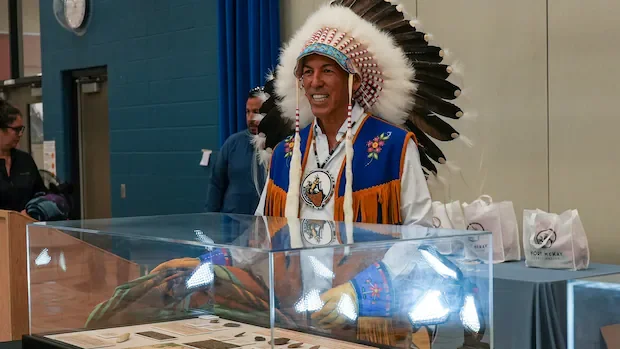
At a ceremony held last week, drumming and singing filled the air at Elsie Fabian School, a K-6 school run by the First Nation, where the first of 77 artifacts were unveiled.
Chief Raymond Powder called the collection a timeline of how his ancestors have lived off the land for thousands of years.
“It’s not only a connection, but it’s also an opportunity to share with the younger generations to come on who we are, how we have lived and how we have roamed around here and harvested, how we’ve had a relationship with the land,” he told CBC News.
“Those artifacts were taken from our ancestral lands, and to bring them back home, it was a really great feeling.”
The artifacts come from an area near Moose Lake, which is located northwest of the First Nation and is considered culturally and historically significant.
Kurtis Blaikie, an archaeologist contracted by the First Nation to be its liaison to the RAM, said some people might find it strange that some of the items being returned, such as spent ammunition casings or an empty can of lard, were not seen as trash.
But he said those items are just as important as centuries-old arrowheads that physically prove how long people have hunted and harvested the land.
“The more research we do, the more people 10,000 years ago look a lot like the people a couple hundred years ago,” Blaikie said in an interview with CBC News.
“Fort McKay First Nation and their ancestors have been using this land in much the same way for a really long time.”
Blaikie said the items were collected by a University of Alberta student between 1975 and 1977. The artifacts were sent to the university and then to the RAM in 1981.
The RAM is considered an archaeological repository by the province for any artifacts found in Alberta by professional archaeologists.
A few months ago, a student at the University of Saskatchewan reached out to the RAM and asked to see the items.
In a statement to CBC News, the RAM said archaeologists reviewing the items discovered they were collected on First Nation land.
“This means they do not fall under the Historical Resources Act, and are legally the property of the nation, not the province,” Meaghan Patterson, the RAM’s executive director, said in the statement.
The RAM’s leadership group contacted the Fort McKay First Nation’s leaders to begin arranging the items’ return.
“Working with First Nations communities to ensure proper cultural care and stewardship of their belongings is a priority for us at the Royal Alberta Museum,” said Patterson.
“We are working with [Fort McKay First Nation] to make arrangements for the return of the remaining artifacts.”
Powder said many people in his community had either forgotten about the collection or did not know about the items. He said he was grateful the museum contacted the community.
“I'm glad that we didn't have to go through this complicated and complex process,” he said. “It was really given freely to us back to our nation.”
Miranda Beaton, the First Nation’s educational director, told CBC News she is happy the artifacts will be shown publicly at a school in the community.
“Honestly, I got goosebumps because it’s just such a beautiful reminder of how long our ancestors have been here,” she said.
“To see them and to have them back and to really be able to showcase them to our region is very special to us.”