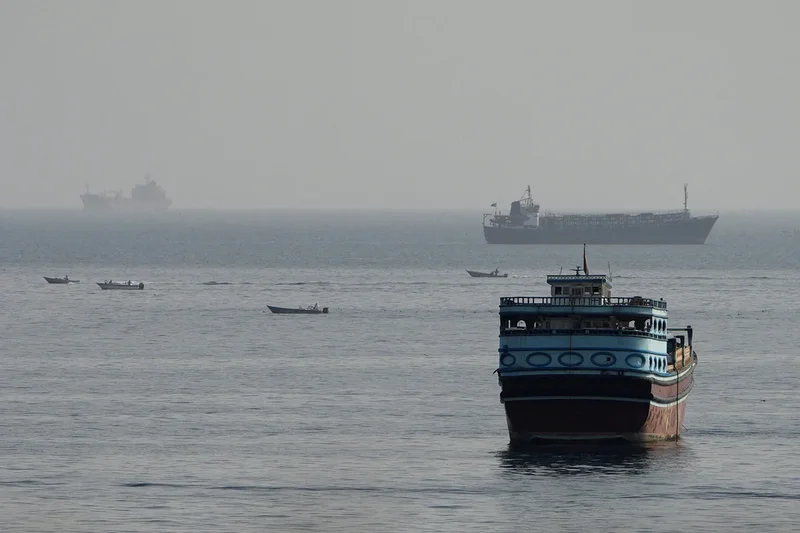
More than five months since Donald Trump and Israel launched their war on Iran, the US president is struggling to solve the biggest problem the conflict helped create: the militarisation of the Strait of Hormuz.
After a cycle of failed negotiations and military strikes, Washington and Tehran cannot agree on whether negotiations are taking place at all. All the while, continued attacks on ships in the waterway are deepening chaos in the global economy and increasing the price of energy.
"They are going on right now," said Trump on Monday, hours after Tehran said that no such talks were happening.
Instead, Iranian officials have said they are negotiating specifically with Oman over Hormuz. The extent of US involvement in these talks is unclear, but experts tell The Independent Trump is likely to seize the credit for any impending deal either way.
“Oman will not act alone and independently. Whilst they hold on the pen on this issue, they will be co-ordinating with other Gulf partners and the US,” said Dr Neil Quilliam, professor on the Middle East and North Africa programme at Chatham House.
The US, he says, may end up agreeing a settlement under which Iran is paid “service” fees which are disguised as environmental payments.
While Trump would likely claim credit for a deal and sell it as a success for Washington, it would ultimately be an embarrassment. The White House has repeatedly rejected Tehran’s demand that ships pay a toll to cross through the Strait.
Optimism in Washington
There are growing signs that Washington will claim responsibility for a deal to open the Strait, after senior members of the Trump administration suggested it was days away.
"There's been progress made in those talks [between Iran and Oman], but not finality yet. We're hoping that will happen very shortly," US secretary of state Rubio told reporters on Tuesday.
Treasury Secretary Scott Bessent also struck an optimistic tone, claiming a deal on reopening the Strait could be reached on Wednesday or Thursday.
“There is no trust between Iran and the US at present. Given that Iran and Oman are the two parties to managing Hormuz, it makes perfect sense for them to work through the issues,” says Dr Quilliam. “But Oman needs the backing of its regional partners and the US.”
Last week, Oman submitted a proposal to Iran envisaging regional management of the Strait and only voluntary fees for transit, rather than Tehran's vision of maintaining control of the waterway and charging for its use.
The proposal was for a joint regional mechanism to manage the strait with voluntary fees to help fund the cost of managing navigation, environmental protection, search and rescue and other services.
But a look at Tehran’s latest demands casts some doubt over the US optimism of an imminent - and lasting - deal.
Tehran’s demands hinder deal progress
During talks with Oman, Tehran has put forward a proposal that would give Iran full control over all inbound shipping, a senior Iranian official told Reuters.
Outbound shipping would follow a route between Iran and Oman, with exit clearance granted through Oman after notifying Iran.
Tehran is “unlikely to change its position” from this, the source told the news agency.
But experts suggest this another sign that Iran wants to create leverage in peace talks - and such a demand would be unacceptable to Washington.
“The US will not accept any post-war arrangement that would actually give Tehran more control over shipping in the region,” says professor Basil Germond, a professor of international security at Lancaster University and an expert in maritime affairs.
Iran’s negotiations with Oman are the regime’s latest attempt to build relationships with regional countries and drive a wedge between them and the US, according to Maziyar Ghiabi, the director for the Centre of Persian And Iranian Studies at the University of Exeter.
“By building a long-term friendship and collaboration with Oman, Iran and its diplomatic team is trying to show that security and economic order will be beneficial to countries that engage with them at the expense of Washington,” he said.
‘US may accept Iran’s demand for fees to transit Hormuz’
Washington could, experts believe, agree to a deal negotiated between Iran and Oman.
A deal which could be acceptable to the US would be one which results in paid “service” fees being paid to Iran, under the guise of “environmental fees”, Dr Quilliam says.
This would ultimately be a win for Iran, who for months have been demanding a toll for passage through the Strait of Hormuz. For the US, it could only be seen as a concession.
Trump’s central concern is getting Hormuz open again, Dr Quilliam says. “Even with ‘environmental service fees’ he will claim it is a victory, and add that he has destroyed Iran’s nuclear programme, its navy and its airforce and so on.
“He just needs the Gulf Arab states to sign up and live with the service fees. And given the alternative is a continuous war of attrition, this looks increasingly likely now,” he adds.
Prof Ghiabi says Trump, who has “attempted to play the role of kingmaker in diplomacy”, may see the ongoing negotiations as a way out from the quagmire in Iran.
“The US and much of the world need a steady flow of oil resources from that region, and we have reached the point where whatever arrangement guarantees that may be somehow reluctantly welcomed.”