Universities would prefer not to.
AI and the degree monopoly
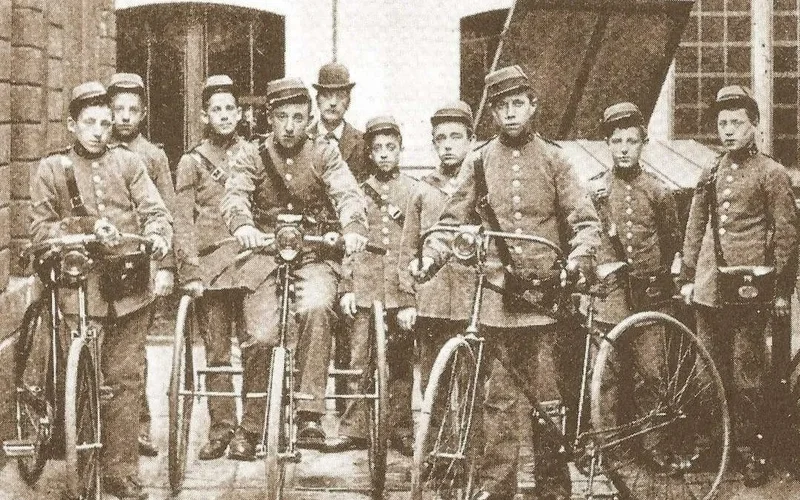
Four years after ChatGPT caught so many by surprise, the primary role of higher education seems to be slowing down the public’s transition to the AI era. For many faculty, this is a win. For those focused on the future, this is the biggest institutional failure since the Victorian Post Office, with its monopoly on telegraph lines, dismissed the telephone because it had plenty of messenger boys. Adoption was slowed so much there were waiting lists for a home phone line into the 1970s.1
Fortunately, the AI frontier race has skirted higher education almost entirely, so universities can’t slow the models. But higher ed is a monopoly too. Nobody else is granting college degrees. I look around and see that except for a few scattered faculty voices across the country (people I’ve shared platforms with this past year) higher education has decided it’s business as usual, squabbling about athletics and anthropology, worrying about federal takeover when the real risk is technological competition.
Some facts. More than 90 percent of notable AI models released in 2025 came from industry: GPT-5, Gemini 3, Claude Opus 4.5, Grok 4, Llama 4, DeepSeek-V3.2, Qwen 3, Kimi K2. The infrastructure supporting frontier development is also overwhelmingly from industry. Global AI compute capacity has been growing 3.3x annually since 2022, doubling every seven months, driven by hyperscalers and enormous data-center investments. Some universities are entering the compute space. Ten New York universities spent two years and $340 million to get to about 400 GPUs. In 2024, xAI in Memphis stood up 100,000 GPUs in 122 days. In the past two years a site in Abilene, Texas got to 500,000.2
Even in China, DeepSeek, Alibaba, ByteDance, Moonshot and the other model developers are working outside of universities. Chinese universities may be producing more research and talent than U.S. universities because their missions are aligned with national goals. China leads in AI publication volume, citations, and patent output, even though the United States still produces more notable models and higher-impact patents. A Hoover Institution analysis of the 356 researchers appearing on DeepSeek’s foundational papers found that 53.5 percent of those with known affiliations had spent their entire recorded careers at Chinese institutions. Of the DeepSeek researchers who spent part of their careers abroad, over 70 percent ended up back in China. Universities are clearly part of the way China created a domestic frontier-research workforce.
I’ve staked a public claim as an AI proponent in higher ed. As a literary scholar I see how LLMs are changing language in front of our eyes. As a former administrator I see how AI is going to change everything about the higher ed business model, from curriculum, pace of learning, research, teaching, assessment. The higher education news still focused on yesterday’s battles over speech and DEI is shocking. It seems the only people paying attention to the AI frontier are anxious faculty and CS students. I spoke to an AI-savvy provost friend the other night. The battles to keep the lights on amid federal funding changes for science are keeping her from making the institutional changes she wants. I get that.
Universities have no influence over the pace of AI frontier development. Obsessed as they are with curricular battles and viewpoint diversity they have no standing even to have a voice. It is unclear whether the handful of individual national voices on AI from inside universities, like Ethan Mollick at Penn, Tyler Cowen at GMU, Scott Latham at UMass Lowell, Mike Madison at Pitt have changed their own institutions. Penn is certainly leading most of its peers in launching degrees and conversations about AI across the curriculum. I’ve shared stages with Penn’s AI leaders from the Center for Technology, Innovation, and Competition and Paideia Program several times this past year, including a major AI conference in South Korea. So it is possible that individual voices inside of universities can make a difference.
Meanwhile, AI technology is changing fast. The new push for more open models will make universities even less important for new knowledge development. More firms are using open-source AI models: 63 percent of organizations run an open model in production, 72 percent inside technology companies, per a McKinsey survey of 700+ global technology leaders. Those numbers will only go up. Universities will likely offer their students and employees weaker models that are cheaper, customizable, locally deployable and independent. Employees will use the open-source model for compliance and university business but the forward-thinking graduate students, faculty, and staff will log onto their frontier models at home, after hours.
Academic AI publications will be less important. There will be fewer conference papers describing modest benchmark improvements, though important breakthroughs will matter, like Berkeley’s vLLM PagedAttention, Stanford’s FlashAttention (now a foundational technique for efficient transformer computation) and Berkeley’s LMSYS-created Chatbot Arena, a major open evaluation platform. So yes, computer science and engineering departments are supplying enabling technology, evaluation systems, and trained researchers. These are consequential projects. But overall, I don’t think most people in the higher ed world realize that computer science’s highest-value contribution has moved down the stack, in the parlance of the field.
It’s not like higher ed does not know how to be a professional preparation system. Where would most moneymaking American sports be without universities being incubators for pro football and basketball players? The NFL requires players to be three years out of high school. The NBA requires one. Universities begin scouting talent in high school. Billions of dollars are paid to tens of thousands of recruiters, coaches, strength coaches, scores of staff and advisor roles largely for the roughly 320 players drafted into the NFL and NBA each year.
Universities are not doing a fraction of that for workers on the AI frontier, whether they’re in history, geography, astrophysics, literature, or music. Yes, U.S. computer science departments, engineering schools, and labs are continuing to train the workforce that AI companies hire. The number of new AI PhDs in the United States and Canada rose 22 percent between 2022 and 2024. The growth went into academic employment. Industry’s share of new AI PhDs fell to 62.75 percent from a 77 percent peak in 2022, while academia’s rose to 31.59 percent, suggesting that universities have a substantial research reservoir even as corporate labs dominate model production. Without university research, yes, AI progress would slow.
But the AI frontier is not just computer science and philosophy. It’s the way people will access knowledge. Historians, linguists, biologists, artists, and every single person entering the real world of business, culture, and government need to understand the jagged edge of AI capabilities as much as computer scientists and mathematicians do. They need to understand the shrinking but still important distance between what AI can do and what it cannot. Everyone’s learning this the hard way now as the internet is breaking down, search is degrading, nobody can find things they used to, history is disappearing, and the two most reliable places to get an answer are the physical library and AI.
Meanwhile university leaders are scrambling to remain solvent by enrolling as many students as possible. Bringing students to the frontiers of knowledge is way down the priority list.
Colleges and universities are currently a brake on AI progress. As cultural institutions, responsible for forming the next generation of young people, the message is a lot of hand flapping about “needing to be workforce ready” and “don’t cheat” and “here are your required courses to graduate.” I’ve been focused for three years on the strangeness of higher ed’s preoccupation with “general education” and the sector’s commitment to staying the course while technology marches forward.
A 2026 Digital Education Council survey covering more than 45,000 students and faculty across 35 countries found the U.S. and Canada are lagging behind the rest of the world in institutional coherence about AI and faculty support for AI. Students are frustrated. Worldwide, only 29 percent believed their instructors were well equipped to guide them in AI use; in the U.S. and Canada, the figure was 17 percent.
Only 35 percent of students said even some of their assessments reflect the work, judgment, and skills they expect to need in an AI-enabled workplace; 37 percent said none or only a few do. In the U.S. and Canada, 48 percent said none or only a few. More students and faculty in the U.S. and Canada would support an institution-wide AI ban than any other region surveyed.
Higher education is failing at its economic, educational, and cultural function when it comes to AI. Students are already using AI, employers are redesigning jobs around AI, and universities are focused on enrollment and survival, preserving assessment and credential structures designed for a world that has disappeared. For individual students, faculty, and staff, AI use is voluntary and unled. Institutions have announced AI fluency requirements and system-wide chatbot licenses but I have not seen a single institution say okay, let’s redesign ourselves for the future.
Back in May 2023, the Chronicle of Higher Education ran a forum “How Will Artificial Intelligence Change Higher Ed? ChatGPT is just the beginning. 12 scholars and administrators explain.” (Some of the other contributors were Bryan Caplan, Ted Underwood, Lee Vinsel; the predictions were along the lines that higher ed would absorb AI the way it absorbed the calculator — some admissions efficiencies, a probable hype bubble, but no major disruption.) I stumbled across my notes in my files and not only do I stand by what I wrote, any institution implementing what I wrote might have escaped the irrelevance of the sector as a whole.
Sadly, unlike Leopold Aschenbrenner I did not make $40 billion off seeing the future (and you should read his piece, especially Chapter II) in part because I didn’t anticipate how slow the university response to AI would be. Situational Awareness (2024) is focused on teaching models and ignores the idea of educating humans entirely. I get that the AI world is frustrated with higher education. Universities are filled with people who won’t cooperate, for better or worse.
I feared, in 2023, that higher ed would not change until it was too late, but I tried to be optimistic. In 2024 I predicted that AI firms would partner with universities to mine proprietary databases and archives for promising new discoveries. That has happened at a few places: Harvard, funded by OpenAI and Microsoft, released a million public-domain books as training data. But elsewhere, the current institutional model is built on delivering known knowns.
In 2023, I offered “Notes on Academic AI,” focusing on the relationship of AI to the university.3 I assumed that everything AI knew (and would learn) would be the base of a knowledge pyramid: free, instant, available to everyone. The university would be (and should be) seen in relation to “general knowledge.” The value of the university is the distance above the baseline. I assumed the baseline would rise. I assumed that the curriculum would rise with it. I assumed that higher ed would take its monopoly position seriously.
I assumed that a university’s welcome packet to new students and new faculty would say something like this: “you know things that AI does not know, and our goal is to increase both AI and human knowledge.” Universities were founded to address a market failure. Nobody knows what might become important (though AI could help us here), so supporting scholars of obscure narrow topics is a smart investment that universities should make. AI can do a certain kind of information transfer, so teachers could focus more on knowledge frontiers. Nearly all AI chat is at the base of the pyramid, where the known knowns are. Why should faculty be there too?
I assumed universities would begin to value private holdings. I knew textbooks would falter; Pearson, the largest education publisher in the world, had just lost roughly a sixth of its market value. I assumed that AI would be part of every classroom. If LLMs can do simple information transfer, education needs to move upstream: scholars to the blank spaces, students to what the machine has not read. I’m surprised there has not been a lot of focus on how LLM writing stands outside culture but is becoming a culture of its own.
If universities had a stable business model I’d understand their resistance to change. But nothing is stable right now and everything I read in the higher ed press about the Vanderbilt report (still!) and plagiarism accusations and cancellations over this or that and how much college athletes are going to get paid — none of it reflects what is happening at the AI frontier. I see little institutional preparedness for a new world. I see individual faculty members scrambling.
If “AI progress” is defined loosely as the rate at which organizations, workers, communities, and the nation move toward a healthy and productive engagement with AI, even if that means being a conscientious objector, deliberately living an analog life while understanding that AI is transforming health care, transportation, agriculture, cities, space travel, higher education is a substantial brake. It is graduating people from programs that do not reflect AI-enabled work and it is still assessing programs and people without the real-world tools available.
The elite research layer of higher education (Stanford, Berkeley, MIT) is still an AI accelerant. But across the country, as Scott Latham told me, “the vast majority of institutions are in a state of AI paralysis.”
A significant percentage of families send their young people to universities to become adults before entering their careers, jobs, professions. Universities are where they decide what to take seriously, what to be ambitious about, what counts as an accomplishment, what they want in a future. Most students are being formed in an institution that is treating the defining technology of their lifetime as something furtive, private, and unserious for the time being. Don’t use it to cheat. We have detection software. Use it at home. Maybe take a class on it.
I’m optimistic that in my own field, culture scholars are interpreting these transformations, for better or worse. But university leaders should be staging the national argument about what AI means for history, for language, for being a person. Instead, I see universities as roadblocks to progress.
Two years ago, I published “AI and the Last Mile,” a top ten tech article of 2024, according to Forbes, about the value in the distance between what AI knows and what people on the ground know. My focus was narrowly on retail “AI assistants” but the larger point was that the space between what AI models “know” and what humans know is the space that universities ought to focus on. In the AI era, knowledge best expands when the best thinkers in every field understand what the frontier is in their field, what AI does not yet know, what humans do not yet know.
In 1879, the telephone was three years old. Two years earlier, Alexander Graham Bell’s agent had offered Bell’s telephone to the British Government, which turned it down. The Post Office had just spent nearly £11 million nationalizing the telegraph lines and held a monopoly on every message that moved through Britain on those lines. On May 2, 1879, a select committee of the House of Commons asked William Preece, the Post Office’s electrician, whether the telephone would be a technology the public would embrace. “I think not,” he said. “I fancy the descriptions we get of its use in America are a little exaggerated; but there are conditions in America which necessitate the use of instruments of this kind more there than here. Here we have a superabundance of messengers, errand boys, and things of that kind.”
Preece had a telephone at home, I should add. He was also one of the most eminent electrical engineers of the country saying that existing arrangements sufficed. And so messenger boys delivered “last mile” communications and the Post Office administered telephone growth so grudgingly that only 35 percent of British families had a phone by 1970 while 90 percent of American families were chatting away.4
Universities hold the monopoly on college degrees. Everyone has to come to us. So far the higher ed sector has decided that the current curriculum is good enough, with the addition of new degrees in AI and announcements of “AI fluency,” “AI literacy,” and “AI readiness.” But the world is in the midst of massive technological change. The AI frontier is moving fast. The baseline of free, accessible knowledge is rising every month. What path will higher ed take?
Charles R. Perry, “The British Experience 1876–1912: The Impact of the Telephone During the Years of Delay,” in Ithiel de Sola Pool, ed., The Social Impact of the Telephone (MIT Press, 1977), pp. 69–96. See also C. R. Perry, The Victorian Post Office: The Growth of a Bureaucracy (Royal Historical Society / Boydell, 1992); Jeffrey Kieve, The Electric Telegraph: A Social and Economic History (David & Charles, 1973); Attorney-General v. Edison Telephone Company of London (1880) 6 QBD 244; F. G. C. Baldwin, The History of the Telephone in the United Kingdom (1925); Hansard, House of Commons Debate 12 February 1930, Postal, Telegraphic and Telephone Services. For a revisionist view of Perry's delay narrative, see Michael Kay, “Troublesome telephony,” Science Museum Group Journal 3 (Spring 2015).
Training a frontier model requires tens of thousands of chips running for months. Running an existing model, adapting one to a specific purpose, or building a smaller model from a defined collection requires a few hundred, so 400 GPUs are useful. The model trained on Harvard's pre-1931 library books was built at this scale. Empire AI's first machine, with 104 GPUs, received more than 300 research proposals and could support 90. University computing cannot produce the next GPT, but it is sufficient for research on a university's own archives and collections, the work this essay argues universities should be doing.
- AI knows more than any one person knows, but every person knows things that AI does not know. 2. A large university may know more than AI knows, but the knowledge is fragmented and distributed. 3. The universe of information includes important, useful information and seemingly unimportant information; it is hard to know what might become important someday. It is good to have scholars focused on obscure narrow topics. 4. Education is still a matter of teaching people how to access information and how to turn information into knowledge. 5. The professional distinction between teachers (who transfer information) and scholars (focused on knowledge production) will become more stark. 6. Knowledge production is upstream from information transfer. Most interactions with AI-chat models occur downstream. Or, if you think of knowledge as a pyramid, most AI chat is at the very base level. 7. Methods of organizing and systematizing information are becoming more important. Catalogs, canons, and curated lists will become more valuable. 8. The textbook industry should be worried. 9. Scholars are best situated to know what is not yet known, to identify “blank spaces” in the universe of knowledge. 10. Higher education will be less about ensuring students know what they’ve read and more about ensuring they read what is not yet known by AI. 11. The written essay will no longer be the default for student assessment. 12. At the time of this writing, AI writing is technically proficient but culturally evacuated. 13. Until culturally inflected AI is developed, models such as ChatGPT will stand apart from culture. Knowledge production within culture will not fully be absorbed by AI. 14. Specific and local cultural knowledge will become more valuable. 15. Experiential learning will become the norm. Everyone will need an internship. Employers will want assurances that a new graduate can follow directions, complete tasks, demonstrate judgment. 16. Programs such as Hallie Pope’s Graphic Advocacy Project will argue for new communication tools and modalities. 17. Years ago, I assigned Hélène Cixous’s feminist classic “The Laugh of the Medusa” (1975) and a student came to class saying, “I can’t write a response essay. Instead, I am going to give you a hug.” And she did. Assessment may take new and unexpected forms
Why are British phone boxes so beautiful? Because in the absence of home phones, pay phones mattered more. The most iconic, the K2, was designed by the architect Sir Giles Gilbert Scott. They were painted red to match Royal Mail post boxes. Technological scarcity resulted in great beauty, which is something I did not know when I re-tweeted Patrick Collison’s post on aesthetics last week.
In the 1880s a home telephone in the UK cost £15 to £20 a year; almost nobody had one. In 1884 public call boxes were approved; anyone could walk in and pay a penny per call. The Post Office kept home phones expensive for the next ninety years. The number of red kiosks grew from 8,000 in the 1930s to a peak of 92,000. In America, phones got cheap, so pay phones were for public convenience.