- READ MORE: Earth's inner core could be full of 'extreme hydrogen'
- See more Daily Mail on Google - save us as a Preferred Source
Scientists have captured the highest–resolution observations of the sun ever taken, revealing astonishing new details.
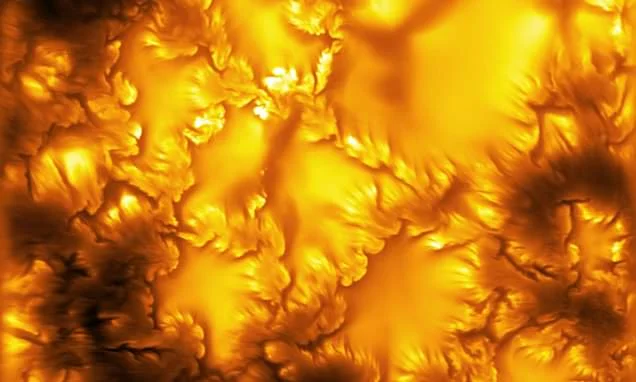
These incredible videos and photos were taken using the NSF Inouye Solar Telescope in Hawaii, the world's most powerful solar telescope.
They show a magnetically turbulent area on the edge of a cool sunspot, in the visible outer layer of our home star.
Combined with cutting–edge simulations, researchers say their new observations reveal something that has never been seen before.
In a new paper, published in Nature, the scientists describe the first 'unambiguous' identification of a phenomenon called 'Kelvin–Helmholtz instability' (KHI).
These are swirling patterns that look like whirlpools on the sun's surface, which form when fluids slide past each other at different speeds.
According to the researchers, these spiralling vortices could be the key to understanding the most violent solar weather.
That could help astronomers better predict the solar flares and coronal mass ejections that threaten to knock out satellite and communication systems on Earth.
Scientists have captured the highest–resolution images of the sun's surface ever taken (pictured), revealing patterns that have never been seen before
The distinctive spiral patterns of KHI can be found everywhere from the smallest ocean waves to the interactions between solar wind and planetary magnetic fields.
However, until now, astronomers haven't had powerful enough tools to spot them in the sun's outer layers.
Jacqueline Keane, NSF Programme Director for the National Solar Observatory, says: 'For decades, seeing these vortices at such tiny scales remained elusive.
'By pairing a massive four–meter mirror with state–of–the–art optics and instruments, the NSF Inouye Solar Telescope delivers the resolving power needed to reveal these ultrafine details for the first time.'
Scientists combined observations from the Inouye telescope with the results of highly specialised computer simulations.
These simulations help researchers understand what they are seeing in the real observations by revealing things that would otherwise be hidden or impossible to measure.
In both the telescope images and the simulations, scientists found dozens of KHI vortices on the edges of magnetically unstable areas with strikingly similar characteristics.
This not only showed that scientists' computer simulations were right, but also helps to explain how these never–before–seen processes actually function.
Scientists describe the first 'unambiguous' identification of a phenomenon called 'Kelvin–Helmholtz instability' (KHI), small–scale vortices of plasma that occur when two fluids slide past each other
These incredible photos were taken using the four–meter NSF Inouye Solar Telescope (pictured) in Hawaii, the world's most powerful solar telescope
The researchers found that the sun's constantly bubbling surface interacts with magnetic structures, causing neighbouring layers of plasma to move past each other.
That difference in speed between the passing fluids then creates the conditions that trigger KHI.
Dr David Boboltz, Deputy Director at the National Solar Observatory, says that this is a 'major step forward in our understanding of the dynamics and evolution of solar and stellar plasma, and will serve as a basis for future discoveries'.
What makes this discovery so exciting is that scientists think KHI could be the engine which drives some of the sun's most violent behaviour.
Solar flares and coronal mass ejections fling vast quantities of radiation and charged particles into space, some of which end up flying in Earth's direction.
When these waves of solar energy collide with the planet, they can cause serious disruption for modern technology, including power grids, satellites, GPS navigation and global communications.
The leading theory on how the sun builds up magnetic energy for these explosions is called 'flux braiding.'
The idea is that as magnetic field lines twist around each other, like braiding strands of hair, they build up tension and create an unstable structure.
Researchers compared the images with highly specialised computer simulations to help understand dynamics that would otherwise be impossible to measure
Researchers say these spiralling whirlpools could be the engines that drive the most violent space weather, including solar flares that can knock out communications on Earth
Eventually, the field lines 'snap' and reconnect into a new, stable shape, releasing a burst of energy out into space.
However, what scientists don't yet fully understand is what causes this twisting and braiding to occur in the first place.
Now, the researchers say that the small swirling patterns produced by KHI could be the key.
Since the swirls appear to be happening everywhere on the sun's surface where magnetic fields are strong enough, they could be the 'engine' that twists magnetic field lines and drives space weather.
Similarly, these swirls could also explain how the outer layers of the sun become so hot.
That would solve the longstanding puzzle of why stars' coronas can reach over a million degrees Kelvin.
But with the first direct observations of these patterns only just being published, a lot more investigation will be needed until scientists understand their mechanics fully.
Dr Friedrich Wöger, Senior Scientist at the National Solar Observatory, says: 'We are only at the beginning of recognising the wide–reaching impact the discovery of Kelvin–Helmholtz instability has on our understanding.'