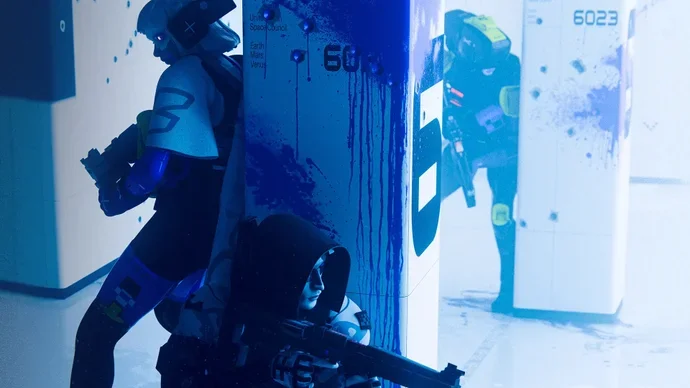
There’s a whole phase to the game of Marathon that occurs right when you might assume it’s over. It begins with the jolting sound effect that indicates a teammate has been downed - knocked on their back by volt fire or a claymore in a dark corner. Then, as you rush to help, a second jolt: another teammate pummeled into helplessness by an unseen assailant. Footsteps all around: a full enemy team, and you alone, as the revive timers of your friends melt away, like clocks in a Dali painting.
Very often, at this point, the best thing you can do for your teammates is turn and flee, as quietly as you can. It might feel counterintuitive - and in fact, your abandoned friends may vehemently disagree with your chosen course of action, until reasoned with or muted on mic, according to taste. If you’ve matchmade with strangers, they might simply quit. But in moments like these, when the battle is lost and vultures pick through the backpacks of your comrades, the match may yet be won.
Partly this is because Marathon is an extraction shooter, and therefore victory is not objectively determined by some abstract score-keeper in the sky, the way it would be in deathmatch or battle royale. It is instead defined by the player. A win might, yes, mean standing atop a pile of looted bodies and letting out the guttural cry of the last shell standing. But it might simply mean persisting long enough to complete a contract that, in cold corporate fashion, doesn’t stipulate that you survive the job. Or reaching exfil with all of your limbs and a half-decent weapon, knowing you’ll live to fire it another day.
But also - crucially - the dead in Marathon are not really gone. If you can reach your teammates again, and spare the excruciatingly long seconds it takes to resurrect them, there’s no reason why you can’t field a full complement once again.
As a result, victory is rarely zero-sum in Marathon. Sure, the enemies squatting over the mangled casing that previously contained your teammate's consciousness are likely to leave with the map’s best plunder this round. But in a ruined colony on an alien planet, there's more treasure than any three people can carry. Frequently, if you’re outmatched, your killers will be packing so much heat that they turn their noses up at your finest equipment. That’s if they find you at all: since Bungie introduced the Night Marsh for Marathon’s second season, the act of gathering loot after a firefight has become less rote and more confusing. The dark obscures huge swathes of the map, and so the champions have to rely on unreliable memories left over from hectic shootouts. When that Destroyer dropped from the roof, where did they crawl to? And how many combatants were there in the fight anyway?
All this uncertainty - the potential for enemies to pass over the spoils - is cause for hope, when you're the last laser-musketeer in the wake of a fight gone wrong. Hope can sustain you during that initial daring escape, in which you rely on quirks of line-of-sight - the obscuring lip of a raised boardwalk, the shadowed interior of a cargo container - to shield you from your hunters as they scour every lab and bathroom to finish the job. You are a final tickbox through which they're determined to draw a sharp black line, yet you must resist the urge to sprint. Noise is the most prolific killer on Tau Ceti IV, and almost every successful evasion I’ve conducted over 200 hours with Marathon was a silent withdrawal. Even the ones that involved three successive smoke bombs and a quick prayer to the Magic Circle.
From there, it’s a matter of orienteering. That is, opening the map and sussing out where your opponents are going to go next. Plump on loot, they’ll likely be looking for a way out. But the nearest exfil is guarded by AI bots; does that mean they’ll head east instead, to leave via a less-well-defended exit? By cross-referencing with hints on the wind - the sounds of gunfire, or alarms that suggest a cache being raided - you can plot a relatively safe route back to your fellows, and affect a rescue.
Much of what I’ve learned about Marathon is akin to reading the weather. Over time, for instance, I’ve learned to distinguish the signature sound of a turret powering up - ‘wha-PING’, like a deflected sword in a Jet Li movie - from the staccato clatter when it winds down. If you’re hearing the former, and didn’t trigger it yourself, you know an enemy player is near. If you’re hearing the latter, you know that a player has probably passed through recently, but moved on - and can adjust your search radius accordingly.
On a higher level still, I’ve become aware of the invisible rhythms that govern the movement of players across Marathon’s three main zones. In contrast to its peers in the extraction shooter genre, Bungie has designed its levels much like traditional multiplayer maps, guiding players down lanes and funnelling them through bottlenecks. That results in a few deadly thoroughfares.
During the first five to ten minutes of a round on Perimeter, as teams rush to reach the locations of their contract objectives, you can all but guarantee they’ll crash through the Hauler - an enormous all-terrain vehicle that doubles as a passage point through the long wall that divides the two halves of Marathon’s starter map. Similarly, if you’re visiting the Dire Marsh, you’ll find clashing teams at Intersection: a congested and exposed depot with more entrances than Swindon's Magic Roundabout. At a certain point, these flare-ups become self-fulfilling, as bloodthirsty players head for hotspots in the hope of getting into a scrap.
In the latter half of a match, however, the weather changes utterly. Exfil points spawn in more obscure corners of the map, drawing players away from Capitalised Points of Interest and toward the embrace of the post-match loot tally screen. As the match timer ticks down to zero, you can take more calculated risks - totting up the total enemy corpses you’ve seen, and the number of times you’ve heard the telltale squelch of a player beaming into orbit. Perhaps you’ll take a pot shot at a looming rocket drone, counting on the absence of fellow players to allow you to focus on a boss fight.
Of course, just like any weather report, these predictions can prove unreliable. A solo Rook sneaks into your exfil dome in the final seconds, and you simply regard each other with shock, neither party truly wanting to take action. An enemy team defies expectation by hanging out quietly in the Intersection control room until late in the day, right up to the moment you trip over them on the stairs. But I like to think that now, when I open the map in any given game of Marathon, I can squint a bit, hold one finger in the air and say, OK: here’s what I think is going to happen.
Read this next
- A month after mass layoffs at Bungie, Marathon game director Joe Ziegler is leaving the studio
- Marathon's experimental PvE roguelite mode is, bafflingly, only around for two weeks when it drops next week
- Following the last Destiny 2 update, layoffs at Bungie are underway, with most of the shooter's team affected