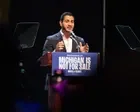
In the final stretch of the state’s Democratic primary for US Senate, Abdul El-Sayed challenged voters at a small event in rural Michigan to think about the message they could send the rest of the country when they cast their ballots.
“Who are we? Who do we want to be?” El-Sayed said. “Do we want a state that’s defined by how much money corporations brought in to tell us what we couldn’t have? Or do we want to be a state where we demonstrate to the rest of the country what’s possible when you build a movement of, by, and for the people?”
On Tuesday, El-Sayed’s vision surpassed its first hurdle: he won the primary over moderate congresswoman Haley Stevens, who was backed by the party’s establishment, and tens of millions of dollars in outside spending.
His rise, and victory, could serve as a revision to how the political establishment views swing-state politics – not requiring candidates to run from the center, but articulating how you will materially improve people’s lives as the working and middle classes struggle with affordability and rising healthcare costs.
A contentious general election, in a battleground state, awaits.
El-Sayed led by 48.5% to 47.5% over Stevens when the race was called. The narrow margin, in addition to more than 60,000 votes for a candidate who dropped out altogether, suggest he will have to unite the party, and convince more independent and even right-leaning voters in a swing state, to beat Republican Mike Rogers.
But the race solidified a growing anti-establishment sentiment on the party’s left, where activists and supporters have sought a proactive vision that doesn’t rely on the pre-Trump status quo, apparent in a string of wins for insurgent candidates. There’s a sense that systems were already broken before Trump’s rise, and a return to those norms won’t serve everyday Americans. They’re looking for politicians who can call out their own party’s orthodoxies, and challenge the big money that haunts US politics.
Michigan voters found it in El-Sayed, who centered his campaign around universal healthcare, and wasn’t shy about calling the war in Gaza a genocide.
“It doesn’t limit us to just what we think is possible, but it changes what we think is possible,” said David Sernick, a voter in Detroit who supported El-Sayed.
El-Sayed first ran for office in 2018, losing to Gretchen Whitmer, now the governor of Michigan, in a Democratic primary. This time, he built a grassroots machine, barnstorming the state with in-person rallies while delivering clippable moments for social media feeds. His campaign knocked on more than 200,000 doors and made more than 1m phone calls, aided by leftwing groups such as the Working Families Party and Indivisible chapters. El-Sayed held more than 500 campaign events and visited 150 churches.
People like Racquel Garcia, who voted for El-Sayed in Dearborn, Michigan, said his willingness to show up underscored their vote. El-Sayed worked as a public health official in Detroit and in Wayne county, and would show up at permit hearings and represent the people, she said.
“Every time we meet with the city of Detroit officials, we’re like, ‘we need you to be like him’,” said Garcia. “You’re here to protect us, not to protect industry. So we’ve been wanting him in office. We were happy that he’s real.”
Andy Levin, a former congressman from Michigan who lost to Stevens in 2022 after their districts were redrawn, said the moment rejected a “static notion of electability” that stems from a politics of anxiety and fear.
“They want authenticity, they want truth telling and they want brave policy, not just proposals but action, so they can breathe in their lives,” Levin told Democracy Now. “This is a movement of Americans who are saying, enough of politics as usual.”
Roy Harris, who voted in Detroit on Tuesday but wouldn’t say for whom, detailed how it was time for a change. “First-time homebuyers can’t buy a house – $400,000, first time you going out, nobody can afford that,” he said. “I’m tired of paying $4 for gas, and I am looking for a change. And I hope the new regime coming in brings that to us.”
In Washington, El-Sayed’s effort to win the race of US Senate in Michigan is critical for Democrats’ ambitious hopes of retaking control of the upper chamber, and will be closely watched by all factions of the left as a bellwether for the party’s future.
Michigan voted for Trump, then Biden, and then Trump, in presidential elections. It is firmly a swing state. If El-Sayed, an unabashed progressive who frequently notes he has a “funny name”, can win a statewide general election, it could remake the contours of the 2028 presidential contest. If he fails, the establishment and pundit class will call him, and his ideas, too extreme – a cautionary tale for play-it-safe politics.
In other parts of the country, moderates won their Democratic primaries, including blue-dog Democrat Marie Gluesenkamp Perez in a purple district in Washington state, who staved off a progressive challenge, and Wesley Bell, who saw off a challenge from Cori Bush, a former representative.
Chris Rabb, a progressive who won a contested primary for a US congressional seat in Pennsylvania, recently noted the high bar people from his branch of the party face as they seek to challenge moderates.
“Nobody asks ‘centrist’ Dems to explain their losses,” Rabb wrote on X. “They lose purple districts every cycle & Beltway pundits call it ‘a tough map’. Progressives lose one major race & Dem operatives call us electoral pariahs. It’s a specious double standard.”
Meanwhile, the attack lines from the right have already been drawn. Rogers posted an AI-generated video of El-Sayed, depicting him as Odysseus among other prominent Democrats inside a Trojan horse, and saying “don’t let communism into Michigan”.
A Republican has not won a US senate seat in Michigan since 1994. The Republican National Committee called El-Sayed “Michigan’s Mamdani” and said the race “pits common sense against crazy”.
El-Sayed himself remains confident.
In November, he is counting on turning out people who normally turn off from politics because they’re cynical, or believe the system cannot change in a way that would make their lives better.
“The goal now is not to dunk on anybody, the goal now is to come together so we can all collectively dunk on Mike Rogers,” El-Sayed said.