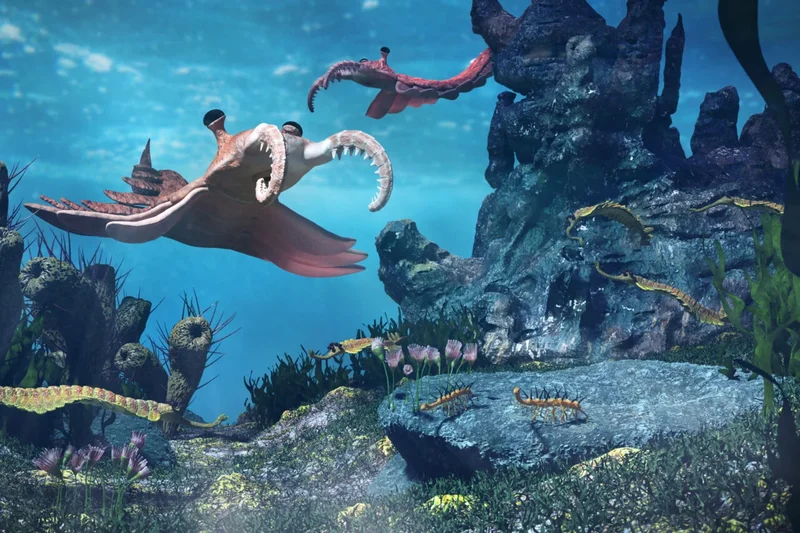
In the first 20 million years of the Cambrian period, Earth experienced an explosion of lifeâa great evolutionary era dubbed the Cambrian Explosion. Scientists have differing views on what drove this phenomenon, but this one may be the strangest one yet: poop. Literally. Just a sh*t ton of poop.
Specifically, a slow accumulation of fecal matterâpoopâhelped allocate organic material and nutrients throughout the ocean, which in turn made marine environments ripe for the birth and evolution of life. The findings, published yesterday in Trends in Ecology & Evolution, suggest a key connection between the distribution of fossilized feces and the emergence of animals with complex digestive systems.
âNext to rising oxygen levels and other contributing factors, the importance of feces in ancient ecosystems is often overlooked,” Russell Bicknell, the studyâs co-author and a paleontologist at Flinders University in Australia, said in a statement.
The âGreat Birthâ
The Cambrian period took place around 539 million to 485 million years ago. It was during this time that nearly all major animal groups we know today emerged, according to an explainer by the U.K. Natural History Museum. Now, more recent findings have suggested that complex animals emerged slightly earlier. However, as of now, the Cambrian explosion is still a benchmark for scientists probing the evolution of early life on Earth.
In particular, discovered fossilized fecesâformally called coprolitesâhave been dated to the onset of the Cambrian, Bicknell and co-author Julien Kimming, a paleontologist at the Karlsruhe Institute of Technology in Germany, wrote in a column for The Conversation. There is also little to no evidence of complex digestive systems in the paleontological record until well after the Cambrian, they added.
âThe fossil record of guts and coprolites shifts dramatically during the Cambrian,â Bicknell and Kimming wrote. âAs we move forwards in time, more diverse coprolites appear. Associated with this shift, there was an increase in very well-preserved fossils with complex digestive systems, particularly among early arthropods.â
A feedback loop
However, as the pair explained in the paper, most studies on the cause of the Cambrian explosion focus on oxygen levels, food webs, or biogeochemical cycles. On the other hand, Cambrian coprolites, recovered from about 36 deposits, are primarily used to investigate the digestive systems of early life.
For the study, therefore, the researchers wanted to explore the origin and role of fecal matter, which remains âone of the most fundamental yet elusive questions in the evolution of animal life,â the paper noted. In their column, the authors explained that today, poop is a vital element of the marine biological pump, or the process that circulates organic carbon and nutrients throughout the ocean.
Everyone poops
Assuming biological processes werenât wildly different back then, greater animal diversity would have triggered an ecological feedback loop in which more poop pumped more nutrients into the environment and, in turn, supported a larger population that would generate even more poop.
Importantly, the researchers emphasized in the paper that the latest theory is complementary to other theories. As with most Earth systems, not one factor is isolated from the other, but a combination of various elements triggered a feedback loop that led to something greaterâin this case, a miraculous explosion of life.