Sree stood behind a white cotton sheet as she peeped at fellow protesters and journalists at New Delhi’s Jantar Mantar protest site on Monday. On the sheet, she had painted the cheeky lyrics of an iconic Bollywood song from the 1990s. “Choli ke peeche kya hai?” it read. What is going on behind the blouse?
The 23-year-old said she had deliberately chosen a sheet that was similar to those used by Delhi Police on Saturday morning to block photos and videos being taken of officials bundling up educator-activist Sonam Wangchuk and dragging him away from the site on the 21st day of his hunger strike.
“When I saw how he was taken away, it startled me,” said Sree, who is pursuing a master’s degree in design from the Indian Institute of Technology in Delhi.
Wangchuk and members of the All India Students’ Association launched their hunger strike on June 28 to demand the resignation of Education Minister Dharmendra Pradhan, whom they blame for allegedly mismanaging competitive examinations.
Sree had followed the sit-in organised by the Cockroach Janta Party on social media for weeks. The police’s aggressive handling of the protest prompted her to visit Jantar Mantar herself.
It was not only Sree for whom the disruption of Wangchuk’s hunger strike proved to be the tipping point. After the activist was forced into a Delhi hospital on Saturday, hundreds of young people began pouring into Jantar Mantar.
By Monday, when protesters responded to a call by Cockroach Janta Party leaders to march to Parliament, the numbers had swollen to thousands.
Wangchuk’s removal from the site also changed the focus of the protest.
While the leaders of the Cockroach Janta Party continued to demand the resignation of Union Education Minister Pradhan, the target of the protesters’ anger became Prime Minister Narendra Modi himself.
A young man at the protest. Credit: Raghav Kakkar.
This was most evident in the slogans raised in the protest on Monday, as lathis and tear gas rained on protesters. “Jab jab Modi darta hai, police ko aage karta hai,” went one. Whenever Modi is scared, he hides behind the police. Or, “Modi teri tanashahi nahi chalegi, nahi chalegi”. Modi, your dictatorship is not acceptable.
While moving among protesters, largely young men, harsh remarks about the prime minister could be heard everywhere – some of them too vicious to reproduce here.
In the line of fire
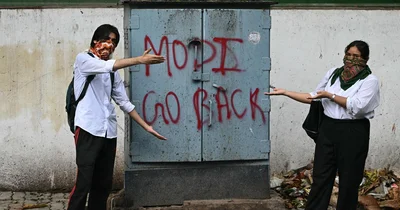
Modi also featured conspicuously in posters and graffiti. “PM is compromised,” someone had scrawled on a wall in central Delhi. Another declaration said simply: “Vote chor Modi”. Modi is a vote thief.
Posters blamed Modi for ruining the future of students, mocked the “Melodi” portmanteau his public relations team had popularised to suggest his proximity to the Italian Prime Minister Giorgia Meloni, his purported proximity to billionaires and the claims that he has a 56-inch chest.
Such jibes were, perhaps, common during the 2019-’20 protests against the contentious Citizenship Amendment Act and the 2020-’21 protests by farmers against a set of laws on agricultural trade and commerce. But the first agitation was led by Muslims and the second by Sikhs – communities that the Bharatiya Janata Party’s Hindutva politics have targeted over the years.
Anger against Modi has rarely surfaced in a protest that has drawn participation from many Hindus, cutting across class lines.
Over the years, Modi has skillfully deflected public discontent. His government's shortcomings are usually pinned on the local administration, a junior minister, the larger “system” or a rotten apple institution – claims that many have accepted.
But in a break from this pattern, on Monday, the angry youth in the streets in Delhi pinned their woes squarely on him.
On a wall in central Delhi. Credit: Shoaib Daniyal.
‘Not colonial subjects’
Several protesters to whom Scroll spoke on Monday said that they had come out to defend democracy and express their opposition to how the Modi government dealt with protests.
“Enough is enough,” complained Fauzia, 26, who had come to Jantar Mantar with three of her nieces. “We cannot be treated like colonial subjects. This dictatorship cannot be tolerated.”
She drew parallels between the manner in which the Delhi Police treated Wangchuk and how it had cleared protests against the Citizenship Amendment Act after the Covid-19 pandemic struck in 2020.
However, Fauzia was hopeful that the initiative taken by the Cockroach Janta Party for education would lead to more campaigns that revolve around livelihood issues. “From now on, we will raise more such issues and the government will have to listen to us,” she said.
Protesters hold aloft a poster of Babasaheb Ambedkar in central Delhi. Credit: Raghav Kakkar.
At a stone’s throw away from Fauzia and her nieces, a group of college-going students had gathered, their faces painted black and white. The posters they carried bore references to American television shows. “Arrest me but make it sexy,” read one poster, which borrowed from a popular song that featured in the police procedural show The Rookie.
One of the students from this group, who requested not to be named, said that she had skipped the sit-in until then because she was busy with placements in her college. She would have stayed away from the site on Monday too, she admitted, had it not been for the events on Saturday.
“I had not thought that the government would go to the length of literally abducting Sonam Wangchuk,” she went on. “That was the breaking point for me.”
When this student contended that she was not scared of being arrested, a friend of hers countered her immediately. “There is nothing wrong in saying that we are scared,” he argued. “But we should not be scared. That is the point.”