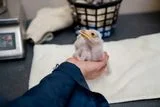
Keepers at Chester Zoo had watched a female secretarybird named Jolene lay eggs that never hatched, while her mate, John, showed little interest. Jolene had shown signs of nesting since she was about two and a half years old.
But recently, John seemed to change his mind. He started helping out, taking his turn sitting on the eggs beside Jolene. Because of this, five secretarybird chicks have now hatched at the zoo, marking the first successful breeding of the species in its 95-year history.
“The most recent breeding has been so successful because John has stepped up and shared incubation and is proving to be a brilliant Dad,” Jonathan Beilby, assistant team manager for birds at Chester Zoo, told Discover.
John’s turnaround comes at a precarious time for the species. As few as 6,700 secretarybirds may remain in the wild, and only three other chicks hatched across Europe’s conservation breeding program in the past year.
Watching Secretarybird Chicks Grow Up Behind the Scenes
The chicks’ eyes opened from the moment they hatched, though it takes time for the rest of their faces to catch up.
Keepers hand-reared the first two chicks so they could document each stage of development, while John and Jolene later raised three more themselves. Those three hatched about 10 days apart, but the parents fed each one evenly.
“The speed at which the chicks grow is staggering, just a weekend off and it feels like they double in size!” Beilby shared.
The oldest already displays and makes threatening noises when keepers approach, possibly to defend its siblings.
“They don’t stand up for around 60 days, so that first time when you come in and see their long legs actually put to use is fantastic,” Beilby told Discover.
Read More: Giant Otter Gives Birth to Triplets at Chester Zoo — A Rare Success for the Endangered Species
Secretarybirds Hunt on Foot
Secretarybirds spend much of their time walking rather than circling overhead. Their long legs carry them through open country and also serve as weapons against prey, including venomous snakes. Even their scientific name, Sagittarius serpentarius, points to this hunting style, translating to “the archer of snakes.”
Built for wide-open country, the birds have fewer places to hunt as grasslands give way to farms and urban development. That change also reduces their prey. The species was uplisted to endangered on the International Union for Conservation of Nature’s Red List in 2020.
The coordinated European zoo population contains just 79 birds, and Chester is among the few U.K. institutions that house them.
What Five Chicks Could Accomplish
Several years of observation in an off-view breeding space lay behind the result. Keepers followed the pair’s courtship closely and fine-tuned their care around what they learned.
Chester’s keepers now plan to share what they learned with other zoos, including records on incubation, hand-rearing, and early development. Beilby said the program can also introduce people to a species many have never encountered.
“Breeding programmes like this in conservation zoos are essential to maintain insurance populations of threatened species, but also to raise awareness. Secretarybirds are such impressive and unique species, but few people will be aware of their existence — so education is really important,” he told Discover.
An insurance population cannot replace the grasslands secretarybirds are losing. Zoo breeding matters most when it supports habitat work, too.
“Every visit to Chester Zoo generates vital funds which can be used to protect habitats for secretarybirds and other threatened species across the world,” Beilby added.
Chester works in several African countries, as the breeding program also helps deepen conservationists' understanding of secretarybird biology in the wild.
For now, the five chicks remain behind the scenes, still growing into their eyes and long legs. Somewhere else, the next secretarybird brood may begin with what Chester learned from them.
Read More: Rare Amur Leopard Born at Cleveland Zoo as Fewer Than 100 Remain in the Wild
Article Sources
Our writers at Discovermagazine.com use peer-reviewed studies and high-quality sources for our articles, and our editors review for scientific accuracy and editorial standards. Review the sources used below for this article:
- This article references information from Chester Zoo: Five highly endangered secretarybird chicks hatch at Chester Zoo