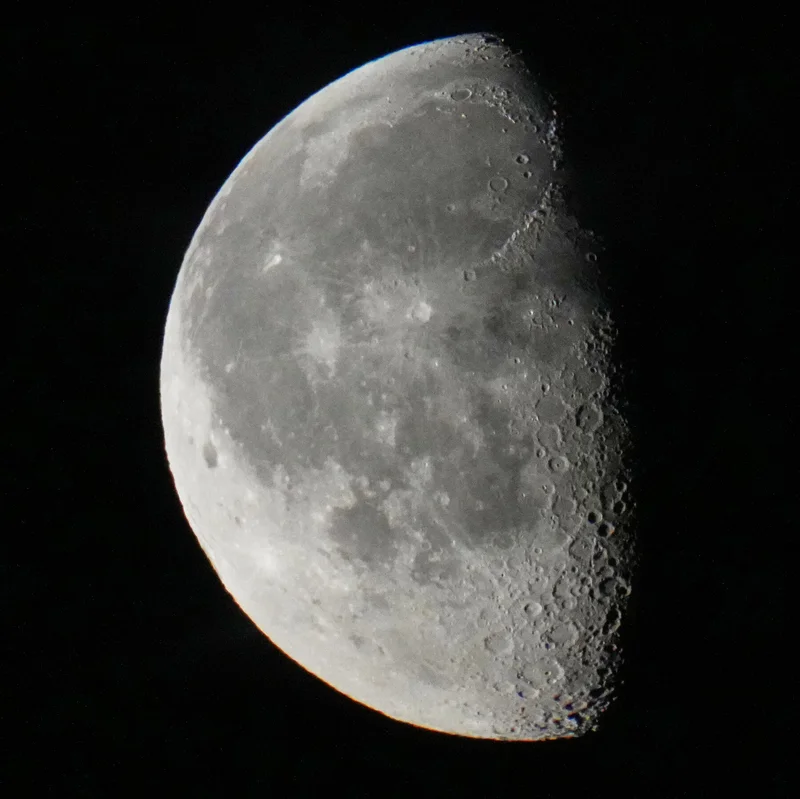
If a rocket stage crashed into the moon and no one saw it, did it really crash?
A discarded upper stage of a SpaceX Falcon 9 rocket slammed into the surface of the moon around 2:35 a.m. Eastern time on Wednesday at a speed of 5,400 miles per hour.
However, it appears no one has yet reported any obvious signs of the impact.
Astronomers hoped that the collision would create a bright enough flash of light and a big enough cloud of dust and debris that it could be observed through telescopes from Earth. But at the appointed time, the moon looked like the moon.
More subtle observations taken at the Lowell Discovery Telescope in Arizona and the Very Large Telescope in Chile could reveal evidence of the collision, like specific wavelengths of light emitted or absorbed by the plume of debris, but those data will take hours to days to analyze.
The anticlimactic demise of the rocket stage was not a surprise.
Computer simulations calculated the effect of the rocket stage striking the moon in a vertical orientation, which would have produced the most debris, but the stage would more likely have belly-flopped at an angle instead. (The vertical case was the only one simple enough to be computed.)
But even in the case of a vertical impact, the predicted flash and plume were at the edge of what might be visible, and the dynamics depended on other unknown factors like whether the stage hit solid bedrock or loose lunar soil.
The Korean spacecraft Danuri passed over the expected crash site about eight hours after impact. Even if it successfully captured an image of the crater, it could take days or weeks to identify it. That is because the process of locating the newly disrupted moonscape is like finding a needle in a haystack. Confirmation will require comparing the gouge with an earlier photograph that shows a pristine surface at that location before impact.
In six days, NASA’s Lunar Reconnaissance Orbiter will also pass over the site, providing additional photographs to aid the search.
Is it possible that the predictions were wrong, and that the Falcon 9 stage missed the moon?
Scientists are confident that the collision happened. Like everything flying around in the solar system, the rocket stage moved according to Newton’s laws of motion with only slight deviations arising from additional forces like the solar wind.
The uncertainty in where the impact would occur was just a few miles.