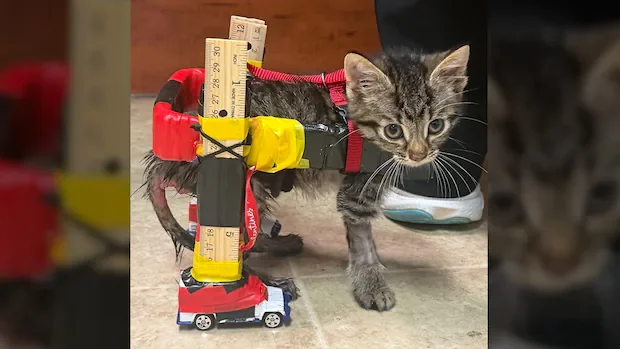
This kitten was too tiny for a wheelchair. So his foster mom made one with Hot Wheels and duct tape
Gelato has since graduated to an adjustable 3D-printed mobility device
LISTEN | Interview with veterinary assistant Mallory Smith:When Gelato the kitten arrived at a Cincinnati animal shelter last month, injured and unable to use his back legs, he was too tiny for an animal wheelchair.
The tabby kitten was found in the streets by a Good Samaritan and brought to Cincinnati Animal Care, where he was diagnosed with a spinal injury.
While not paralyzed, his little back limbs had atrophied from lack of use, and he needed a way to get around while regaining his muscle strength. But none of the devices at the shelter were a good fit.
"He was only about just shy of one pound when he came," Mallory Smith, veterinary assistant lead at Cincinnati Animal Care, told As It Happens guest host Rebecca Zandbergen. "He was a really little guy."
So Smith, who is currently fostering said little guy, decided to get creative and make one herself out of household items, including Hot Wheels, zip ties, and lots and lots of duct tape.
"When a tiny kitten comes in who needs some extra help getting around, you use what's available to make it happen," the shelter wrote __in a social media post. __
The key component? 99-cent rulers
Wheelchairs for cats and dogs aren't actually chairs, but rather harnesses that strap the animal to a set of back wheels, so they can use their front legs to pull themselves around.
It took some experimenting to get Gelato's just right, says Smith.
For her first prototype, she used cardboard to fashion a cradle and two legs. At the bottom of each leg she fastened a Hot Wheels ambulance. The whole contraption was held together with zip ties and electrical tape.
But the cardboard didn't cut it.
"They weren't able to hold up his weight, especially when he would try and turn. So then I just got some wooden rulers for 99 cents each and put them on the sides."
Thus, Gelato's chariot was born.
"He was able to walk around with it and it gave him some autonomy while also getting physical therapy at the same time," she said.
Out with the Hot Wheels, in with the actual wheels
Smith says the device soon turned Gelato into an internet celebrity. But despite its charm, she says it wasn't a good long-term solution for the growing kitten.
She has since worked with an engineer friend to design Gelato a 3D-printed wheelchair that's adjustable as he grows.
"He's able to use it really well and it's very exciting," she said.
Gelato uses his device to get around and play, while undergoing regular physiotherapy to get his back legs moving again.
So far, Smith says, he's showing progress.
"He's already starting to stand up on his own without the wheelchair assistance, but he can't quite take a lot of steps," she said. "But I have a good feeling that he will be able to walk unassisted soon enough."
Smith says she's glad Gelato is bringing attention to the need for a wider variety of assisted mobile devices for animals.
"There's definitely other kittens who are in need of this stuff," she said. "I'm really happy that he's getting that attention to kind of broadcast a bigger light on special needs animals in general."
If all goes well, he will walk right into a new home as soon as he's ready for adoption. It'll be a bittersweet moment for Smith, who has grown fond of her little ward.
"I do really, really love him, but if I were to keep him, then it would hinder my ability to help the next animal that needs a foster," she said.
- Elmer the kitten is now thriving after he was found in a bucket of glue
- Cupid, the 2-legged puppy, left to die in the trash, fitted with prosthetics
She doesn't think it'll take for Gelato to get scooped up.
"He's a popular guy."
Interview with Mallory Smith produced by Leslie Amminson