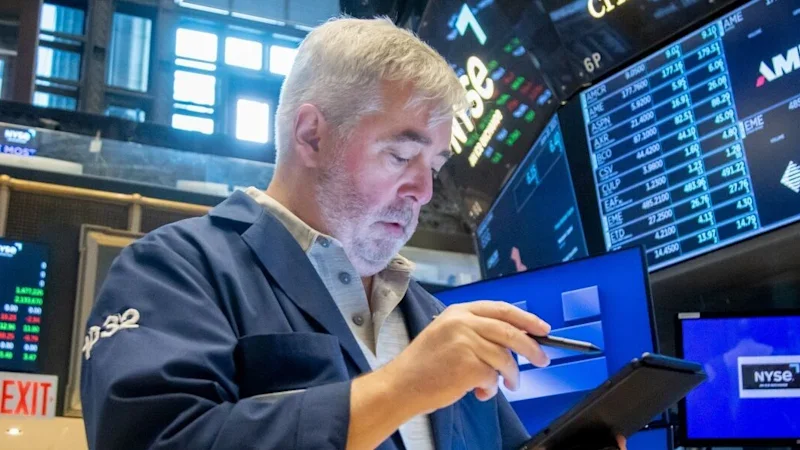
Stocks wavered in afternoon trading on Wall Street and hovered around their records set a day earlier, while oil prices held steady.
The S&P 500 rose 0.1 per cent. The Dow Jones added 473 points, or 0.9 per cent, as of 2:12 p.m. Eastern time. The Nasdaq composite fell 0.4 per cent. The Australian sharemarket is set to edge lower, with futures pointing to a dip of 3 points at the open. The ASX added 0.9 per cent on Wednesday to close at a record high. The Australian dollar was stronger at US70.60¢.
The S&P 500 and the Dow both set records, while the Nasdaq is 2 per cent below its record. Every major index had been surging this week, giving August a strong start.
“The coiled spring investors have been waiting for has finally released, with the S&P 500 Index surging to record highs for the first time in two months,” said Mark Hackett, chief market strategist at Nationwide, in a report.
The market has been generally rising as companies head into the closing stretch of their latest round of earnings reports with sharp overall gains. Three-quarters of the companies within the S&P 500 have reported results so far, and Wall Street expects profit growth of 50 per cent when they are all finished.
The Walt Disney Co. rose 3.7 per cent after easily beating Wall Street’s profit forecasts, helped by a $USUS1 billion ($US1.4 billion) box office haul from Toy Story 5 and theme park revenue.
Booking Holdings jumped 6.5 per cent after reporting that strong travel demand drove profit and revenue growth during its most recent quarter.
Elon Musk’s SpaceX fell 11.9 per cent following the release of its first quarterly report as a public company, which showed that it sharply boosted spending on artificial intelligence. The company did help give semiconductor giant Nvidia a 4.4 per cent boost after announcing it would exclusively use that company’s chips for its artificial intelligence technology.
That announcement weighed on Advanced Micro Devices, which fell 6.2 per cent. Musk had previously said that SpaceX and his electric vehicle company, Tesla, would use chips from both Advanced Micro Devices and Nvidia.
Treasury yields held relatively steady in the bond market. The yield on the 10-year Treasury slipped to 4.62 per cent from 4.63 per cent from late on Tuesday.
Markets in Asia rose. Benchmarks jumped more than 3 per cent in Tokyo and Seoul as computer chipmakers and other AI-related companies climbed. European markets were mixed.
Strong corporate profits and expectations for more growth ahead have been steering stocks higher. Wall Street has also been worried about stock prices becoming unjustifiably high, especially within the technology sector and for companies focused on artificial intelligence. Profit growth, especially for some of the big chipmakers, like Nvidia, could help justify some of the big investments those companies are making in AI.
“The market appears to be moving from rewarding companies for AI spending to assessing the revenue and earnings that these investments can generate,” said Brian Therien, analyst, investment strategy, at Edward Jones, in a report.
AI-focused companies, with their big market values, have been behind many of the big market swings and most of Wall Street’s gains. Nvidia’s gain helped support the broader market on Wednesday, despite slightly more stocks losing ground than gaining within the S&P 500. Micron Technology also helped support the market with a 2.7 per cent gain.
Uncertainty about the direction of the US war with Iran continues hanging over the market. President Donald Trump said a deal to reopen the Strait of Hormuz could come as early as Wednesday. But there have been many stops and starts during the five-month old conflict that has stifled the global supply of oil and rattled energy markets.
The price of Brent crude, the international standard, fell 0.2 per cent to $US79.26 a barrel. Oil prices have been swinging for months and were as high as $US102 per barrel at one point during the conflict, jolting already stubbornly high inflation. Higher oil prices pushed gasoline prices higher and increased shipping costs for a wide range of products.
Inflation concerns have been hanging over markets and the Federal Reserve. The central bank has been holding its key benchmark rate steady as it monitors the costs and the impact on the economy. Wall Street expects the central bank to raise rates at least once before the end of 2026. Household spending remains resilient, despite the stress from higher costs on everything from gas to groceries.
The jobs market has been one of the stronger areas of the economy, though growth has been slowing. Wall Street will get another update on Friday with the monthly employment report for July.
AP
The Market Recap newsletter is a wrap of the day’s trading. Get it each weekday afternoon.