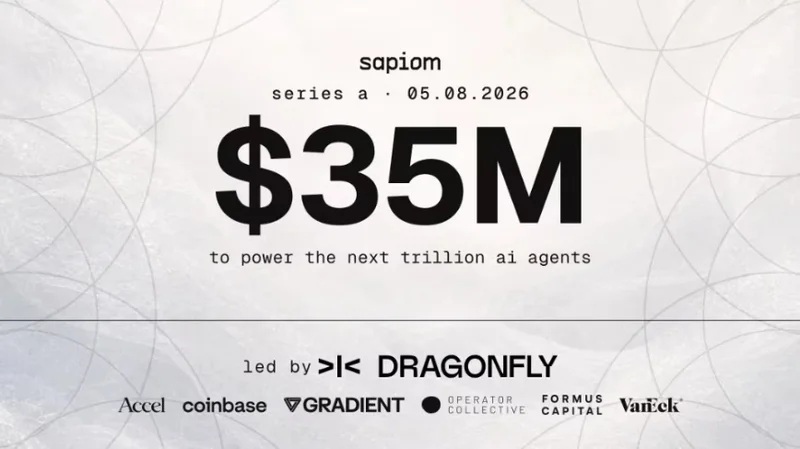
Sapiom is a San Francisco startup that sits between AI agents and the models they run on. It has raised a $35 million Series A. Dragonfly led the round. It comes 11 months after the company launched, and six months after a $15 million seed led by Accel. That takes total funding to $50 million.
The pitch is narrow and timely: make AI agents cheaper to run. At the moment an agent acts, Sapiom decides which model, tool, or service it may use. It enforces a budget before the money is spent. Its Router sends each call to the cheapest capable model, not the most expensive one. The platform has processed more than 270 million transactions since launching six months ago.
The bill that made the case
The clearest case is a customer named Polsia. The AI startup employs nobody, running swarms of agents to help operate other businesses. Its projected revenue jumped from $100,000 to $10 million in a year, Semafor reported. But its token bill climbed with it, hitting $1.2 million a month on Anthropic. After Sapiom ran a series of evaluations, that bill fell roughly tenfold, to about $100,000.
“It’s just unsustainable,” founder Ilan Zerbib told Semafor. He argues that startups cannot deploy at the prices frontier labs charge, even when the demand is there.
Here is the awkward part. Anthropic is one of Sapiom’s investors, returning for the Series A alongside Okta Ventures, Menlo Ventures, and Array Ventures. A model maker is helping fund the startup whose product is spending less on model makers. Zerbib frames it as aligned, not adversarial.
Cheaper inference lets companies build more agents. Some of that work, he argues, will still need the most powerful models.
Cost is the new constraint
Sapiom is riding a shift in how companies talk about AI. Gartner forecasts that companies will cancel more than 40% of agentic AI projects by the end of 2027. Escalating costs are among the leading reasons. Corporate AI budgets are getting their first hard audit. Some firms are already capping what staff can spend. Semafor pointed to a KPMG survey of 2,100 executives in June, in which just 7% could name established returns.
Zerbib’s bet is that the number of agents is about to explode. There may be tens of millions of software developers, he told Semafor. In his words, “we’re talking about trillions of agents that will operate in the economy in the next three years.”
Most of that work, on his numbers, does not need a frontier model. “In 95% of cases, it doesn’t make sense to go to a very expensive frontier model,” he said. TNW has covered how US firms are already swapping frontier models for cheaper ones to control spend.
Dragonfly’s Haseeb Qureshi is joining the board. He calls the gap an infrastructure problem, not a dashboard one. “Agents are becoming employees with no manager and no budget,” he said, “and increasingly, the CTO is the one acting as CFO, allocating real money with no visibility into where it goes.”
A crowded toll booth
Sapiom’s Router puts it up against OpenRouter, the best-known name in model routing. Its difference, per Semafor, is the infrastructure. Sapiom serves open-weight models from its own racks in a San Jose data centre. Most rivals act purely as middlemen. It charges for the compute directly, instead of adding a markup. It is one of a wave of startups selling agent infrastructure to investors this year.
That edge may not last. Routing is starting to look like a commodity. Amazon and Microsoft now bundle it into Bedrock and Azure. Open-source routers are free. OpenRouter alone moves around 25 trillion tokens a week.
One market tracker counts 80 active routing competitors. Sapiom is betting on what it owns underneath: the inference, and the controls around it. That, it hopes, is what separates a feature from a company.
Get the TNW newsletter
Get the most important tech news in your inbox each week.