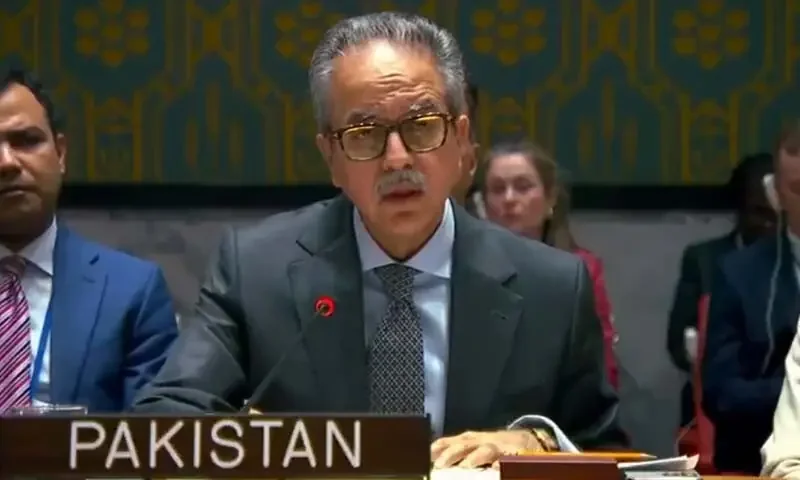
WASHINGTON: Pakistan on Wednesday informed the United Nations Security Council (UNSC) that multiple terrorist groups continued to operate from safe havens inside Afghanistan, posing a growing threat to regional security. Speaking at a UNSC briefing on threats to international peace and security caused by terrorist acts, Pakistan’s Permanent Representative to the UN Ambassador Asim Iftikhar Ahmad also highlighted Islamabad’s concerns over Jammu and Kashmir, as the Council met on the seventh anniversary of India’s August 5, 2019, decision to revoke the region’s special constitutional status. Ahmad described the measures imposed on that day as a new phase of repression against the Kashmiri people and accused India of committing what he called “state terrorism” in the disputed territory. He said the international community must show “zero tolerance” for such actions and should not allow counterterrorism efforts to be used as a pretext to suppress what Pakistan describes as legitimate struggles for self-determination. The Kashmir reference came alongside a broader discussion of terrorism and regional security, with the ambassador focusing heavily on Afghanistan-based terrorist groups — an issue that has become central to Pakistan’s security concerns and increasingly part of Washington’s regional agenda. The UN remarks followed the fourth US-Pakistan Counterterrorism Dialogue held on Tuesday in Washington, where both countries reaffirmed their commitment to combating terrorist organisations and strengthening security cooperation. In his address to the Council, Ahmad said that while sustained international counter-terrorism efforts had degraded the capabilities of groups such as the militant Islamic State, the terrorist threat continued to evolve, particularly in parts of Africa, the Middle East and Afghanistan. He said Islamic State’s Khorasan chapter (IS-K) had suffered setbacks, including because of counter-terrorism operations by Pakistan, but continued to pose a significant concern, particularly in Afghanistan. “The situation in Afghanistan remains deeply alarming,” Ambassador Ahmad told the Council. “Since the Taliban takeover in August 2021, multiple terrorist groups continue to thrive in that country in an increasingly permissive environment.” He specifically named the banned Tehreek-i-Taliban Pakistan (TTP), the Balochistan Liberation Army (BLA) and its Majeed Brigade, IS-K and its affiliates, the East Turkistan Islamic Movement (ETIM) and Al Qaeda affiliates as groups that, according to Pakistan, have access to safe havens inside Afghanistan. Pakistan has repeatedly accused the TTP of using Afghan territory to plan and carry out attacks inside Pakistan, a charge that Taliban authorities have rejected. Islamabad has also accused external actors of supporting terrorist groups operating against Pakistan. The ambassador urged the Taliban authorities to fulfil their obligation to ensure that Afghan territory is not used by any terrorist organisation to threaten other countries. He also called for international action against what he described as external sponsors of terrorism. The US-Pakistan counter-terrorism dialogue reflected a similar focus on Afghanistan-based terrorist groups. Counter-terrorism has emerged as one of the areas where the two countries continue to see a clear convergence of interests. Later in his UNSC speech, Ambassador Ahmad returned to Kashmir, linking the issue to Pakistan’s broader argument that international security frameworks should address all forms of terrorism, including what Islamabad calls “state terrorism” resulting from foreign occupation. He argued that the global response to terrorism must avoid double standards and selectivity, saying that all groups posing a threat to international peace and security should be addressed through a consistent approach. The ambassador concluded that terrorism “knows no borders” and “has no religion,” calling for a coordinated international effort to combat the threat. According to the Pakistan Institute for Conflict and Security Studies, an Islamabad-based think tank, violence linked to terrorist attacks and counter-terrorism operations intensified sharply in July, making it the deadliest month of 2026, with 112 security personnel among 205 people killed.
Islamabad raises Afghan terrorism concerns at UN Security Council