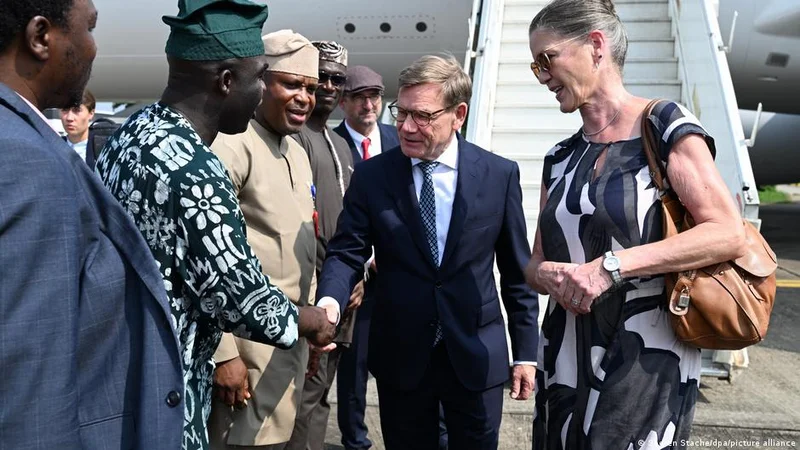
Germany's Foreign Minister Johann Wadephul is currently visiting Nigeria as part of a multi-country trip across Africa, with a preceding major stopover in Mauritania, and an upcoming call on South Africa.
The trip follows up on prior journeys by Germany's top diplomat to Africa, with Wadephul having visited Ethiopia and Kenya in January, and Morocco in April.
Wadephul says these repeated travels to the continent are a strategic necessity for Europe as part of Berlin's expanding engagement with Africa.
"This is my third trip to Africa now. Why? Africa is a continent of both destiny and opportunity for Europe," he told reporters, highlighting the continent's economic potential while also emphasizing its persistent security challenges.
In Nouakchott, Wadephul met with Mauritanian President Mohamed Ghazouani alongside several other German diplomatsImage: Soeren Stache/dpa/picture alliance
Mauritania: Security, migration and counterterrorism
As the first destination on the current tour, Wadephul's stop in Mauritania focused on various interlinked issues such as security cooperation, migration management and regional stability.
Geopolitical analyst Fidel Amakye Owusu believes that "Germany will go to Mauritania because of migration," highlighting the growing use of Atlantic migration routes by people desperate to reach Europe.
In fact, the foreign minister's visit came just days after the UN refugee agency reported at least 144 deaths along this route near the Mauritanian coast.
Wadephul's trip to the country, however, also focused on opportunities for deeper security cooperation with Mauritania; his delegation visited the Mourchidates, an all-female Islamic spiritual guide group trained and deployed by the state to counter extremism.
DW's Silja Fröhlich, who accompanied Wadephul on the trip, noted that the foreign minister's interaction with the Mourchidates women was one of the main highlights: "In Mauritania, he was visibly moved by women working with the UN to prevent extremism and violence — women who, despite living in a deeply patriarchal society and often carrying personal ties to the very conflict they are confronting, are determined to protect their communities," she explained.
Support for such a grassroots initiative is also a reflection of Germany's intent on bolstering community‑based approaches to preventing radicalization.
Germany hopes to intensify its involvement — and investments — in NigeriaImage: Soeren Stache/dpa/picture alliance
Nigeria: Economic partnership and youth‑driven innovation
The second leg of the trip took Wadephul to Nigeria, where he met with various entrepreneurs, creatives, influencers, filmmakers and students.
"We are looking for new global partners. This is the very reason that I am here: that we are looking to Africa and to the countries in Africa. I view Nigeria as some kind of a powerhouse, a striving nation, growing faster and faster and with a lot of creative ideas," the foreign minister commented, describing Nigeria as an African powerhouse, particularly in the creative industries.
Vocational education, skills development and collaboration in science, technology and innovation were highlighted as key areas for future cooperation, with discussions also centering on expanding economic and commercial partnerships and attracting greater German investment into priority sectors.
Nigeria's Ministry of Foreign Affairs Ministry in a statement said that the country "looks forward to productive engagements that will further consolidate the existing friendship, and open new avenues for collaboration in support of inclusive economic growth, regional stability and shared prosperity."
Local content creator Shalom Onyuinye said that Wadephul's recognition of Nigeria's growing cultural momentum around the world marks a significant shift in the global perception of Africa's most populous country.
German Foreign Minister Johann Wadephul wants to support and boost Nigeria's creative enterprisesImage: Soeren Stache/dpa/picture alliance
South Africa: Germany's closest economic partner in Africa
Wadephul's trip across the continent is due to will conclude in South Africa — Germany's most significant economic partner in Africa; more than 600 German companies operate there.
German direct investment in South Africa reached €7.99 billion ($9.1 billion) in 2023, with South African investment in Germany totaling €2.6 billion, according to Germany's Federal Foreign Office.
Analyst Owusu thinks that South Africa's advanced and diverse economy as well as its role as Africa's chief manufacturing hub make the country attractive to foreign investors; he also noted that German investment could generate substantial benefits in the long run — for both sides.
However, against the backdrop of recent xenophobic attacks across the country, the foreign minister is also expected to double-down on shared democratic values between the two nations.
Furthermore, this upcoming leg of the trip is expected to focus on industrial cooperation, energy transition partnerships and strengthening ties with South Africa's business and political leadership.
Germany's FM stresses Europe's 'need' for skilled workers
[](https://hlsvod.dw.com/i/dwtv_video/flv/je/je20260121_INTWadephulVideored_,AVC_480x270,AVC_512x288,AVC_640x360,AVC_960x540,AVC_1280x720,AVC_1920x1080,.mp4.csmil/master.m3u8)
Germany's growing interest in Africa
Wadephul's visit to Africa also builds on a partnership established last year, when Germany and the African Union (AU) launched their first‑ever strategic dialogue on foreign and security policy at the AU headquarters in Addis Ababa, Ethiopia.
This new framework aims to deepen cooperation on global security crises and multilateral engagement, for which Germany pledged funds exceeding €100 million in total.
"Especially at a time of major global geopolitical upheaval, reliable cooperation with our African partners is essential," Wadephul remarked at the launch of the initiative.
The foreign minister stressed at the time that Europe and Africa were "closely interconnected politically, economically, and in terms of security, and face many of the same challenges," stressing that "a strong Africa is in Germany's interest."
Silja Fröhlich contributed to this article
Edited by: Sertan Sanderson