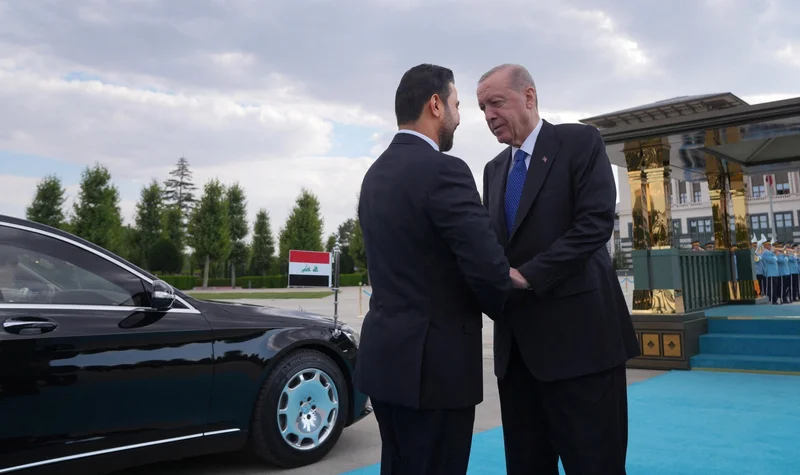
Iraqi Prime Minister Ali al-Zaydi’s Ankara visit bolstered the strategic partnership between Ankara and Baghdad at a time when the Middle East remains consumed by conflict and uncertainty. Türkiye and Iraq are choosing a path centered on connectivity, economic integration and shared prosperity.
The visit also put to rest many of the questions surrounding Iraq's post-election foreign policy trajectory. Following the formation of the new government, some analysts speculated that the momentum achieved under Prime Minister Mohammed Shia Al Sudani could slow amid Baghdad's shifting domestic political balances. Yet the latest agreements in the fields of trade, logistics, energy, sports and education demonstrate that cooperation between Türkiye and Iraq has become increasingly institutional rather than personality-driven. The relationship is now underpinned by shared strategic interests that transcend changes in government. Both capitals recognize that long-term economic interdependence offers a more sustainable foundation for regional stability than short-term political calculations.
Nothing illustrates this strategic convergence better than the Development Road Project. Extending approximately 1,200 kilometers (745 miles) from the Grand Al-Faw Port on Iraq's southern coast to Türkiye's Ovaköy border crossing before connecting with European markets, the corridor represents one of the most ambitious infrastructure initiatives in the Middle East. Estimated to cost around $20 billion, the project will integrate highways, railways and logistics centres into a multimodal transport network capable of reshaping regional trade patterns.
The memorandum of understanding (MoU) signed on railway and highway transportation through the Fishkhabur-Ovaköy border crossing marks another critical step towards realising this vision. Rather than viewing infrastructure as an end in itself, Ankara and Baghdad are constructing an integrated connectivity ecosystem that links Iraq's emerging logistics network with Türkiye's advanced transportation infrastructure and, ultimately, with European supply chains. Once operational, the Development Road will not simply connect two neighbouring countries; it will connect the Gulf to Europe through a faster, more resilient and geopolitically stable corridor.
Its importance has only grown as global trade routes become increasingly vulnerable. Since the outbreak of the Gaza war, commercial shipping has faced unprecedented disruptions across the Red Sea due to the Houthi disruptions, while escalating tensions surrounding the Strait of Hormuz continue to expose the fragility of maritime commerce. Nearly 90% of global merchandise trade still travels by sea, while around 30% of global container traffic normally passes through the Suez Canal. The rerouting of vessels around the Cape of Good Hope has added up to two weeks to shipping times between Asia and Europe, significantly increasing freight costs and insurance premiums. In today's geopolitical climate, reliable connectivity has become as strategically valuable as access to energy resources themselves.
It is precisely here that Türkiye's strategic vision becomes apparent. Rather than merely reacting to regional crises, Ankara has sought to transform geopolitical uncertainty into an opportunity for regional integration. The Development Road reflects a broader Turkish foreign policy approach that prioritises connectivity over confrontation and economic cooperation over geopolitical fragmentation. Instead of exclusive geopolitical blocs or zero-sum competition, Türkiye has consistently advocated inclusive regional initiatives capable of generating mutual economic gains for all participating states.
The project also complements Türkiye's broader connectivity strategy across Eurasia. By linking Iraq's transport network with the Middle Corridor stretching through the Caucasus and Central Asia, Ankara is gradually positioning itself as the indispensable junction connecting the Gulf, Asia and Europe. In an era when governments increasingly seek to diversify supply chains away from vulnerable maritime chokepoints, Türkiye is emerging not simply as a transit country but as one of Eurasia's principal logistical hubs.
Energy cooperation constitutes the second major pillar of the evolving partnership. Alongside the Development Road, the Iraq-Türkiye Crude Oil Pipeline carries considerable strategic significance. Designed with a capacity of approximately 1.6 million barrels per day, the pipeline has historically served as Iraq's principal northern export route through Türkiye's Mediterranean terminal at Ceyhan.
Restoring pipeline operations would generate tangible benefits for both countries. For Iraq, reopening the route would diversify export options beyond the Gulf, reduce transportation risks and improve export flexibility. For Türkiye, increased throughput would complement its broader objective of expanding its role within regional energy markets alongside existing infrastructure such as the Baku-Tbilisi-Ceyhan pipeline, the Trans-Anatolian Natural Gas Pipeline (TANAP) and TurkStream. More broadly, as Europe continues to diversify energy supplies following recent geopolitical shocks, additional export capacity from Iraq could contribute to wider regional energy security while enhancing market flexibility.
The significance of al-Zaydi's visit therefore extends well beyond the agreements signed in Ankara. It demonstrates that Türkiye and Iraq increasingly view their relationship through a long-term strategic lens rather than the fluctuations of day-to-day politics. In a region where conflict too often dominates the agenda, the two neighbors are investing in connectivity, trade and economic interdependence. If successfully implemented, the Development Road will not merely reshape bilateral relations; it could redefine the economic geography of the Middle East. At a time when the world is searching for more secure and diversified trade corridors, Türkiye is actively helping to build a new connectivity map in the region.