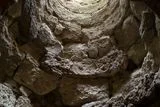
Archaeologists at the ancient city of Kainua had been given 14 more days to dig. As the extended excavation near Marzabotto, Italy, approached its end, the team reached the bottom of a well in a sanctuary devoted to the goddess Uni.
What waited there had kept some of its shine for roughly 2,500 years. The excavators uncovered two bronze statuettes of women and a bronze plate whose metal still appeared bright. The well also contained the skeletons of two adults.
Elisabetta Govi, the University of Bologna professor who directed the excavation, believes the finds came from two ceremonies held at opposite points in the well’s history. The bronzes were placed there when Kainua was founded, between the late sixth and early fifth centuries B.C.E. The skeletons appear to belong to a ritual that closed the well.
The well stood in a district built around temples and cults devoted to some of Kainua’s most important gods.
"It is precisely within this rich cultic framework that the newly discovered ritual well fits," explained Govi in a translated press release. "The results of this excavation campaign therefore enrich our knowledge of the foundation rites of Etruscan cities and Etruscan religiosity with new, precious details."
Read More: Ancient DNA Uncovers Startling Family Secret of a 3,500-Year-Old Bronze Age Community
The Etruscan Ritual Well Marked Kainua’s Beginning and End
The discovery came during the 39th excavation campaign at Kainua, where the University of Bologna has worked since 1988. Members of the Gruppo Ravennate Archeologico helped excavate the well and recover the objects.
Calling the well’s closure a ritual does not explain what happened to the two adults. The university does not say how they died or whether they were killed at the site. Their presence alone is not evidence of human sacrifice.
For now, the skeletons tell archaeologists more about how the well was closed than how the two people died.
Why Water Mattered at Ancient Kainua
The Etruscans lived across central Italy before Rome took control of the region, and Kainua was one of their cities.
The well stood within Kainua’s sacred urban area, near two monumental temples that Etruscan inscriptions link to Tinia and Uni. The two held roles similar to Jupiter and Juno in Roman religion. People in the same area also worshipped Vei, an Etruscan goddess associated with agriculture and human fertility.
The deposits show how Kainua’s water cult worked in practice. When residents established the well, they placed offerings inside as part of the city’s foundation. The act connected water for daily life and crops to the gods worshipped nearby.
Each time Kainua’s residents drew water, they were returning to a well that had been treated as sacred since their city began.
Two Extra Weeks Changed the End of the Dig
The extra time at the beginning of the story came from a €140,000 (about $161,700 USD)grant from Italy’s Directorate General of Museums. It allowed the 2026 campaign to continue for two weeks beyond its original schedule, which the university says made the discovery possible.
The finds will now be studied and conserved. They could eventually be displayed at MNEMA, the National Etruscan Museum of Marzabotto, which reopened in June 2026.
MNEMA’s galleries were planned with ongoing research in mind. The museum can add objects from active excavations and revise its account of Kainua as archaeologists learn more. That makes MNEMA part museum and part working record of the excavation, with displays that can change alongside the research.
Those extra 14 days got the team to the bottom of the well. The next phase will happen indoors, where the finds can keep changing what MNEMA tells visitors about the people who founded Kainua.
Read More: Bones Buried in Italian Necropolis Offer Clues on Ancient Diets and Society Before the Romans
Article Sources
Our writers at Discovermagazine.com use peer-reviewed studies and high-quality sources for our articles, and our editors review for scientific accuracy and editorial standards. Review the sources used below for this article:
- This article references information from the University of Bologna: A ritual well with intact artifacts and human remains discovered in ancient Kainua, Marzabotto.