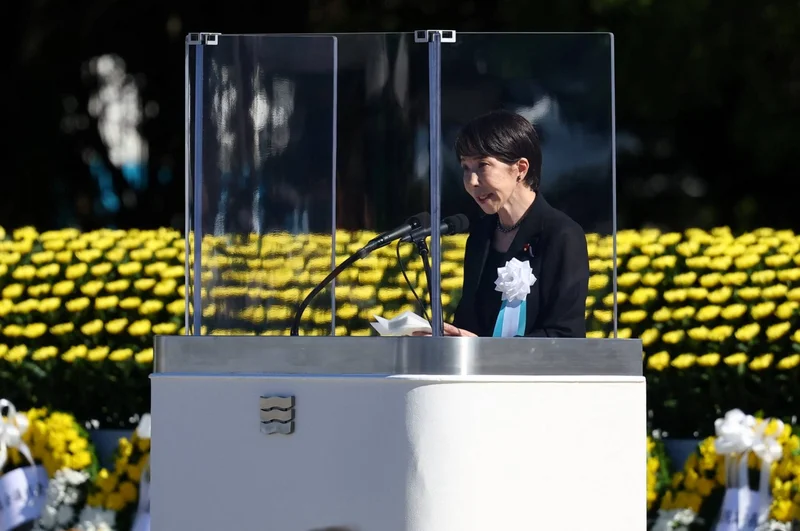
Prime Minister Sanae Takaichi pledged to uphold Japan’s long-held non-nuclear principles in a speech marking a ceremony Thursday paying tribute to those killed and injured 81 years after the city was devastated by a U.S. atomic bomb.
The prime minister joined hibakusha, bereaved families, foreign and local representatives at the Hiroshima Peace Memorial Park, where participants observed a minute of silence at 8:15 a.m., the exact time when the bomb exploded over the southwestern city on Aug. 6, 1945, leaving an estimated 140,000 ultimately dead. Three days later, another 74,000 were killed when a second bomb was dropped on Nagasaki.
“The devastation caused by the atomic bombings of Hiroshima and Nagasaki, and the indescribable suffering endured by so many people, must never be repeated,” Takaichi said in a speech.
“I pledge to devote every effort to achieving a world without nuclear weapons and lasting peace,” she added, saying Japan would firmly uphold its long-held “three non-nuclear principles” and continue its efforts toward realizing a world without nuclear weapons.
Under the three principles, Japan pledges not to possess, produce or permit the introduction of nuclear weapons into the country.
Her first appearance at the ceremony as the nation’s leader comes as the government prepares to revise its key national security documents later this year, raising questions over whether the three nonnuclear principles will remain intact.
Takaichi has maintained the position of adhering to the principles, but previously has said she is carrying forward a 2010 position taken by then-Foreign Minister Katsuya Okada that, in a crisis, the government of the day could decide whether to permit a temporary port call by nuclear-armed vessels.
The Japan Innovation Party, junior partner in the ruling coalition, has also called for a “realistic examination” of the third tenet in its policy proposal submitted to the government in June.