There is a surrealistic scene written almost 30 years ago by a former colleague of mine that describes her night at Pauline Hanson’s country retreat on what is known as Queensland’s Scenic Rim.
Margo Kingston, who was a take-no-prisoners journalist working at the Canberra bureau of The Sydney Morning Herald at the time, 1998, described Hanson’s home as idyllic, with vast tracts of polished floors surrounded by big windows granting views of pasture and bushland where cattle and horses grazed.
However, she found the place to be more fortress than haven: a police guard sat in a caravan at the gate, and every door and window was double-bolted.
Margo wasn’t a One Nation sort of person, to put it mildly. One of her abiding interests was Aboriginal affairs, and she was volubly critical of the strong thread of racism running through Hanson’s public rhetoric and that of One Nation’s supporters.
Yet, Hanson invited Kingston and another journalist following the 1998 Hanson election campaign, Helen McCabe of The Daily Telegraph, to dinner at her country home, breaking up a roasted chicken and piling plates with salami, cheese and bread.
“We ate the chicken with our hands, drank red wine and discussed Aboriginal affairs,” wrote Kingston in her subsequent book Off the Rails: The Pauline Hanson Trip, an eye-popping, almost hallucinogenic and sometimes nightmarish account of the 1998 federal election campaign.
The election turned out to be a disaster for Hanson, despite polling and dreamers suggesting there could be an upset almost as astounding as the Queensland state election four months previously, when One Nation won 11 seats.
At the federal poll, Hanson lost her seat, and One Nation won nothing more than a single Senate spot. It would be another 18 years before Hanson found herself back in parliament, this time in the Senate.
Margo Kingston recognised back then that One Nation was a potentially serious political movement when old divisions between labour and capital were breaking down, the gap between rich and poor was widening, and people from all sides were losing their living standards while the “elite” were prospering, often obscenely, from a global system they kept saying was good for everyone.
Ringing any bells?
Improbably, Hanson had the two journalists stay the night when it became clear there was no ride to be had out there in rural Queensland, and built a fire to keep Kingston warm on the couch.
Kingston didn’t know what to make of it all. She speculated that Hanson hadn’t engaged with people who thought the way she and her fellow journalist thought.
“We were curiosities to her, and she was a curiosity to us. Or maybe she wanted to size up her enemy,” she wrote. McCabe wondered whether Hanson was simply lonely and had no friends.
Pauline Hanson in those days courted and valued media attention.
In Canberra’s press gallery, I recall her trolling the corridors, her adviser and One Nation co-founder David Oldfield sticking to her like an insect to flypaper, whispering in her ear about the best approach to whomever journalist they came across.
These years later, however, the very idea of Pauline Hanson having a journalist from The Sydney Morning Herald – sister paper of The Age – stay the night at her home is risible. As risible, in fact, as any continuing relationship between Hanson and Oldfield (or any number of her former jettisoned, abandoned or flounced-off colleagues and recruits).
Now that she’s soaring in the polls and flooding the internet with uncheckable social media posts, she is in the business of banning major news organisations and their journalists even from attending her press conferences.
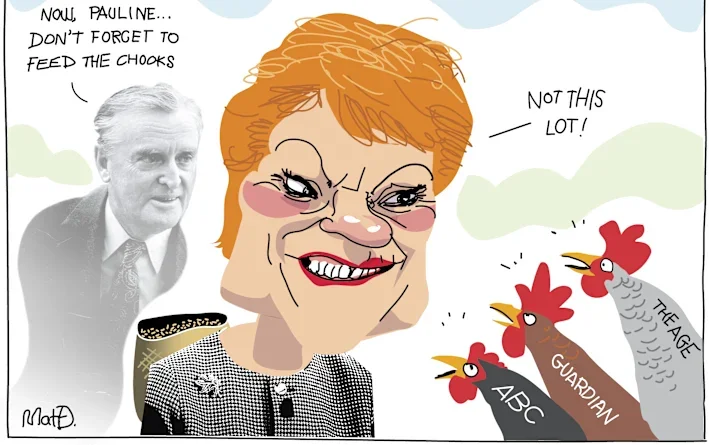
The Age, the ABC and The Guardian were all struck off her list this week, and she has promised to wipe SBS off the media map.
Hanson, of course, grew up in a Queensland run by a cunning authoritarian named Joh Bjelke-Petersen.
He fantasised about becoming Australia’s prime minister, and spoke a language designed to make it almost impossible to pin him down.
“Don’t you worry about that,” he’d yammer when asked about anything of substance. He described his press conferences as “feeding the chooks”.
“The greatest thing that could happen in Queensland and the nation is when we get rid of all the media. Then we could live in peace and tranquillity,” he once said, according to a little book called Feeding the Chooks: A selection of well-known sayings of former Queensland premier Sir Joh Bjelke-Petersen, compiled by author Helen Cameron.
All these years later, with Bjelke-Petersen under the ground since 2005, Pauline Hanson appears to have carried Joh’s sentiment with her.
Not so long ago, at her first and only address to the National Press Club, she declared to the media: “One Nation’s new support brings with it much greater responsibility. I get that.
“And I can assure you that One Nation, its administration, its candidates and its leadership will prove we can deliver. It’s your job to scrutinise my party, its people and its policies. Unlike the prime minister, I welcome it.”
This week, by banning from her presence three major organisations still with a thirst for investigation, she gave scrutiny the shove.
Perhaps the timing shouldn’t surprise. She was at the time introducing her new Victorian state leader, Warren Pickering, a fellow with a Richard Nixon five o’clock shadow, a muck sweat and a history of conspiracy theories.
According to our excellent reporter Patrick Hatch, who didn’t need access to Hanson’s press conference to introduce her Victorian champion to readers, Pickering has claimed Australian government policy is controlled by a cabal of foreign “globalists”, and has endorsed the idea that the world economy was deliberately crashed to trigger a “great reset”.
Very on-brand for One Nation, really.
Truth is, Pauline Hanson and her current One Nation director and previously senior adviser James Ashby, both Queenslanders, have graduated from old Joh Bjelke-Petersen’s lessons.
They have modernised by importing the approach of Donald Trump.
He has long made a sport out of banning from his presence journalists he doesn’t like, abusing mostly female journalists who don’t please him – “quiet piggy” was one of his recent classics, echoed feebly by Hanson when she called a Guardian journalist “trashy” for asking a perfectly legitimate question – and generally describing major news outlets as fake news.
Which, you might think, is a very long way from a cheerier time Pauline Hanson broke bread, shared wine and hosted a sleepover for two journalists on the campaign trail.