Foreign tourists visiting Gyeongbok Palace in Seoul, July 13, shield themselves from the blazing sun with parasols as sweltering heat blanketed the country. Yonhap
Click here for more articles by Kormedi.com.
An umbrella in one hand, a handheld fan in the other.
If you could bring only one while heading out in sweltering summer heat, which should it be? If you have to walk under direct sunlight, an umbrella should come first. While a handheld fan creates airflow, it cannot block the heat your body absorbs from the sun.
Block sun’s heat first
The reason it feels especially scorching under direct sunlight is that your body is exposed not only to the air temperature but also to radiant heat from the sun. A handheld fan cannot block this heat. It simply helps sweat evaporate, making you feel cooler.
An umbrella, by contrast, shields you from direct sunlight and reduces the amount of heat reaching your body. It also creates shade over your head, face, shoulders and part of your upper body.
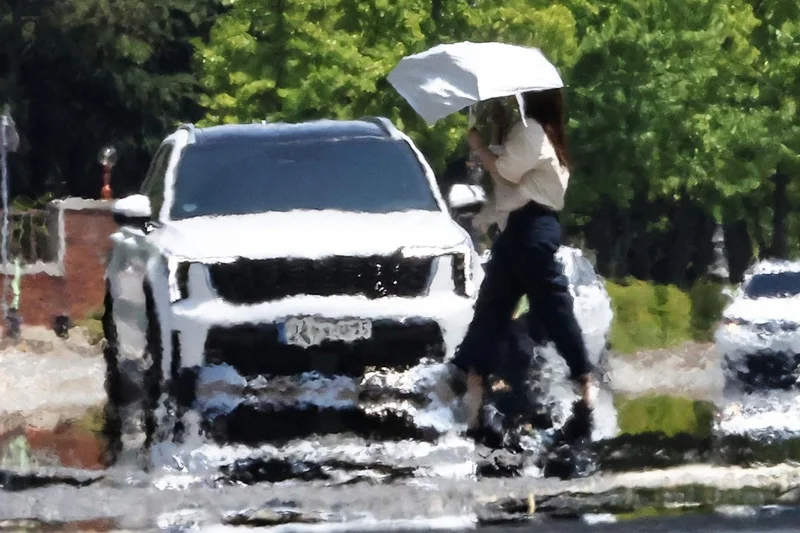
A pedestrian passes through a fountain at Gwanghwamun Square in Seoul, July 14, as hot weather continues. Korea Times photo by Shim Hyun-chul
A study by Japanese researchers found that under intense sunlight, using an umbrella lowered the heat stress index at head level by an average of 1.8 degrees Celsius compared with having no shade. The index takes into account air temperature, humidity, solar radiation and wind.
A hat can also provide shade, but it covers a much smaller area. If ventilation is poor, heat can become trapped around the head. For prolonged outdoor activities, an umbrella or a UV-blocking parasol offers better protection.
A handheld fan does not lower the surrounding air temperature. Instead, it cools the skin by promoting sweat evaporation. As sweat evaporates, it carries heat away from the body, creating a cooling sensation. In shaded areas or indoors, this can help reduce perceived heat.
However, the airflow from a handheld fan usually cools only the face and neck, making it insufficient to cool the entire body. Its effectiveness also declines in very humid conditions, where sweat evaporates less efficiently. On extremely hot days, the fan may even blow hot air onto the skin, adding to the body's heat load.
The World Health Organization warns that when temperatures exceed 40 degrees Celsius, fans may actually increase heat stress. The U.S. Centers for Disease Control and Prevention also advises that fans alone cannot prevent heat-related illnesses during extreme heat and recommends seeking air-conditioned environments. Older adults, people with chronic illnesses and those who are already dehydrated should be especially cautious.
When outdoors, experts recommend blocking direct sunlight with an umbrella first, then using a handheld fan to help sweat evaporate. Drinking water regularly and taking breaks in the shade or in air-conditioned spaces are also important to reduce the risk of heat-related illness.
According to the Korea Disease Control and Prevention Agency, the country recorded 4,460 cases of heat-related illness in 2025, up 20.4 percent from 3,704 cases in 2024. There were also 29 suspected heat-related deaths. Nearly 30 percent of all patients — 1,341 cases — occurred during the 12-day period from July 20-31.
While an umbrella is one of the most effective tools for protection, it is not a complete solution against extreme heat. For activities involving prolonged sun exposure — such as golf, football, outdoor events or construction work — schedules should be shifted to early morning or late afternoon whenever possible. If engaging in such activities during the hottest hours between noon and 5 p.m. is unavoidable, people should take regular breaks in shaded or air-conditioned areas.
"Shade structures and UV-blocking umbrellas are among the simplest yet most effective ways to protect lives during outdoor activities in summer," said Kim Ho-joong, a professor of emergency medicine at Soonchunhyang University Bucheon Hospital. "Anyone who must be outdoors in hot weather should strictly follow heat illness prevention guidelines."
Anyone experiencing dizziness, headaches, nausea, muscle cramps or excessive sweating should stop all activity immediately. Move to a cool place, loosen clothing and begin cooling the body.
Water or sports drinks should be given slowly only if the person is fully conscious. If the person becomes dizzy or collapses, do not force fluids. Call emergency services immediately.
On days of intense sunshine, don't pack only a handheld fan — bring an umbrella as well. Blocking direct sunlight first, then using airflow to help sweat evaporate, while staying hydrated and taking frequent breaks, is the recommended order for preventing heat-related illness.
This article from Kormedi.com, Korea’s top health care and medical portal, is translated by a generative AI system and edited by The Korea Times.