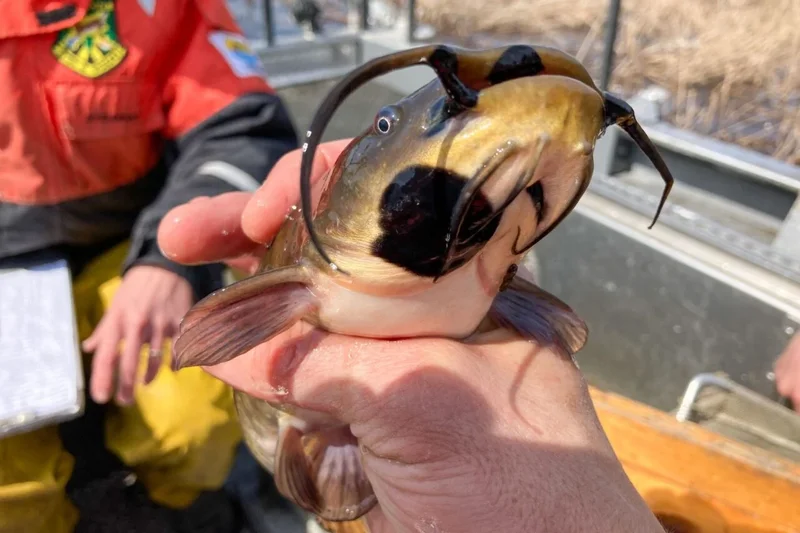
A mysterious cluster of blackened skin lesions affecting catfish in New England turned out to have a stranger cause than anyone would have predicted: a contagious form of cancer.
Researchers in Vermont studied melanoma tumors collected from brown bullhead catfish (Ameiurus nebulosus) living in Lake Memphremagog. The tumors on different fish were genetically much more similar to each other than their hosts, they found, strongly pointing to the cancer’s infectious origin. It’s only the fourth ever kind of transmissible cancer discovered in animals, and there remain many questions about this cancer and others like it, the researchers say.
“Transmissible cancers are a puzzling biological phenomenon that are not expected to exist,” the researchers wrote in their paper, published Wednesday in Nature, “with the potential to devastate host populations.”
Blackened catfish
Lake Memphremagog is a freshwater lake that stretches from Quebec, Canada, to Vermont. Since 2012, both local biologists and fishers have been spotting an increasing number of brown bullhead catfish with blackened skin in the lake. Surveys have indicated that by 2014, roughly a third of catfish in the area had these lesions.
Though scientists initially suspected the lesions were directly caused by a virus or environmental toxin, it became evident that they were actually melanoma tumors. This only raised more questions since these catfish, like most species, are bottom dwellers unlikely to get much ultraviolet radiation exposure from the Sun (in humans, UV exposure is responsible for the vast majority of cases). The growing and high rates of cancer also indicated that something out of the ordinary was going on.
Another example of a catfish with the transmissible melanoma. © Vermont Fish \& Wildlife
The researchers decided to genetically analyze tumors from affected fish and compare them to healthy tissue from the fish as well as other unaffected catfish. They expected to find mutations that might explain why these cells were more prone to becoming cancerous. Instead, they found evidence the tumors were very genetically different from their hosts; this then prompted a deeper whole-genome sequencing of the tumors.
Ultimately, they uncovered hundreds of thousands of genetic variants shared between the tumors that weren’t found in the fish hosts or other catfish, well beyond the sort of similarity you might get from a conventional type of cancer.
“When you look at shared variants in non-transmissible cancers, you see many random variants, and as you compare more and more cancers, they share fewer and fewer variants,” lead author Julia Dragon, an associate professor of microbiology and molecular genetics at the University of Vermont, told Gizmodo. “In the case of transmissible cancers, it is the opposite. The more you sample, the more shared variants you find.”
The researchers did investigate other possibilities, such as the introduction of toxins to the lake from a nearby landfill. But affected fish are widely distributed throughout the lake, and water quality tests haven’t revealed anything unusual. More recently, the researchers have also found this cancer among catfish populations in other ponds and lakes across New England, including places with no major human-made sources of pollutants. So, barring any huge surprises, the only plausible explanation is that this particular lineage of cancer has shifted into a parasite-like entity, one that has long outlived its original catfish host and now spreads to others like an infectious disease.
The mysteries of transmissible cancers
To date, transmissible cancers have been found in dogs, Tasmanian devils, and at least 10 different species of bivalve mollusks, including clams and mussels. This is the first ever documented in any fish and the first ever found in a freshwater animal.
There are plenty of unresolved mysteries about this cancer. Though it doesn’t pose any danger to humans, for instance, it’s still unclear how it might affect the long-term population health of brown bullhead catfish. Outbreaks of some transmissible tumors, like the one found in Tasmanian devils, have a fatality rate of 90%, yet transmissible venereal tumor in dogs is rarely fatal and highly curable.
We also don’t know how it transmits between the animals. Since these cancers have only been found in sexually mature catfish, it may primarily spread when the fish huddle close together during the spawning season. Yet it’s also possible these cells can survive long enough in lake bottoms to be caught by other fish (something similar happens with transmissible cancers in bivalves). And the environment might still play a role in fueling its spread; the researchers note these tumors tend to have high levels of arsenic, a well-known carcinogen. So toxins like arsenic or the hormonal changes of the spawning season might be making these fish more vulnerable to the cancer.
“A big [question] is how the cancer is avoiding the fish’s immune system. We will be exploring that for sure because it can tell us something about how cancers avoid the immune systems in humans as well,” Dragon said.
Another mystery to solve is when this cancer first split off from its original host. The researchers note that the first scientific reports of melanoma in brown bullhead catfish date back to the early 20th century, but naturalist and essayist Henry David Thoreau wrote about similar-looking fish in his home state of Massachusetts even earlier than that in the mid-1800s.
On a broader level, it’s likely there are even more transmissible cancers out there that have yet to be discovered, the researchers argue, and that their impact on the world is greater than we know.
“We think that these may be more widespread, but we are just not noticing them. You often donât see things you are not looking for intentionally,” Dragon said.
The researchers next plan to continue studying other populations of these fish that seem to have this cancer and to start answering some of the questions above. And while these sorts of parasitic cancers aren’t a problem for humans (as far as we know, hopefully), the lessons we learn from them could still help us down the road, according to Dragon.
“What I hope folks take away is that cancer goes beyond humans, and genomics is a powerful tool for researching cancer and other diseases,” she said. “With this project we have a unique opportunity to research melanoma in a new way that could greatly benefit humans.”