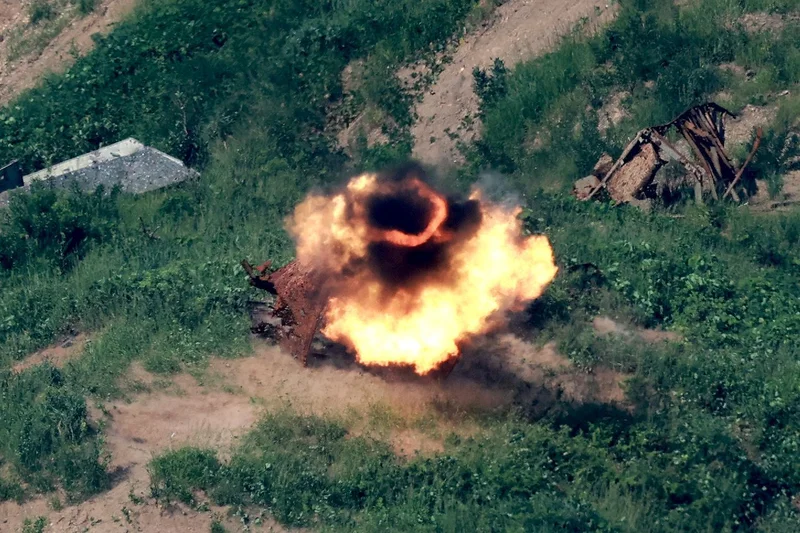
POCHEON, Gyeonggi Province — A voice over the radio quietly called out, “Splash.”
About three seconds later, an explosion echoed across Rodriguez Live-Fire Complex as a first-person view (FPV) attack drone slammed into a target about 2.5 kilometers from the observation post.
The U.S. Marine Corps on Wednesday publicly conducted its first live-fire exercise with FPV attack drones on the Korean Peninsula, using the Neros Archer as part of the Korea Marine Exchange program (KMEP).
Marines from the 3rd Battalion, 7th Marine Regiment launched six quadcopter-style drones, all six of which struck targets about 900 meters away.
Operated in hit-to-kill mode, the drones were guided through onboard cameras until impact, allowing operators and reporters at the observation post to watch the flight in real time from the drone’s perspective before the video feed abruptly cut out at impact.
Roughly the size of a backpack, the Neros Archer has a maximum range of 25 kilometers, a top speed of about 130 kilometers per hour and can carry payloads weighing up to three kilograms. Depending on the mission, it can be equipped with anti-armor, anti-material or anti-personnel payloads.
According to the U.S. Marine Corps, its anti-armor payload is capable of penetrating up to 100 millimeters of rolled homogeneous armor. The Marines said the system is used for long-range reconnaissance and precision strikes beyond the range of weapons typically carried by small infantry units.
The live-fire event was held last week during the same KMEP training in which a communication issue involving a U.S. Marine Corps drone flight occurred. The incident prompted Korean forces to briefly classify the U.S. drone as an unidentified aircraft before the situation was clarified.
Col. Peter Ankeny, deputy commander of U.S Marine Corps Forces Korea, said the exercise was intended to strengthen allied readiness while allowing both militaries to gain experience operating the new capability together.
“It’s all about combined readiness. Combined readiness is credible readiness,” Ankeny said. “It is also an opportunity for us to work through the ranges, the airspace management, the regulatory controls, the joint force coordination, and to build a mutual understanding with our ROK counterparts as we develop new standard operating procedures, tactics, techniques and procedures.”
He said the process requires repeated training rather than a one-time event. The Marines taking part in the drill were temporarily deployed to Korea for training.
Ankeny said operating in Korea allows the unit to train in the kind of terrain where it could be deployed in the future.
The live-fire exercise was delayed by about 90 minutes as temperatures climbed above 37 degrees Celsius, with much of the country under an extreme heat warning. The training overall proceeded as scheduled.
“The weather isn’t always going to cooperate with us,” Ankeny said. “If anything bad were to ever happen, it’s not going to be dependent on the weather.”
He said the Marines follow strict heat-mitigation procedures, including keeping troops under camouflage nets, supplying ice water and positioning corpsmen and safety vehicles nearby throughout the exercise.
The Neros Archer has received the Pentagon’s Blue Unmanned Aircraft Systems certification, which the company says reflects compliance with U.S. security requirements and a supply chain with little to no reliance on Chinese components.
Company officials said the drone is in service with the U.S. military and has also been supplied to Ukraine.