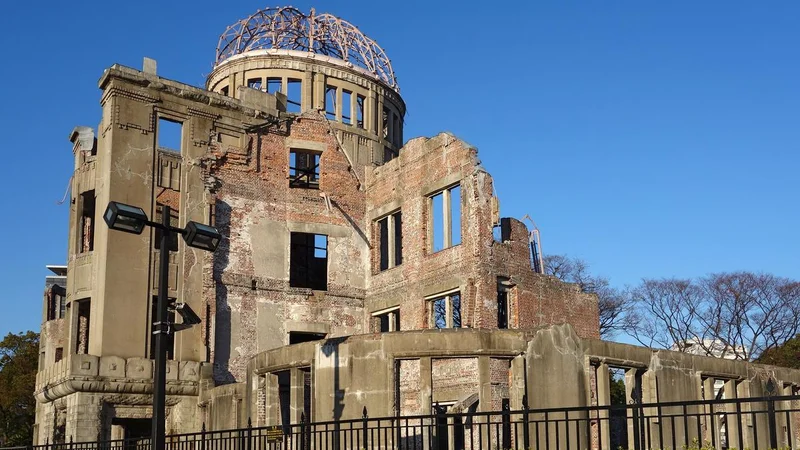
The world is in a deep crisis. The once sacred “rules based world order” is driven to collapse by those who formulated it, especially the most powerful, the U.S. Countries around the world appear powerless when faced with this onslaught created by men with dangerous ideologies. The self-proclaimed “gatekeepers” of the order have largely fallen silent.
The moral dimension of attacks on people of West Asia, Ukraine, and its impact on the poorest in the rest of the world are swept under the carpet in an atmosphere where military power overrides every other imperative.
In this atmosphere, the media narratives, irrespective of the ideological orientation, end with a common question. What if one of these drivers of the conflict uses the nuclear option? It has been 81 years to this day since the U.S. dropped an atom bomb on Hiroshima — the first time the weapon was used in war, and the first of only two times, and the world seems to be on the brink of a similar mistake today.
An ageing treaty
Russia and the U.S. are declared nuclear weapons powers, Israel is an undeclared one, with no independent oversight of any kind. And Iran may want to have one sooner rather than later under the prevailing circumstances. All these questions would have been hypothetical just a couple of years ago but are now in the realm of possibility.
The one instrument that was supposed to prevent the kind of catastrophe staring at us now is the Nuclear Non-Proliferation Treaty (NPT). The NPT will undergo a review in 2026, its 11th, as a formality. From its inception, the NPT has been problematic. It divided the world into nuclear haves — the nuclear-weapon states, a.k.a. the P5 group — and the have-nots. The essential pillars of NPT are non-proliferation, peaceful uses of nuclear energy, and, most importantly, disarmament commitments, moving towards the abolition of nuclear weapons.
A majority of nations have followed the first two commitments but the P5, after signing the NPT, moved in the opposite direction, before returning to reduce the size statistically while increasing the effectiveness of the weapons. However, the abolition commitment was never on their horizon. Apart from the P5, there are also outliers that never signed the NPT but possess nuclear weapons, like India, Pakistan, North Korea, and Israel. And of these, Israel maintains a strategic ambiguity and is not subject to any oversight by international agencies, including the International Atomic Energy Agency.
Russia and the U.S. each have more than 5,000 nuclear warheads. All the other P5 countries maintain an arsenal of a few tens to a few hundreds, with China leading with nearly 600 or more. The really dangerous part of these stockpiles is that nearly 4,000 of them are already deployed by various states and a little more than 2,000 are already in ‘high alert’ state of deployment. And only China and India have a ‘no first use’ policy in place; others have completely rejected such a doctrine.
Deterrence means little
Given the ground realities of the present conflicts, there are many signatories of the NPT who are not part of the P5 but close to becoming one within a very short span of time. Recall that North Korea was a signatory but withdrew from the NPT in 2003. The one country that is farthest from any international obligation is Israel. It is, by all accounts, certainly a nuclear weapons state but maintains strategic ambiguity by not declaring itself as such. This creates a deep sense of instability in a region where conflicts are a commonplace. A nuclear tipping point is no more beyond the realm of possibility.
Strategic experts often mention the theory of deterrence in preventing wars. However, there have been wars going on all the time and deterrence means little when the heads of state are despotic or bellicose. The world’s countries urgently need to move towards a treaty on the total abolition of nuclear weapons. Meaningless reviews of the NPT, whose aims are violated with impunity, are not going to help.
Of the nearly 200 countries in the world, only nine have nuclear weapons. The power of the have-nots has to be compelling enough to allow the haves to renounce their nuclear-weapon stockpiles and use nuclear power for the benefit of all, rather than for the destruction of all.
Mundur V.N. Murthy is professor (retired), The Institute of Mathematical Sciences, Chennai. murthymundur@gmail.com
Published - August 06, 2026 08:30 am IST