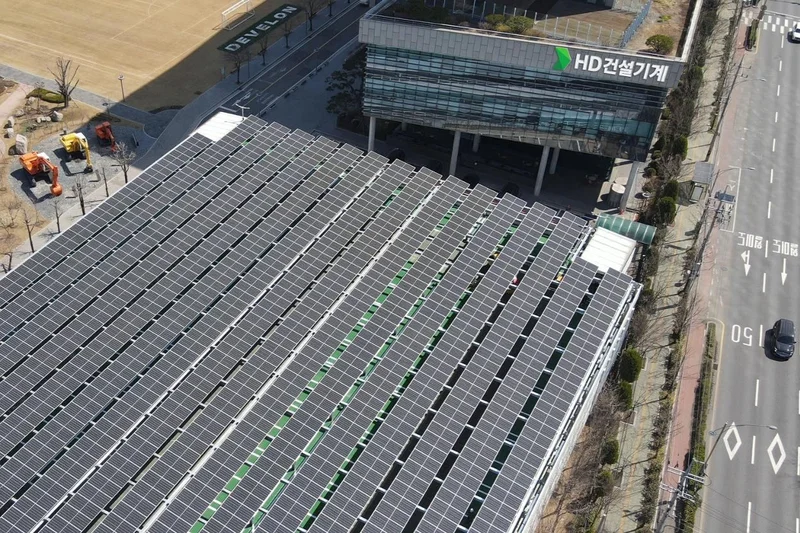
HD Construction Equipment said Thursday it has signed power purchase agreements totaling 12.4 megawatts-peak with multiple renewable energy generators for its plant in Incheon, part of a broader push to source all its electricity from renewable sources by 2040.
A power purchase agreement is a long-term contract in which a company buys electricity directly from a renewable energy producer, such as a solar or wind farm, often at a fixed price.
Under the new agreements, the Incheon plant's share of renewable electricity is set to more than double, from 19 percent to 43.9 percent, by January 2027. The company's plants in Ulsan and Gunsan are expected to reach 42 percent and 53.1 percent renewable electricity, respectively, over the same period.
Company-wide, renewable electricity use across HD Construction Equipment's Korean plants is projected to rise from 22 percent currently to 40.3 percent, a shift the company said would cut annual greenhouse gas emissions by 22,155 tons — equivalent to the carbon absorbed by roughly 3.36 million 30-year-old pine trees.
The company became the first in Korea's construction equipment industry to join RE100 in 2023, committing to reach 100 percent renewable electricity use by 2040.
RE100 is a global corporate campaign launched in 2014 by the Climate Group and the Carbon Disclosure Project that calls on companies to transition their electricity use entirely to renewable sources such as solar and wind.
According to a 2025 report by the Korea Energy Economics Institute, Korean companies that disclose their progress under RE100 use renewable electricity for an average of about 12 percent of their power needs.
Beyond the new power contracts, the company said it is installing solar panels, purchasing renewable energy certificates and replacing high-emission facilities. It also runs a factory energy management system that tracks energy use by process; the system helped the company identify power losses from aging transformers at its Incheon plant last year, and replacing them with high-efficiency units cut that energy loss by 45 percent.
"Expanding our use of renewable energy is a core task for securing sustainable manufacturing competitiveness," a company official said, adding that the firm would keep expanding external renewable power procurement and its own power generation to meet its 2040 RE100 and 2050 carbon neutrality goals.
This article was published with the assistance of generative AI and edited by The Korea Times.