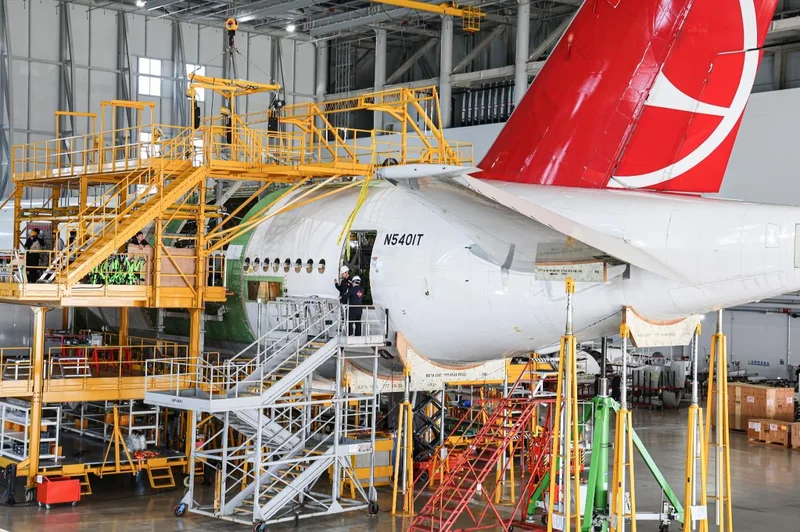
YEONGJONG ISLAND, Incheon — Incheon International Airport is moving beyond its traditional role as a passenger and cargo gateway, expanding into high-value aviation maintenance, repair and overhaul (MRO) services through a large-scale aircraft conversion and maintenance complex.
The Incheon International Airport Corp. (IIAC) said Thursday the construction of the airport's first tenant facility — a passenger-to-freighter (P2F) conversion center within its High-Tech Aviation Complex — was completed late last year. It has since entered full-scale operations, marking a major milestone in Korea's effort to build a competitive domestic MRO industry.
The global MRO market is projected to grow from approximately 171 trillion won ($120 billion) in 2025 to 224 trillion won by 2035, expanding at an average annual rate of 2.7 percent, according to data from the airport operator.
Despite the industry's strategic importance for aviation safety, Korea has long relied on overseas providers because of its limited domestic maintenance ecosystem, high labor costs and substantial upfront investment requirements.
As of 2024, more than 60 percent of the country's aircraft maintenance spending was outsourced abroad, up from 45.5 percent in 2019.
Successive government policies, including a national strategy to strengthen the MRO industry, have sought to reverse that trend by fostering large-scale MRO clusters and enhancing domestic technological capabilities.
The first P2F project is conducted by IKCS — a joint venture between Korea’s Sharp Aviation K and Israel Aerospace Industries (IAI). A Boeing 777 aircraft arrived at the IKCS facility here in May and is now undergoing conversion into a cargo plane.
The joint venture is scheduled to complete the first aircraft conversion project by the end of this year, and deliver it to Fly Meta, a cargo charter carrier based in Hong Kong.
The project has now entered one of its most technically demanding stages: installing the main deck cargo door.
The process requires engineers from Sharp Technics K, an MRO affiliate of Sharp Aviation K, to cut through the aircraft's fuselage and structural frame precisely before reinforcing the surrounding structure to restore the same level of structural integrity as the original airframe.
The work is widely regarded as the most complex and critical phase of a passenger aircraft’s conversion into a freighter.
Aircraft parts manufacturer AST, based in Sacheon, South Gyeongsang Province, is producing the main cargo door and reinforcement structures.
More than 4,000 components are being supplied by roughly 40 partner companies in the same region, helping establish a broader domestic aerospace supply chain.
Starting from 2029, IKCS plans to convert six Boeing 777 passenger jets to carry cargo annually.
“Demand for the aircraft conversion far exceeds supply, and few players can offer the service due to high technological barriers,” an official from Sharp Technics K told reporters during a guided tour of the facility.
According to the company, converted jets make up roughly 65 percent of the global cargo fleet, with demand expected to remain robust as the air freight market continues to expand.
The High-Tech Aviation Complex spans approximately 2.35 square kilometers within Incheon International Airport and is being developed in three phases through 2040.
The project aims to establish a one-stop MRO ecosystem covering heavy maintenance, P2F conversions, aircraft painting, engine and component repairs and logistics support.
Of seven planned hangar sites, three have already secured anchor tenants: IKCS for aircraft conversions, Trinity Aviation for maintenance operations and Korean Air for heavy maintenance.
The airport operator plans to attract additional painting hangars to complete the integrated MRO cluster.
IIAC acting President Kim Bum-ho said the airport would continue expanding the complex to bring maintenance demand back to Korea.
“We will contribute ourselves to strengthening the domestic aerospace supply chain and establishing Incheon as a leading global aviation MRO hub capable of driving the country’s future economic growth,” Kim said.