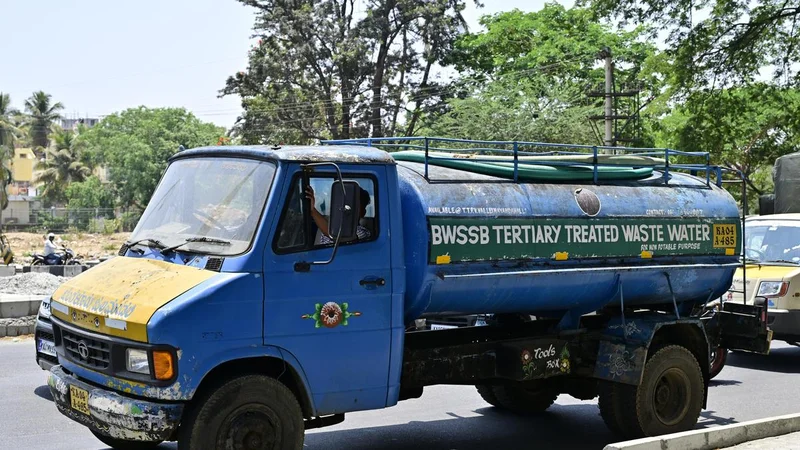
Amid a deficient monsoon this year due to the El Niño effect, the Bangalore Water Supply and Sewerage Board (BWSSB) on July 5 banned the use of potable water for non-drinking purposes and mandated the use of treated water instead. Though the sale of treated water has increased sharply since then, it is yet to reach the summer levels seen earlier this year, indicating slow implementation of the BWSSB’s norms on the ground.
The sale of treated water rose by 80%, from 31.68 lakh litres in June to 57.32 lakh litres in July. However, this remained 42% lower than the 1.05 crore litres sold through tankers in April this year.
“The sale of treated water has increased significantly compared to previous months, and we expect it to rise further. We are also booking those who violate our water usage regulations,” said N. Manjula, chairperson, BWSSB. From July 5 till the end of the month, BWSSB booked nearly 800 cases for violations of water usage norms and levied penalties of around ₹30 lakh, several times higher than the revenue earned from the sale of treated water. The board sells treated water at a nominal cost of ₹10 per kilolitre and earned ₹2.23 lakh from its sale in July.
Construction sector
One of the biggest consumers of treated water in the city is the construction sector. Bhaskar T. Nagendrappa, president of the Confederation of Real Estate Developers’ Associations of India (CREDAI) - Karnataka, said most large construction projects had already adopted the use of treated water. He urged the board to create greater public awareness about treated water so that homebuyers do not object to its use. He added that CREDAI had also appealed to the government to include the use of treated water and benchmark its parameters in the National Building Code of India, which guides construction activities.
Meanwhile, Amar Mysore, chairman of CREDAI-Bengaluru, said many large construction projects had set up treatment plants at project sites to further treat the water supplied by BWSSB and improve its quality.
However, smaller construction projects are yet to adopt the use of treated water, and many of them continue to rely on borewells dug on-site instead, industry insiders said.
| Month of 2026 | Number of bookings | Total litres of supply | Revenue generated |
| April | 537 | 1.05 crore | ₹2.8 lakh |
| May | 263 | 49.39 lakh | ₹1.34 lakh |
| June | 183 | 31.68 lakh | ₹1 lakh |
| July | 427 | 57.32 lakh | ₹2.23 lakh |
Swimming pools
BWSSB has mandated the use of treated water even for filling swimming pools, except those used by competitive athletes for training. However, most apartment communities are not willing to do this. “As it is, swimming pools are used by a small fraction of residents in any apartment community. People are not open to filling them with treated water. So, we have asked communities to stop topping up. We will not refill the pools with potable water, allowing them to dry out gradually,” said Satish Mallya, president, Bangalore Apartments’ Federation (BAF). He further said that apartments with swimming pools pay 25% extra in their water bills and appealed for a waiver when pools are not being filled with water supplied by the board.
Mapping apartment STPs to users
BWSSB is also working to promote the use of treated water produced at Sewage Treatment Plants (STPs) at apartment complexes. At a recent meeting with BAF, Ms. Manjula directed board officials to draw up an action plan to map proximate users, such as construction projects and industries, with surplus treated water from apartment STPs. The board had earlier proposed drawing pipelines to supply treated water from apartment STPs to proximate users, but the plan yet to take off.
Published - August 06, 2026 06:01 am IST