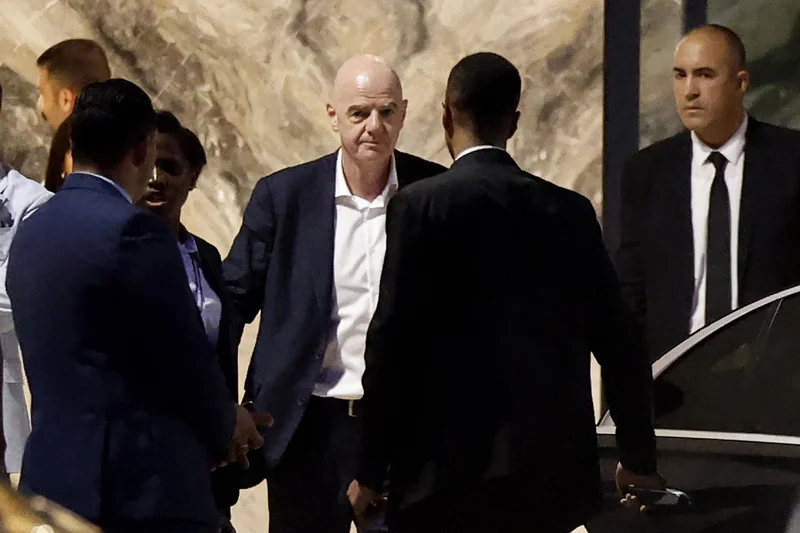
FIFA sought to steady the ship on Wednesday after the collapse of its controversial World Cup commercial rights proposal, with the organization's senior leadership reaffirming its support for President Gianni Infantino while issuing a formal apology to member associations over the way the plan was handled.
Following a crisis meeting in Rabat, Morocco, FIFA acknowledged that mistakes were made during the process that led to the now-abandoned proposal, which would have involved selling a minority stake in a new commercial rights entity to private investors. The governing body said it regretted that national associations and FIFA Council members felt excluded from discussions and pledged to review its decision-making process.
The proposal, which was withdrawn last Friday after widespread opposition, had envisioned selling a 20% stake in a newly created commercial rights company in a deal reportedly valued at about $4.2 billion. The plan quickly became one of the biggest governance controversies of Infantino's presidency, drawing criticism from football confederations, clubs and senior officials, while raising fresh questions about his leadership ahead of FIFA's presidential election in March.
In a statement issued after Wednesday's meeting, FIFA said Secretary General Mattias Grafstrom and members of the FIFA Management Board "reaffirmed their full support" for Infantino. The president, in turn, expressed his confidence in Grafstrom and FIFA's administration, praising their work in delivering the organization's objectives.
FIFA said the meeting marked an important step toward restoring confidence within the organization.
"FIFA's top management is fully confident that the outcomes of today's meeting will strengthen FIFA's governance, help restore confidence in the organization and enable us to prepare for the major events and challenges ahead in a united and transparent manner while continuing our mission to develop the game around the world," the statement said.
The governing body confirmed that letters had been sent to FIFA Council members and all 211 member associations acknowledging errors in the process and apologizing for the lack of consultation.
"It was not the intention for the FIFA Council and FIFA Member Associations to feel excluded from the process and the process should have been handled differently," FIFA said, adding that the proposal had been permanently shelved and that a full review would be presented at the Council's next scheduled meeting.
At the same time, FIFA defended its governance standards, saying it would "no longer tolerate any attacks on its integrity, good governance and due process" and would take the necessary steps to protect its reputation.
Behind the scenes, however, the fallout has exposed deep divisions within world football.
According to sources familiar with the matter, Grafstrom circulated an internal memo to FIFA staff this week describing the affair as a "sad and reproachable series of events" that resulted in the project's permanent abandonment.
Although he did not mention Infantino by name, he wrote that "individuals, unstable moments and unfortunate episodes come and go," while emphasizing that FIFA's broader mission would continue.
His comments echoed those made days earlier by FIFA Chief Operating Officer Kevin Lamour, who reportedly told staff they had been "deceived" by what he characterized as the project of a single individual.
The abandoned proposal also attracted additional scrutiny because of the reported involvement of a company with family ties to U.S. President Donald Trump, further fueling criticism from football stakeholders.
UEFA led the opposition, saying it had lost confidence in Infantino's leadership after the proposal was presented without sufficient consultation. CONCACAF adopted a similar position, while the Asian Football Confederation criticized FIFA for presenting the plan as effectively a completed decision rather than a proposal open for discussion.
The backlash extended beyond football's governing bodies.
Former Portugal star Luis Figo said Infantino should resign over the controversy, while UEFA Vice President Laura McAllister described the episode as a defining leadership crisis for the FIFA president.
On Wednesday, European Leagues, representing more than 1,300 clubs across the continent, urged FIFA to stop making unilateral decisions that affect clubs, players and supporters. The organization also criticized the governing body's decision to allow only four weeks for stakeholders to evaluate a separate proposal to expand the 2030 World Cup from 48 to 64 teams.
The controversy has also sparked speculation about Infantino's political future.
Under FIFA statutes, an Extraordinary Congress can be convened if at least 43 member associations submit a formal written request. While no such movement has materialized, several European federations have reportedly withdrawn their support for the Swiss-Italian administrator following the collapse of the commercial rights proposal.
Despite mounting criticism, Infantino continues to enjoy significant support across other regions.
Many football associations in Africa, Asia and Oceania rely heavily on FIFA development funding, and several have publicly backed the 56-year-old president. Qatar, Kuwait, Lebanon, Sri Lanka, Indonesia and the Philippines have all reaffirmed their support, even as the AFC criticized the consultation process.
The Confederation of African Football has yet to adopt an official position, while Oceania's executive committee is scheduled to meet next week to determine its stance.
FIFA's one-member, one-vote system also remains a major advantage for Infantino. Every national association, from world champions such as Brazil, Argentina, Germany and Spain to San Marino, whose men's national team sits at the bottom of the FIFA rankings, carries equal voting power in presidential elections.
With no prominent challenger yet emerging ahead of March's election, Infantino still appears well placed to seek another term that would extend his presidency through 2031.
Morocco, one of the first associations to publicly support Infantino after the proposal was abandoned, remains among his key allies. The country will co-host the 2030 World Cup alongside Spain and Portugal and hopes to stage the tournament final.
FIFA, however, rejected reports suggesting Infantino had promised Morocco hosting rights for the final in exchange for political support.
"It is false and misleading to claim the FIFA president has made any promise in relation to hosting the FIFA World Cup 2030 final," a FIFA spokesperson said.
"A decision will be made by FIFA in due course."