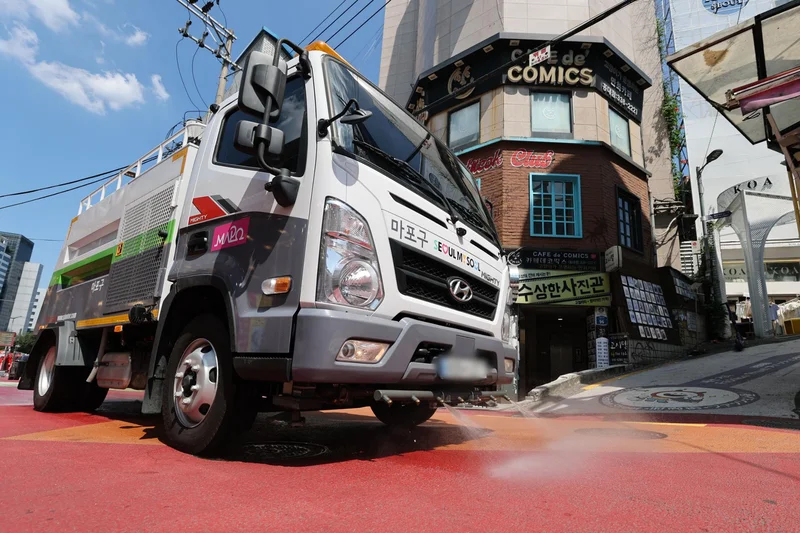
The scorching heat wave in Korea is expected to reach its peak, Friday, before easing slightly over the weekend, although forecasters warned that temperatures will remain well above seasonal averages and the respite is likely to be short-lived.
The Korea Meteorological Administration (KMA) forecast Seoul's daytime high to remain at 39 degrees Celsius, Friday, after reaching the same temperature, Thursday, leaving it just 0.6 degrees Celsius shy of the city's all-time record of 39.6 degrees Celsius, set on Aug. 1, 2018.
The agency said temperatures could again exceed 40 degrees Celsius in parts of the capital region after topping that mark, Thursday, while widespread tropical nights — when overnight lows remain above 25 degrees Celsius — are expected to persist.
Elsewhere, daytime highs are forecast to reach 38 degrees Celsius on Friday in Incheon and Gwangju, 37 degrees Celsius in Daejeon and Daegu, 35 degrees Celsius in Busan and 34 degrees Celsius in Ulsan.
Temperatures are expected to ease over the weekend nationwide, with daytime highs ranging from 27 to 36 degrees Celsius, Saturday, and 26 to 36 degrees Celsius, Sunday.
Even so, the heat will remain well above seasonal norms, with average daytime highs for early August typically ranging from 29 to 33 degrees Celsius, according to the KMA.
The forecast comes as the country marks "ipchu," or the onset of fall, one of the 24 solar terms, Friday — a day that traditionally signals the heat wave's retreat. This year, however, the timing underscores the severity of the summer's prolonged heat, with the heat wave expected to continue.
The KMA placed Seoul and much of the western region under its highest-level heat warning, describing the conditions as potentially life-threatening.
Authorities urged people to avoid outdoor activities and strenuous work during the hottest hours of the day, while advising employers to suspend or postpone nonessential outdoor work.
On Thursday, President Lee Jae Myung convened an emergency government meeting, ordering ministries and local governments to mobilize all available resources to minimize damage from the extreme weather.
"We are experiencing an unprecedented heat wave that continues day after day," Lee said during the meeting at the Central Disaster and Safety Countermeasures Headquarters in Seoul.
"As scorching temperatures are likely to persist for the time being, we must activate an all-out emergency response system," he said, stressing that protecting people's lives and safety is the government's top priority.
Lee instructed officials to strengthen protection for vulnerable groups, including elderly people living alone and residents of substandard housing, by checking on them directly if they have limited access to air conditioning.
He also called for stricter enforcement of safety measures at outdoor workplaces, including suspending work or ensuring adequate rest during the hottest part of the day.
The president further ordered ministries to prevent damage to livestock, aquaculture and crops, closely monitor infrastructure such as roads and railways, maintain stable electricity supplies and step up measures to address worsening drought conditions in southern regions.
Meanwhile, forecasters said the intense heat is being fueled by the combined influence of the North Pacific High and the Tibetan High, which have trapped hot, humid air over the Korean Peninsula.
The pattern is expected to remain in place through Friday, before weakening over the weekend as cloud cover increases and easterly winds develop.