What is friendslop? Inside gaming's fastest-growing trend, including the newest hit Big Walk
Recent viral games focus on co-operative multiplayer madness instead of sweaty competition
It might sound like an insult, but the fastest growing trend in video games today is something called "friendslop."
Games like Peak, RV There Yet? and Meccha Chameleon have sold millions of copies over the past year or so, thanks to simple-to-learn scenarios, a relatively low cost of entry and a willingness to embrace the chaos of multiplayer gaming.
"The idea is you play these games co-operatively with your friends to achieve ... oftentimes a menial task, that is made more difficult by the fact that you guys are basically just a bunch of idiots," said Patrick Thornley of Langley, B.C., who plays several friendslop games with his friends across Canada.
"You're there to play around and have fun and not take it seriously."
A new game out this week, Big Walk, has many of the hallmarks of friendslop. But it elevates the form by mixing emergent chaos with a meticulously crafted world that carries the DNA of classics such as Myst and The Legend of Zelda: Breath of the Wild.
It is a delightful contender for game of the year, thanks to its focus on what friendship and mutual discovery can look like in a video game sandbox.
What even is friendslop?
An X user with the handle @wooosaaaahhhhh is widely credited for coining the term in 2025, primarily in reference to Lethal Company, a co-operative multiplayer horror game released in 2023.
"Its sole purpose of existence is friendfarming," the user offered as an explanation.
"Friendfarming" is itself uncommon slang. Online discussions, including those on Reddit, define it as either acquiring as many friends as possible or simply spending time with the friends you already have.
Nevertheless, friendslop has come to describe multiplayer games that share several characteristics. They are often low- to mid-budget games developed quickly, with simple visuals compared with the realistic graphics of a game such as Call of Duty.
Their premises are usually straightforward: Climb a mountain in Peak. Drive an RV through the back country in RV There Yet?
WATCH | Peak trailer:Many feature proximity chat. When players communicate by voice, they sound fainter the farther apart they are, forcing them to stay close or find walkie-talkies or other devices for long-distance communication.
"If you're playing together and you do something for a laugh, it's often to your detriment in a traditional game," Thornley said. "But in games like this ... it's kind of the point, right? It's to goof around and ... the consequences are minimal at best."
Making a friendslop game is certainly no guarantee of success, but the genre has produced some of the most viral releases in recent memory.
Peak, from independent studio Aggro Crab, was built in only a few months and has sold more than 10 million copies since June 2025.
The two-person team behind Meccha Chameleon — in which players camouflage themselves by painting their bodies to match their surroundings — says the game sold 10 million copies in its first 16 days.
Big walk, big talk
Big Walk arrives in this environment from Melbourne studio House House, the developer of 2019's charming Untitled Goose Game.
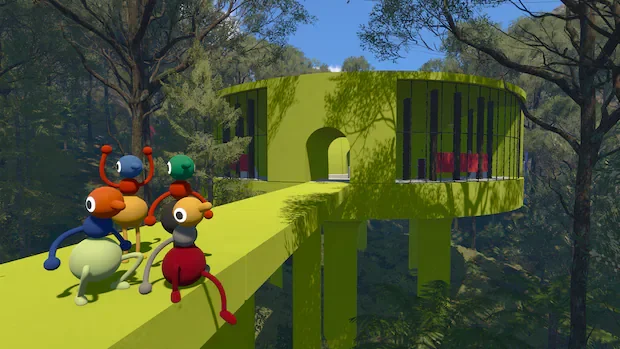
Groups of two to 12 players take the form of cartoon characters with round bodies and wiry arms and legs, like figures from a children's playset.
Players explore a large outdoor area modelled on the Australian outback, encountering stations with puzzles that require teamwork.
Solving each puzzle yields a red, gourd-like object. Deposit enough of them at a nearby station and you receive a key to the next area. Simple.
Many friendslop games generate a new environment for each session. The mountain in Peak, for example looks different each time.
By contrast, Big Walk offers a single, meticulously designed landscape. Each puzzle has one solution, ranging from deceptively simple to impossibly baroque.
In an early example, a red gourd hangs from the top of a small construction tower. Players must learn they can stand on one another's shoulders to reach a button that unlocks it.
Things quickly become more complicated, with rooms requiring several people to perform different roles at the same time.
Strip away the laughter and chatter as friends fumble toward a solution, and the game can feel like a reworking of Myst, with strange clockwork contraptions scattered across the landscape as though left behind by a long-dead civilization of tricksters.
The characters have a range of motions to communicating. They can wave their arms, point in any direction or jump.
Players must quickly develop their own conventions for giving instructions because some tasks block their lines of sight or mute voice chat. Crucially, there is no conventional thumbs-up or thumbs-down gesture, forcing players to improvise more abstract signals.
Objects found throughout the world help players navigate. Walkie-talkies keep teammates in contact over long distances. A lost player who finds a flare gun can fire it to reveal their location.
At the same time, Big Walk is more interested in how friends communicate and learn to work together than in how many tasks they complete.
Detours are encouraged. Small blunders, such as dropping a walkie-talkie down a mountainside and having to retrieve it, become organic parts of the experience.
Players may also find areas designed simply for their group to sit on a beach at sunset, listen to chill-hop music and chat.
Because it's not procedurally generated like many other friendslop games, Big Walk may lose some of its novelty after the estimated 20 hours needed to see everything its world has to offer.
But those hours promise to be among the best a new video game has to offer this year.
With files from CBC's Gabrielle Huston and Natasha Ramoutar