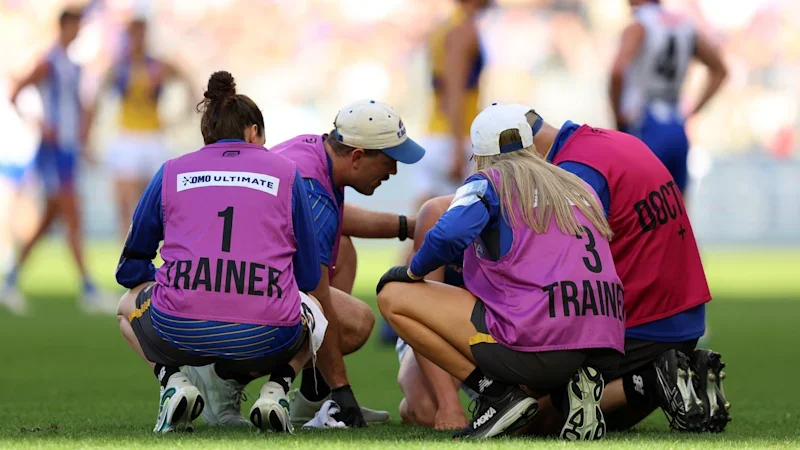
The AFL says it did not approve an arrangement that meant a Geelong player with a history of concussion waived his legal responsibility for future on-field head trauma.
The Cats were forced to scrap the waiver on Thursday after the AFL Players Association condemned the deal between the club and the player.
The unnamed Geelong player signed the agreement acknowledging his elevated risk of concussion in 2024.
“The AFL and AFLPA are aware of a complex and unique case in which a Geelong player was cleared as fit to play following an assessment by an AFL Concussion Panel,” the league said in a statement.
“The player then signed a letter acknowledging the potential risk and sought to waive some potential future legal rights, which was not lodged with or approved by the AFL or the AFLPA.
“Geelong has advised the AFL today that the waiver in the letter will be removed, noting that the player continues to acknowledge potential risks.
“The AFL is satisfied that the letter was not used by Geelong to allow a medically unfit player to return to play.”
Three industry sources, speaking anonymously because of the sensitivity of the situation, confirmed Geelong was the club involved.
The Cats were contacted for comment.
“The game has a duty to provide a workplace that protects the health, safety, and wellbeing of players and all clubs hold this duty as employers,” AFLPA chief executive James Gallagher said.
“Clubs cannot unilaterally contract out of their obligations under the CBA and standard playing contract, nor attempt to avoid their responsibilities under health and safety laws. Importantly, no player is permitted to return to play or train unless they have been deemed medically fit to do so.”
AFL chief executive Andrew Dillon and executive general manager of AFLW, health and football operations Laura Kane appeared at a mental health media round table on Thursday morning but did not answer questions about the initial report in the Herald Sun, which did not name the player or the club that struck the agreement two years ago.
The league was expected to make a statement later on Thursday.
The agreement reportedly acknowledged that the player was at a higher risk of more concussions and more serious damage because of his history, and required him to “take upon yourself the physical and legal risk of loss, damage or injury” arising from future concussions.
Melbourne coach Steven King responded to the report at his media conference on Thursday.
“All I’ll say about that is, as a club, or me personally, I would never do anything or ask my players to put themselves at risk,” King said.
“I think what we are doing, and the things we have implemented in the game to help look after players’ safety and wellbeing has been really positive.
“As a coach, my opinion is, I would never ask a player to put himself at risk to play. Those decisions are with our doctors and medical team and that’s where, as a coach, I leave them to be honest.”
The revelation comes as the AFL and its clubs face a number of lawsuits relating to the long-term impacts of repeated head trauma. These include a $1 billion class action set to go to trial next year, involving more than 100 former AFL players, led by former Geelong defender Max Rooke.
WorkSafe is also investigating the AFL’s concussion management protocols.
Sports law expert Leon Harris, who is doing his PhD in head trauma and concussion liability, said he was not surprised to hear such a contract had been drawn up. He said whether it was enforceable was another matter.
“You can’t contract your way out of a statutory liability. If you have breached workplace health and safety requirements, you can’t say, ‘oh no we got them to sign a waiver for any injury they suffer at any point, we’re in the clear’,” Harris said.
“So under the civil liability legislation in theory you would have rights still even if you were encouraged to contract your way out of those rights, but it just becomes a fight you don’t really want.
“If the player as an adult knows the risk that they’re running by continuing to play and is willing to voluntarily assume that risk then, in a way, that’s up to the player. But the question then becomes, is it OK for a professional sporting organisation to allow somebody in that situation to assume that risk of harm, and that potentially is more of a moral question than a legal question.”
Harris said part of the problem was that there was still a grey area around the issue as it was yet to be fully decided in court. There remained limited research around the prolonged effects of repeated sub-concussive head trauma, he added.
While numerous legal actions have been brought in Australia and overseas, most have resulted in settlements.
“I think eventually it will end up going to a court to make a decision, whether it’s here, whether it’s in England … and they will make a ruling and a variety of sports will have decisions to make, unless those sports start putting rules in place now to deal with sub-concussive events, not just concussion.”
The AFL was contacted for comment.